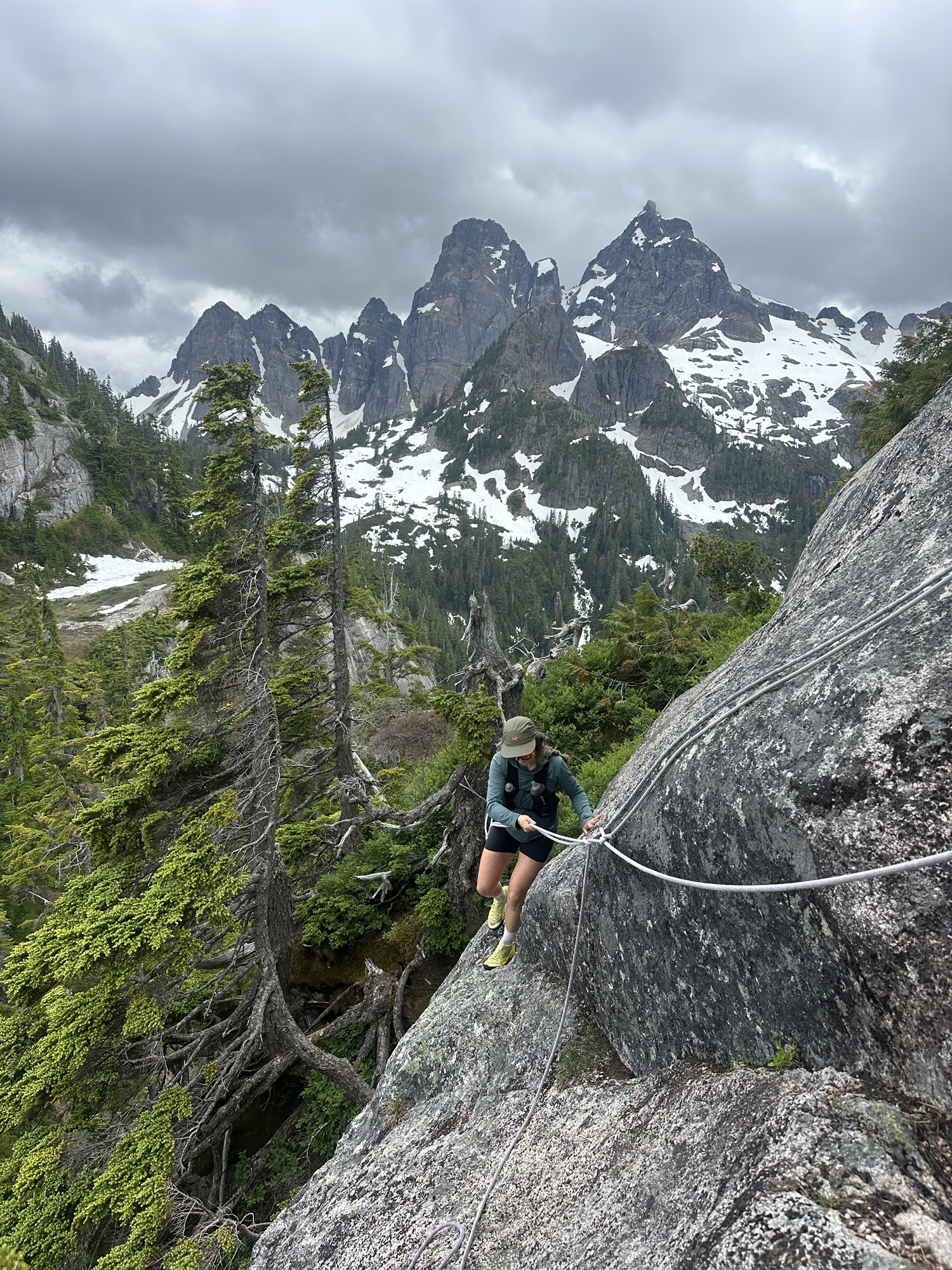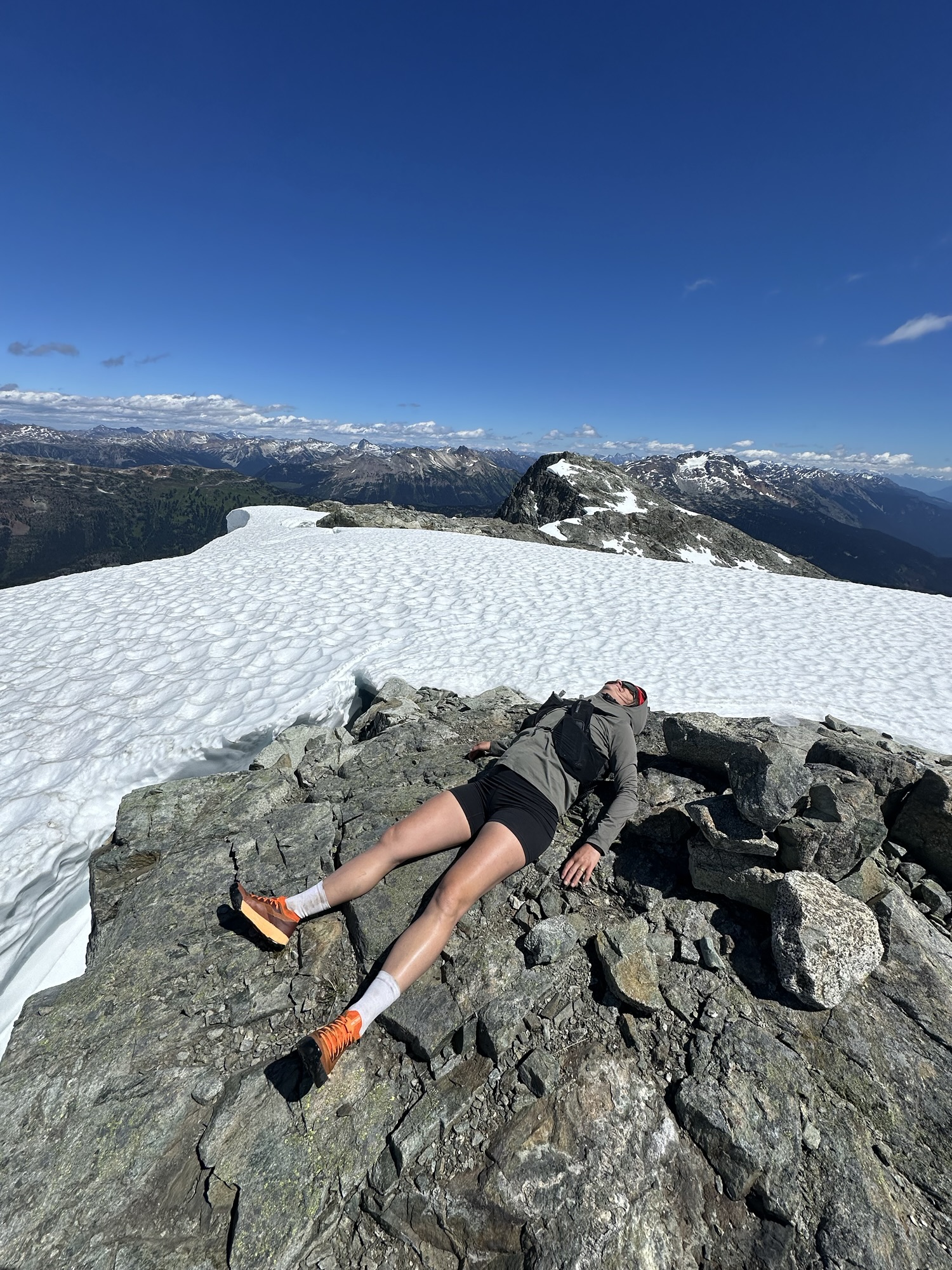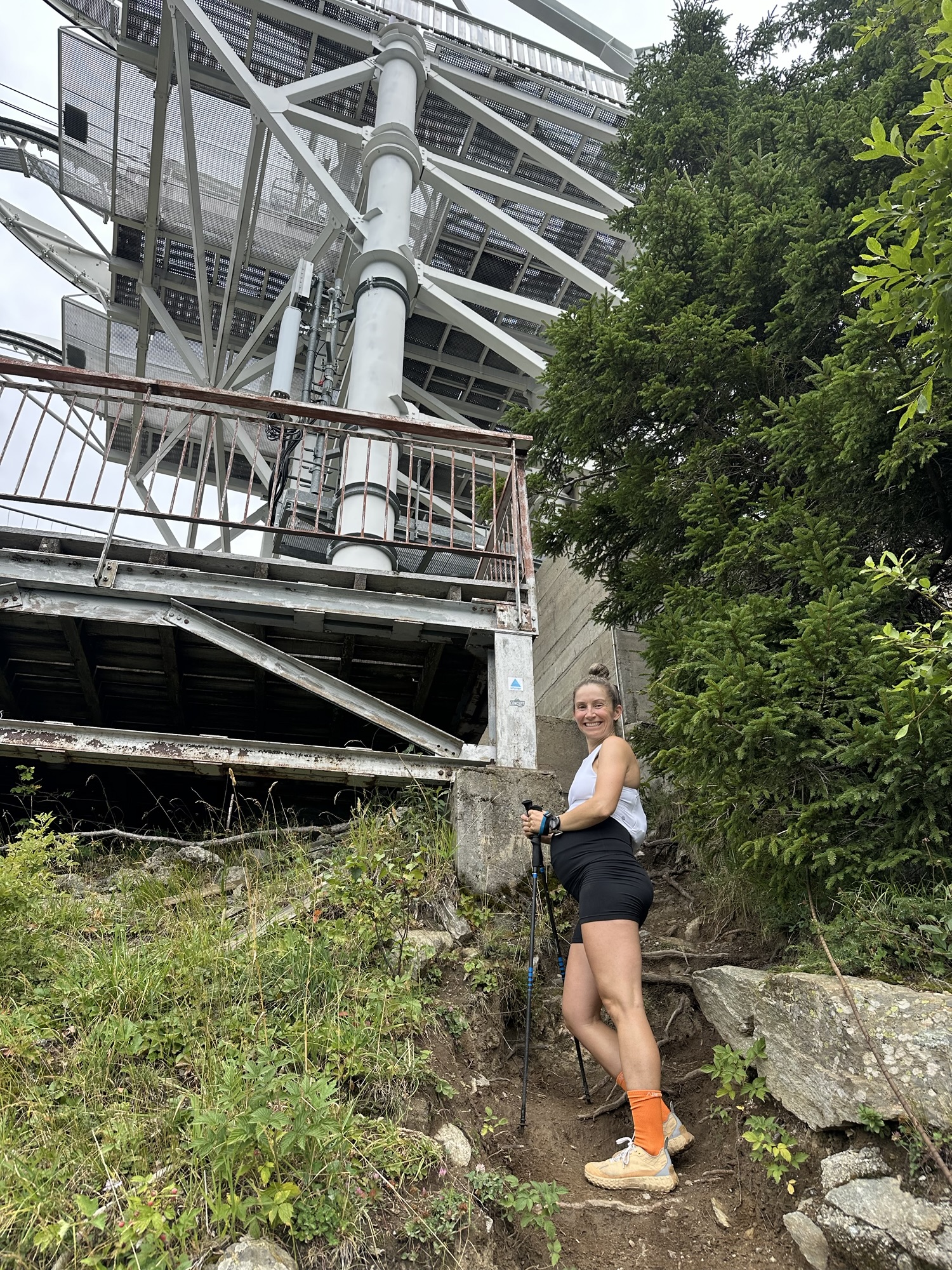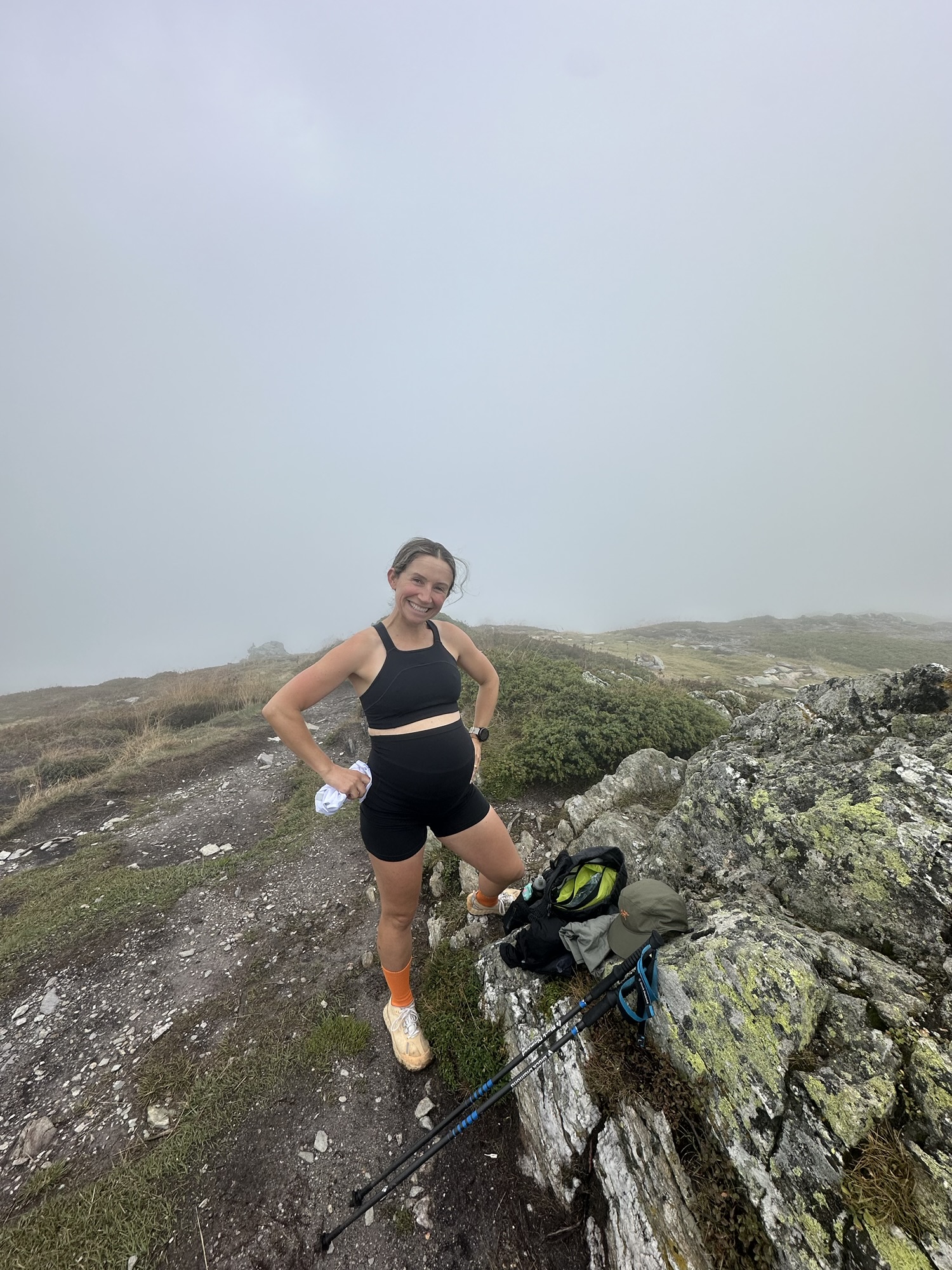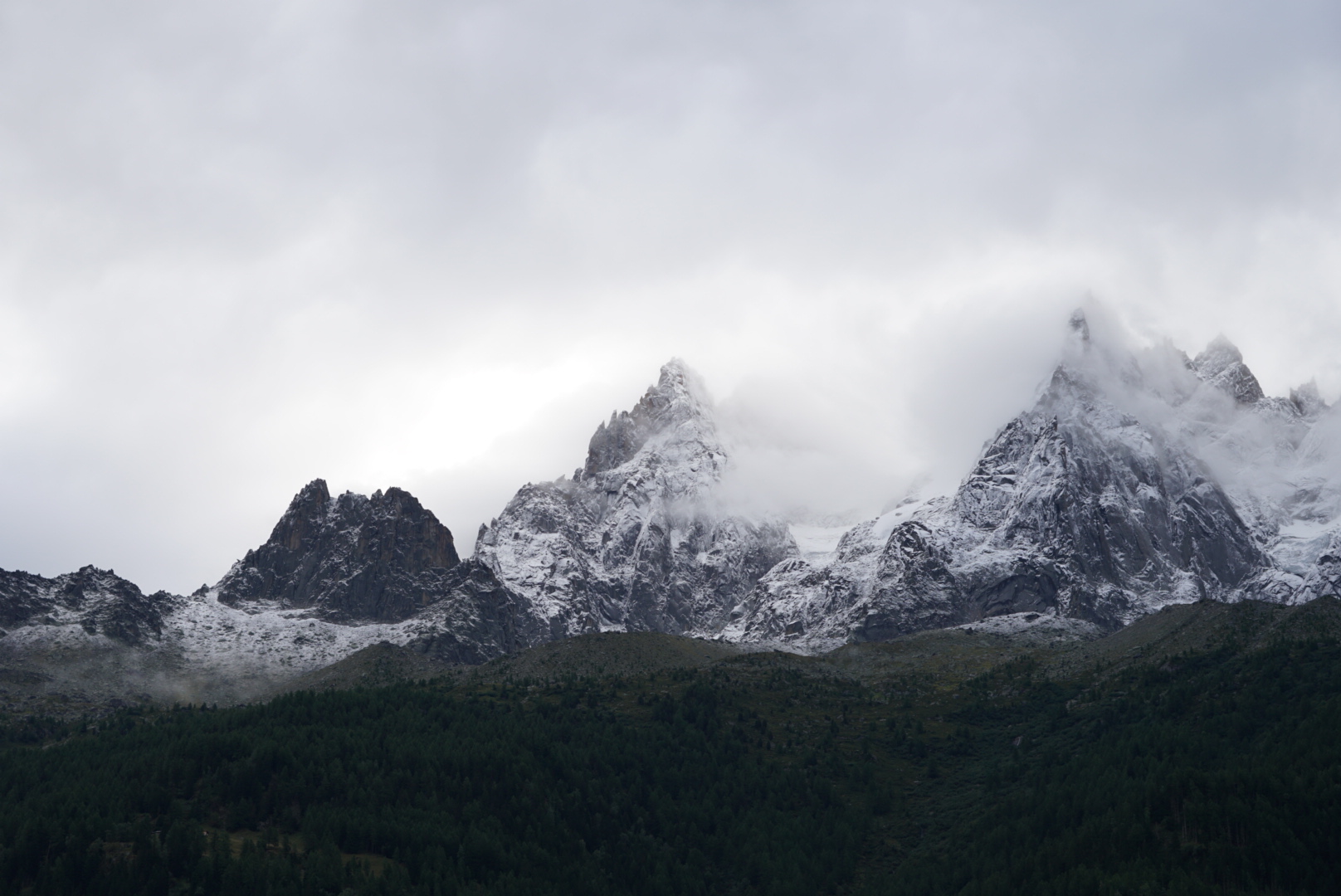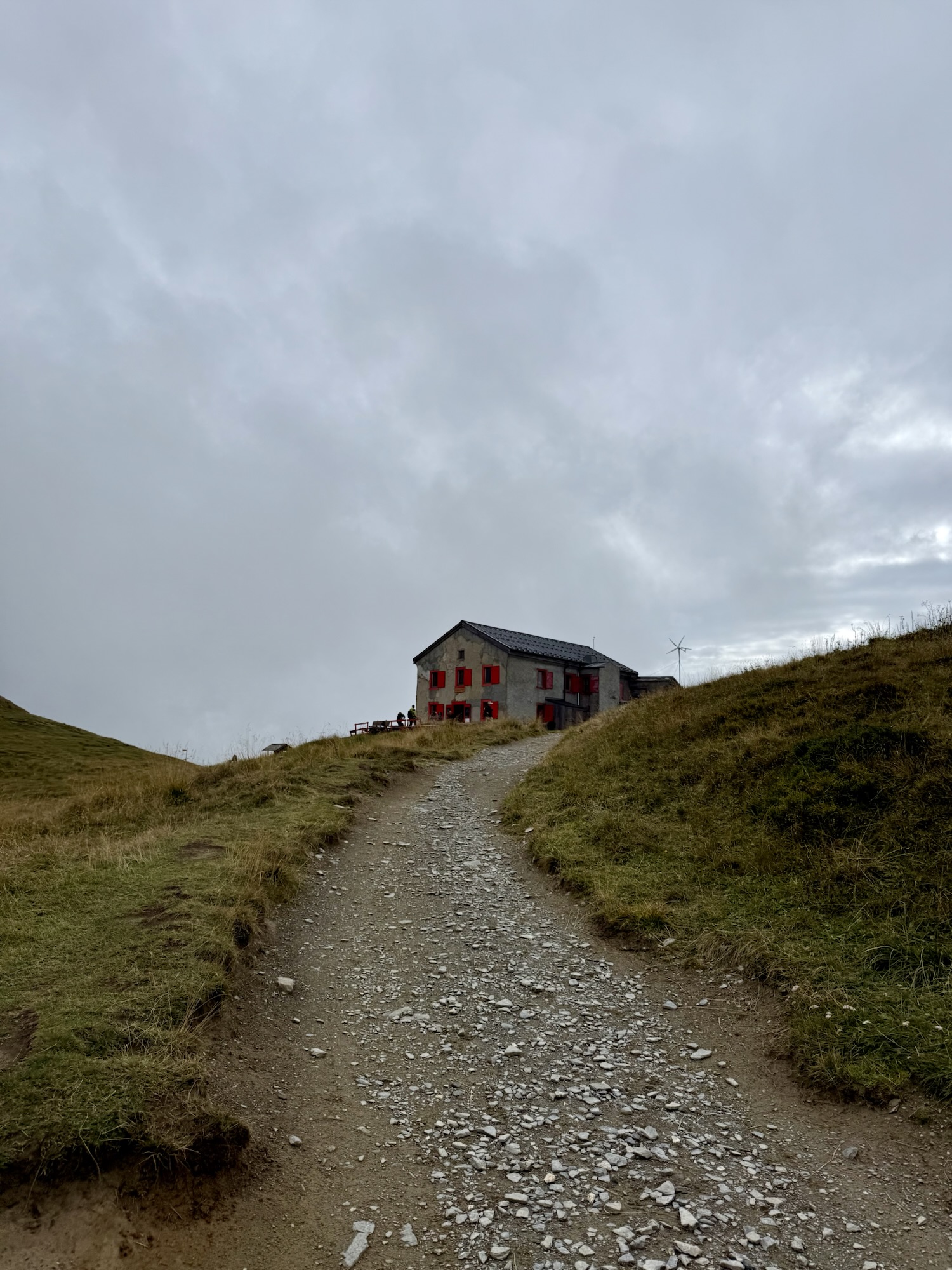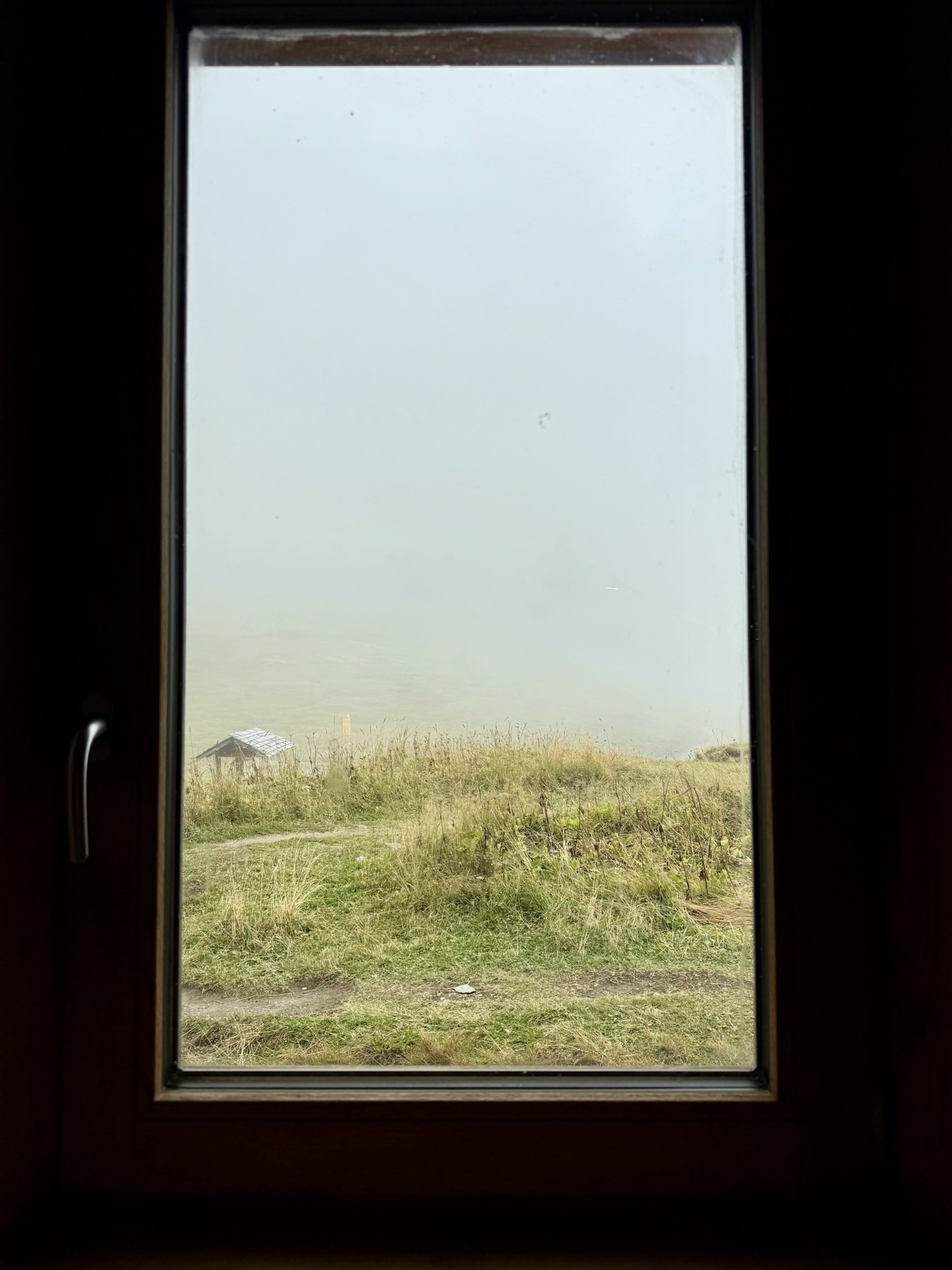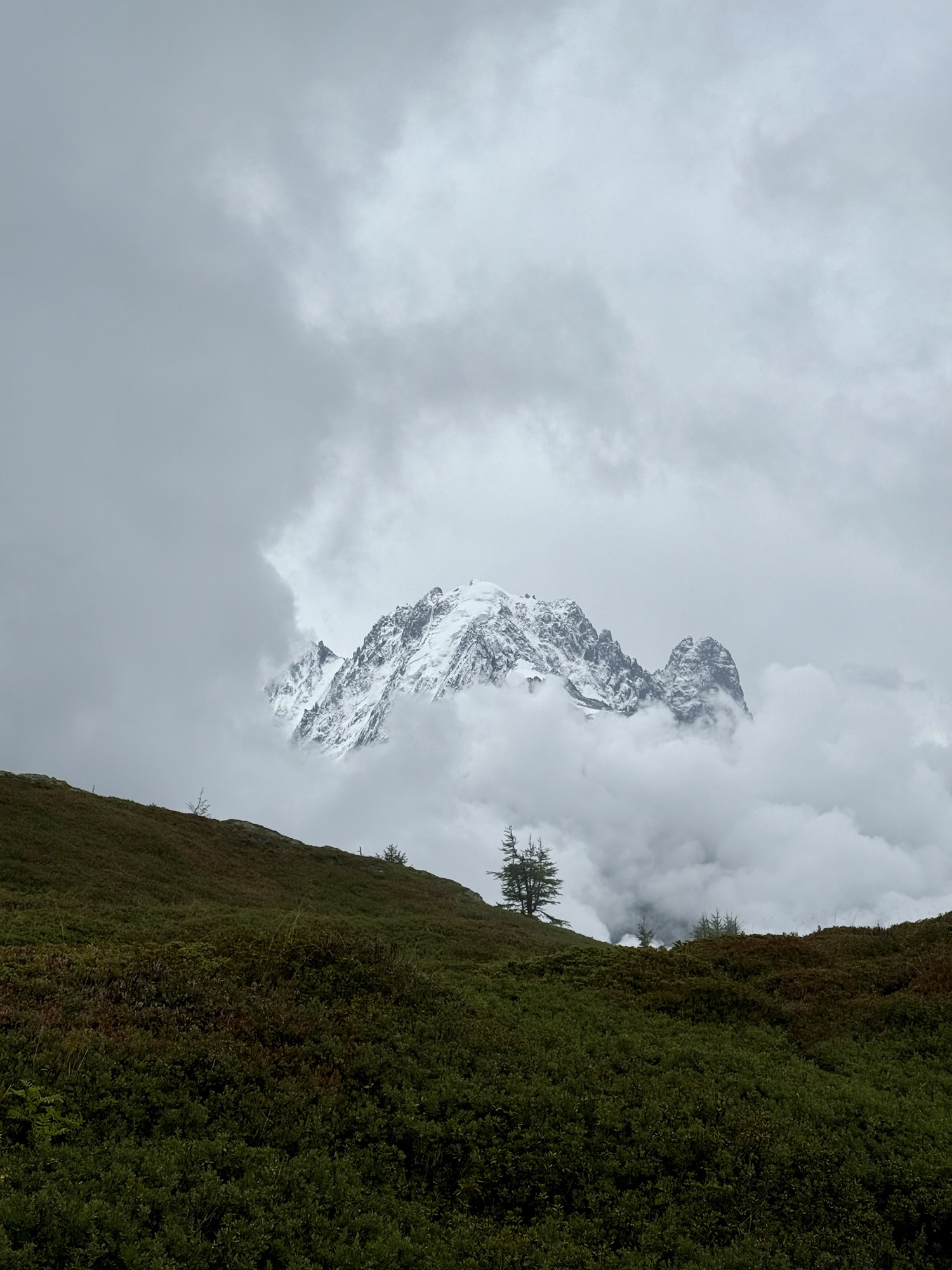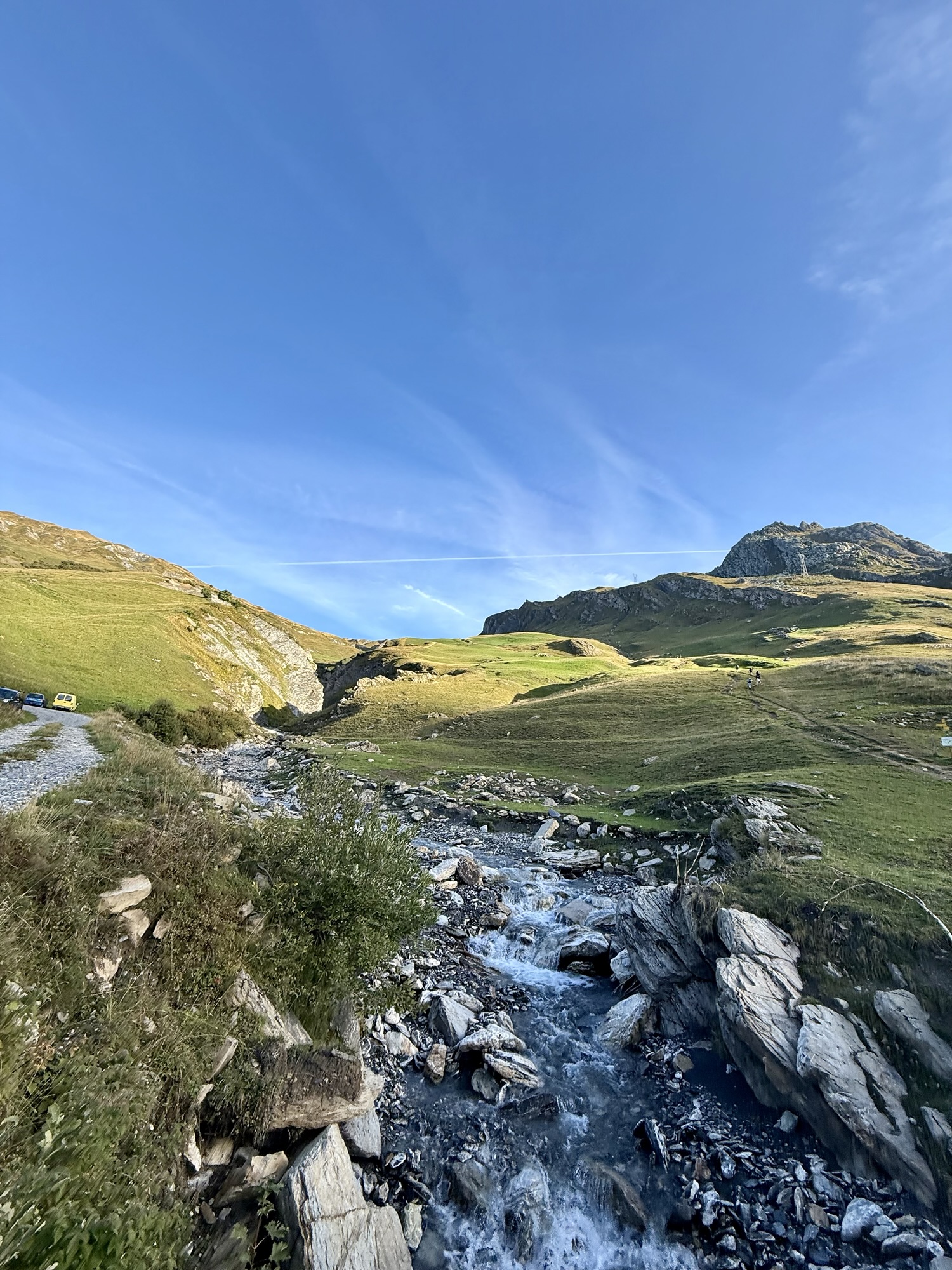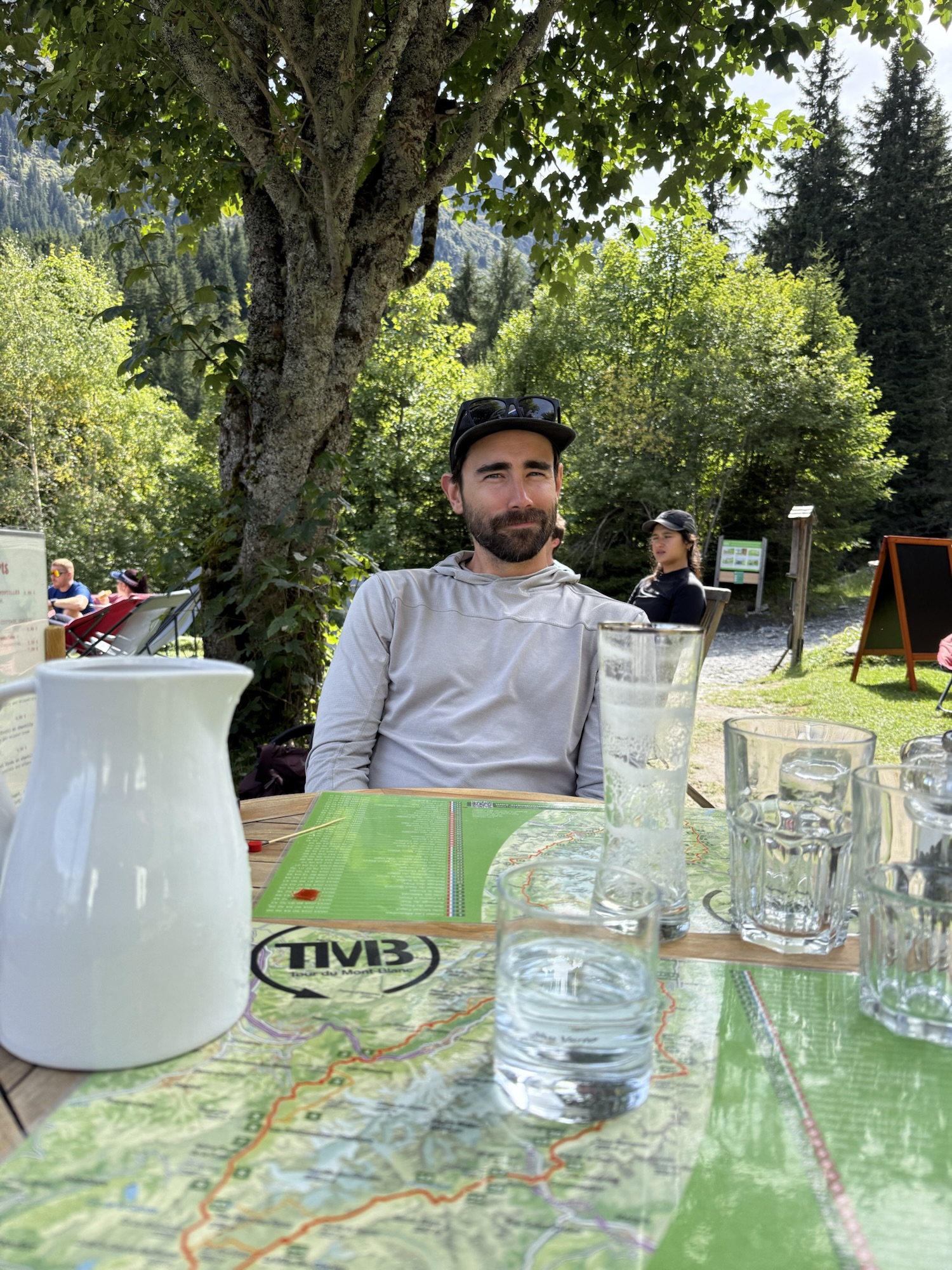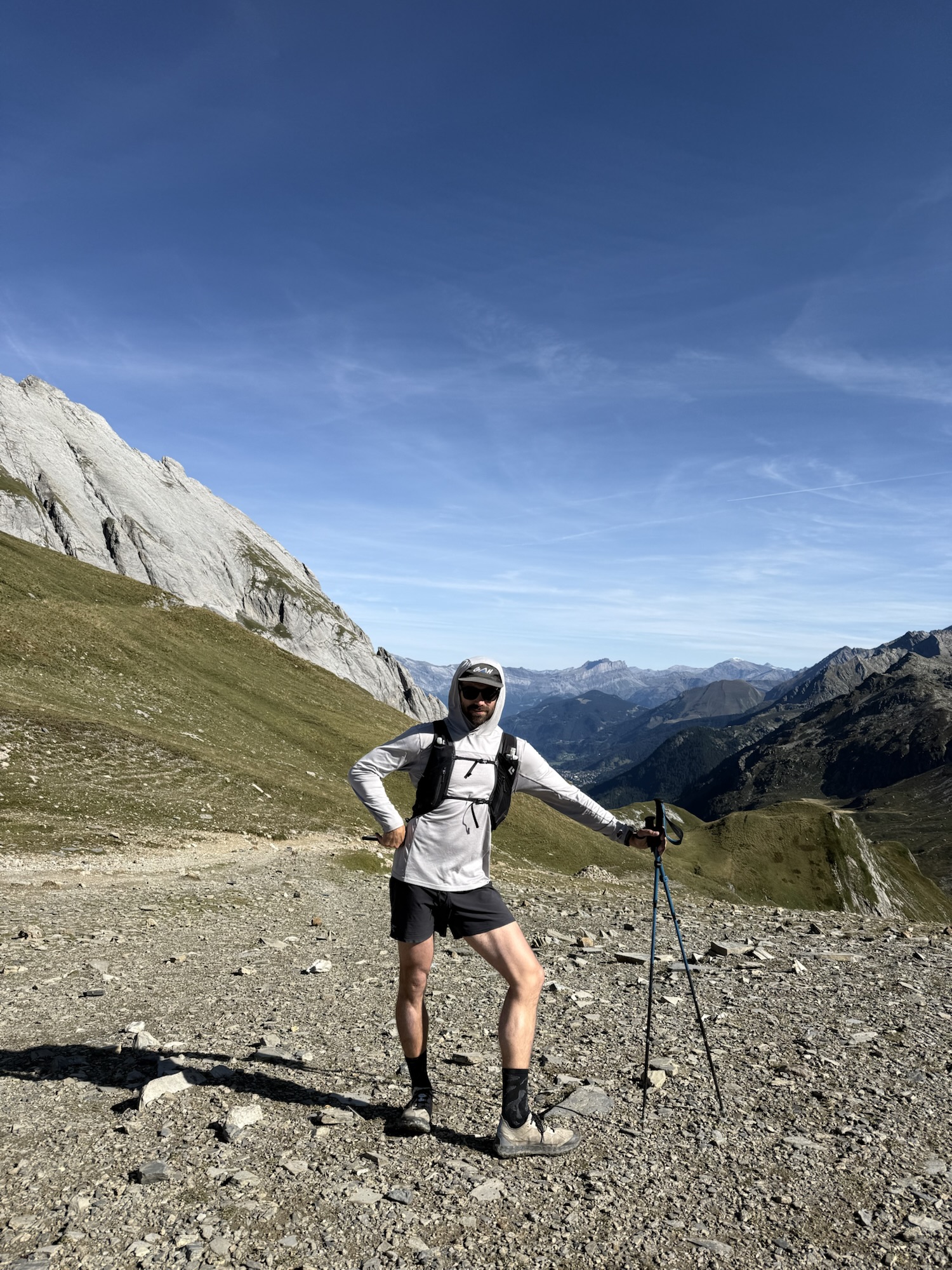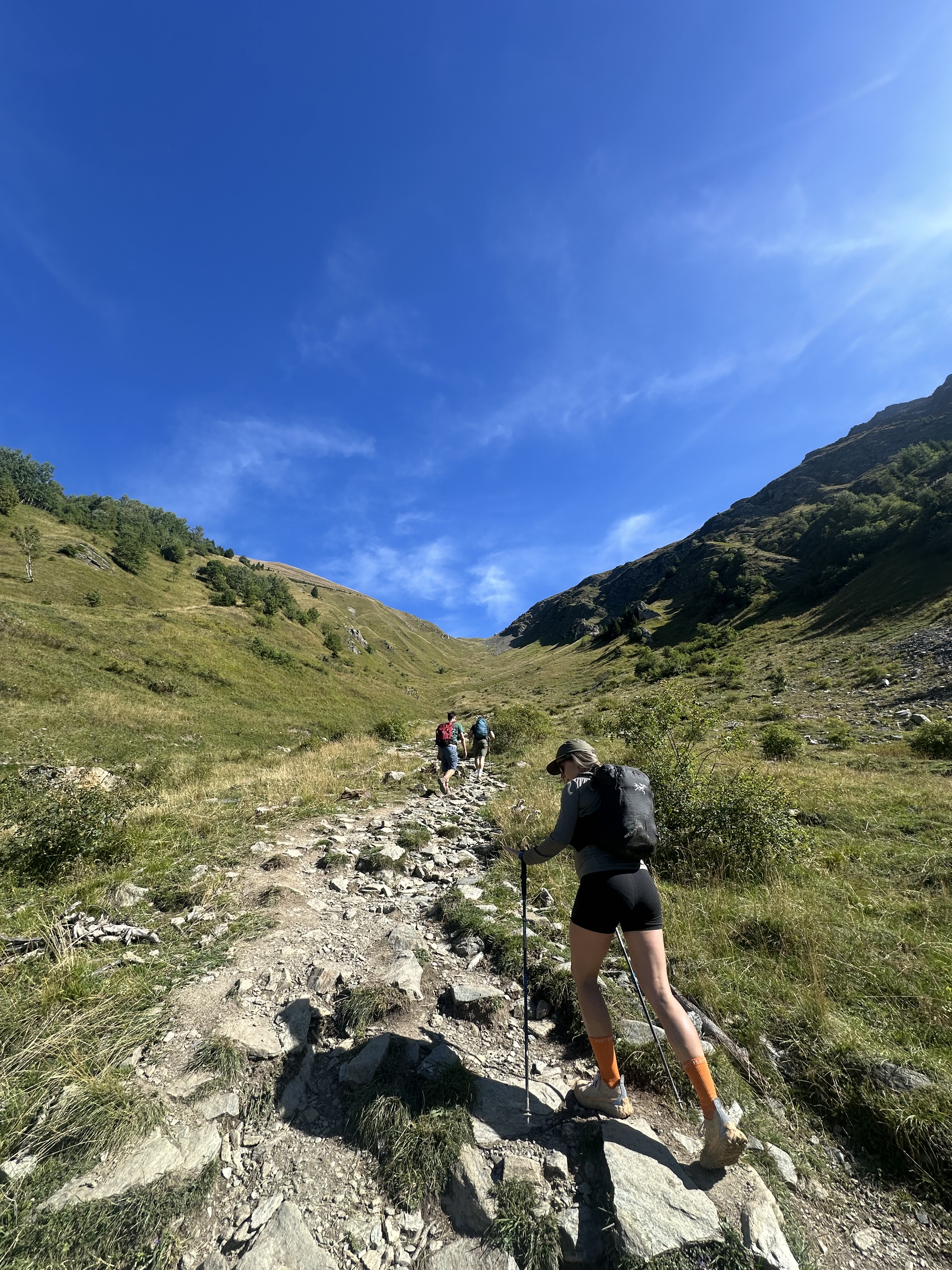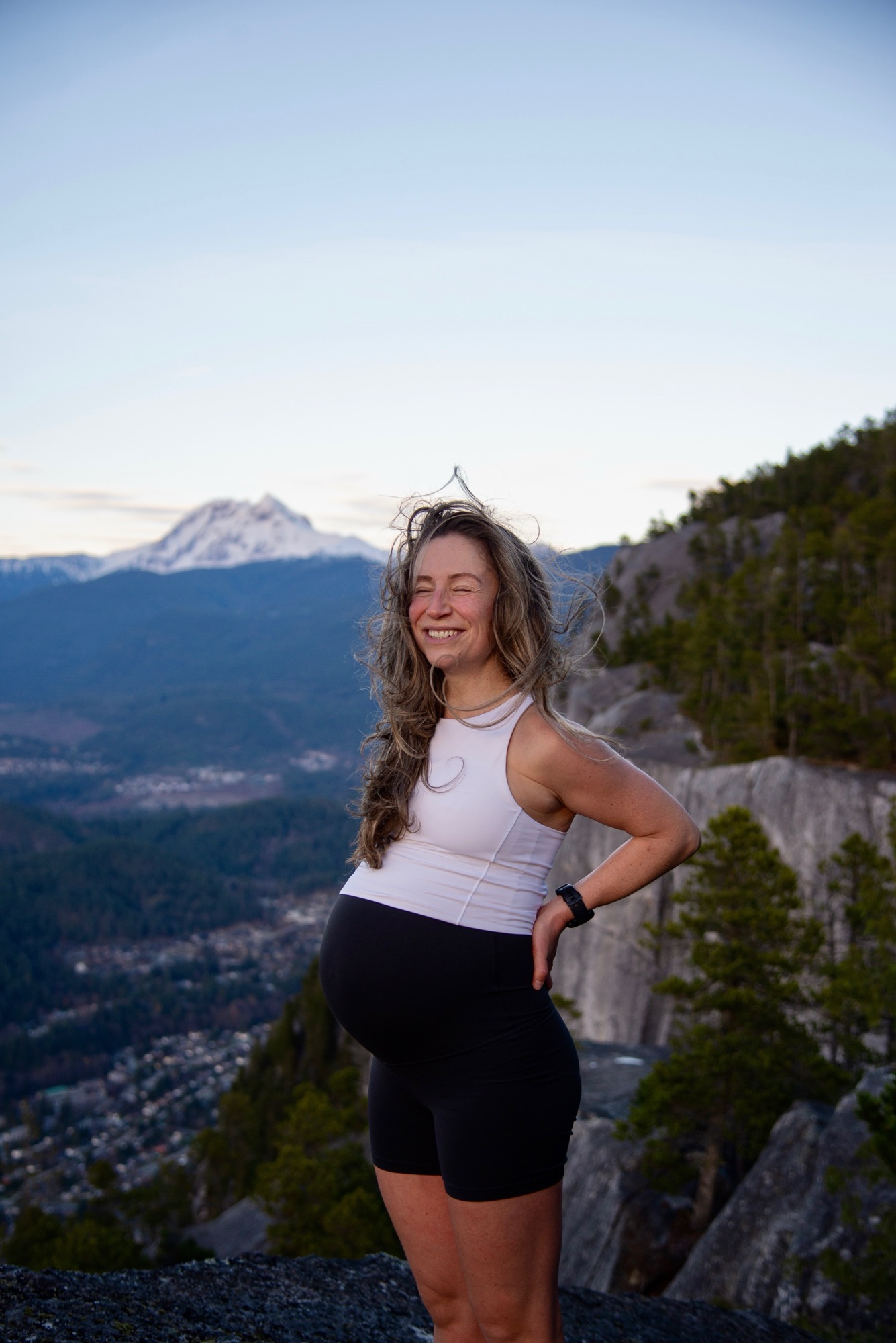
“The human race would end if you were in charge of PR for pregnancy”: A firsthand account from a pregnant athlete.

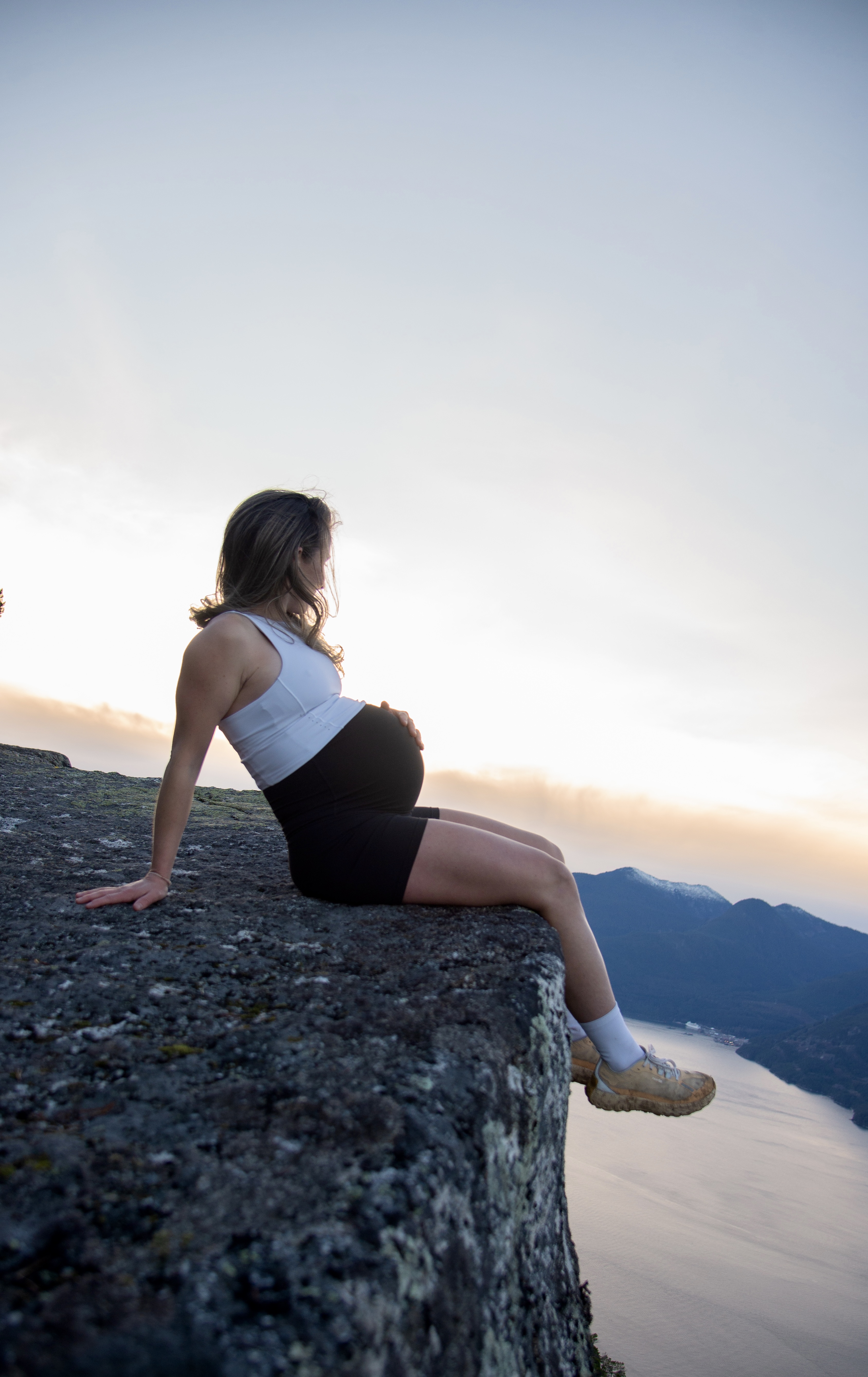
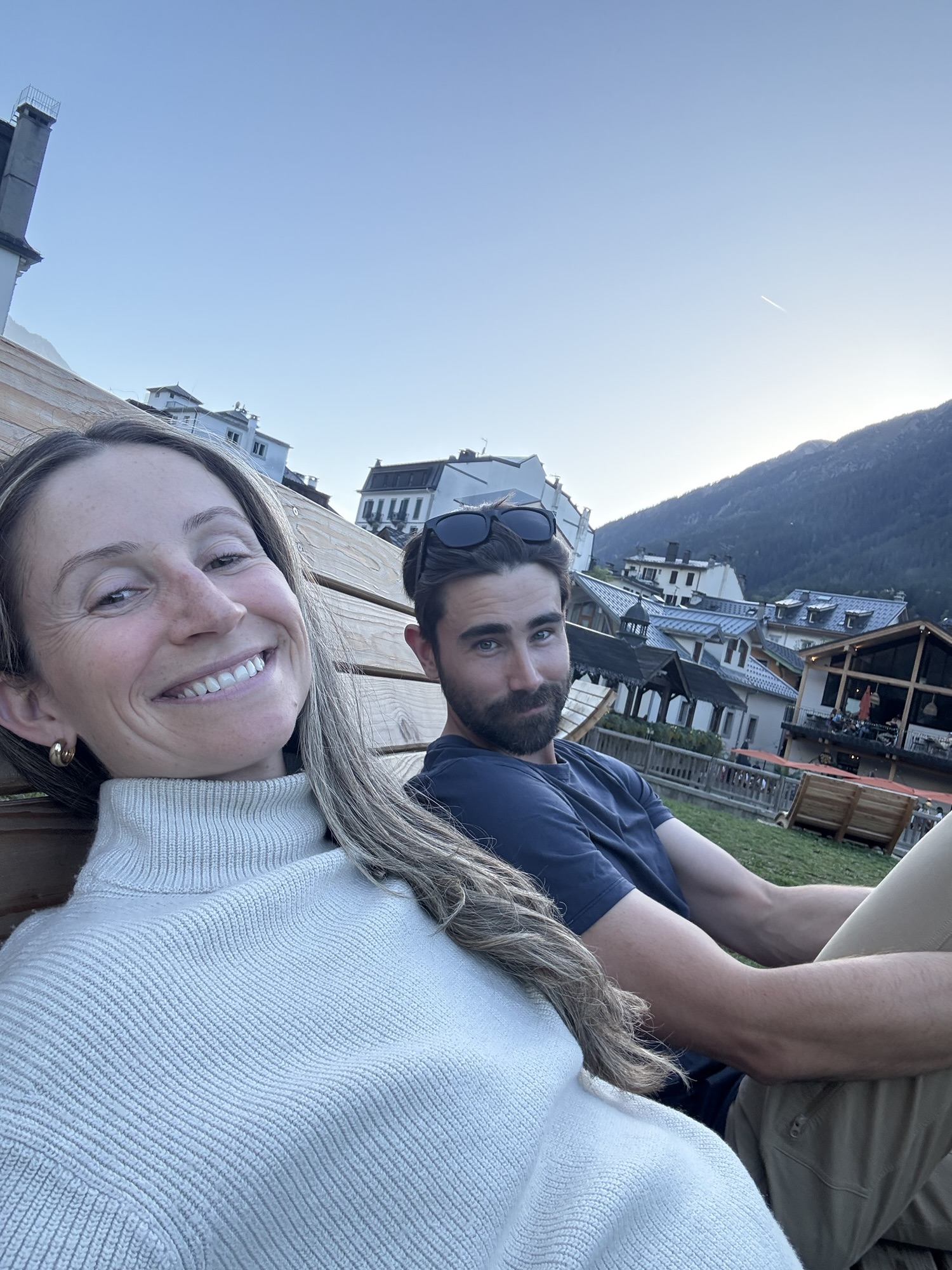
Images: 2% of pregnancy (Sam Schonewille), 98% of pregnancy

March 2026

Background

My intention in writing this post is to share information that could help other pregnant athletes. It’s difficult to find good information about this experience and I benefitted greatly from anecdotes and conversations with other pregnant and postpartum athletes. Please reach out if you’d like to chat, I learned many hard-earned lessons during pregnancy and am more than happy to pass knowledge along. Keep in mind that every pregnancy is different, so what worked for me might not work for you, and if you’re pregnant or would like to become pregnant, I sincerely hope that your pregnancy feels better than mine did.

My pregnancy

My pregnancy was low-risk but miserable. I had morning sickness (aka: pregnancy sickness, which is not limited to mornings) until week 39 (I delivered at week 4o+4 days). I was too hot for my entire pregnancy (the kind of too hot that led me to hike the Chief in a sports bra in the November rain many times). I had strong food aversions to butter, cookies, and some days, everything (the exception was always Vietnamese food, shoutout to Ahn Noodle Fusion). I had soul crushing fatigue 70-80% of the time, and a generally bad attitude 90% of the time. I had cramps for the entire first trimester, and then Braxton Hicks starting in the second trimester. In the third trimester, I had restless leg syndrome and insomnia. The baby ‘dropped’ (meaning her head descended into my pelvis, which is as uncomfortable as it sounds) and I had pre-labour contractions for 5-6 weeks before I actually went into labour, which resulted in a lot of sleepless nights.

Will running make the baby fall out?

I fucking wish. I would have hauled my whale body off the couch every day to run starting at week 37 if running could make the baby fall out. Alas, I was forced to wait it out in my bloated, leaky, insomnia-riddled body until the mysterious magic of labour took hold. Complaints aside, some people have asked me whether it’s safe to exercise while pregnant. The better question is whether it is safe not to exercise while pregnant, and the answer for most pregnancies is no. Guidelines indicate that pregnant people should exercise. Physical, mental, and emotional outcomes for the pregnant person and the fetus are improved with exercise, both during and after pregnancy (of course, there are some pregnancy complications that contraindicate exercise). Even those who didn’t exercise before pregnancy are advised to begin as it reduces pregnancy-related risk.

What do the guidelines say?

There are (surprisingly) quite a few studies on the topic of exercise and pregnancy, many of which are summarized in the Canadian guideline for physical activity throughout pregnancy. Unfortunately, when it comes to guidance on what exactly to do, most research encourages an individualized approach, which leads us right back to not knowing what to do.

I dealt with this uncertainty by listening to my body as best I could. Since that’s pretty vague, I’ll try to outline how I made decisions throughout this post. I will note that guidelines explicitly advise avoiding high risk sports while pregnant, such as skiing, climbing, and mountain biking. Obviously I didn’t follow that guideline, but I did dial it down quite a bit. My ski season ended in my first trimester (more on that soon) and I was much more conservative with mountain biking and climbing.

The First Trimester: Am I gregnant?

March to June

We decided to try for a kid starting in March 2025. Our doctor said the average timeline to conceive is 6 months to a year. Being squarely in my late thirties, I was pretty sure we’d be closer to a year, so I stacked my 2025 race season accordingly. I signed up for Survival of the Fittest 18k, the Kulshan Randonee skimo race, the Coaster Marathon, Reckless Raven 50 mile, and UTMB 100 mile, but I bought insurance just in case. We found out I was pregnant on April 4, 2025 with a due date in mid-December. Julie and I skied the Spearhead traverse on April 5 and she helped me process the initial shock and excitement. After 3 more positive pregnancy tests, I finally started to accept the possibility that I was pregnant.

We went on a ski trip to the Mount Waddington area about a week after finding out I was pregnant. We made a basecamp with our friends Myrika and Vincent on the Dais glacier and spent the week skiing all around, including a failed attempt at Mt Waddington. I started to get nausea and fatigue during that trip and developed the food aversions that would haunt me for months to come (cookies, Pringles, and tragically, butter ramen). Several times I lay down in the snow while skinning and hoped the others would leave me to silently perish. They did not leave me, and luckily I still felt good for the majority of the trip.

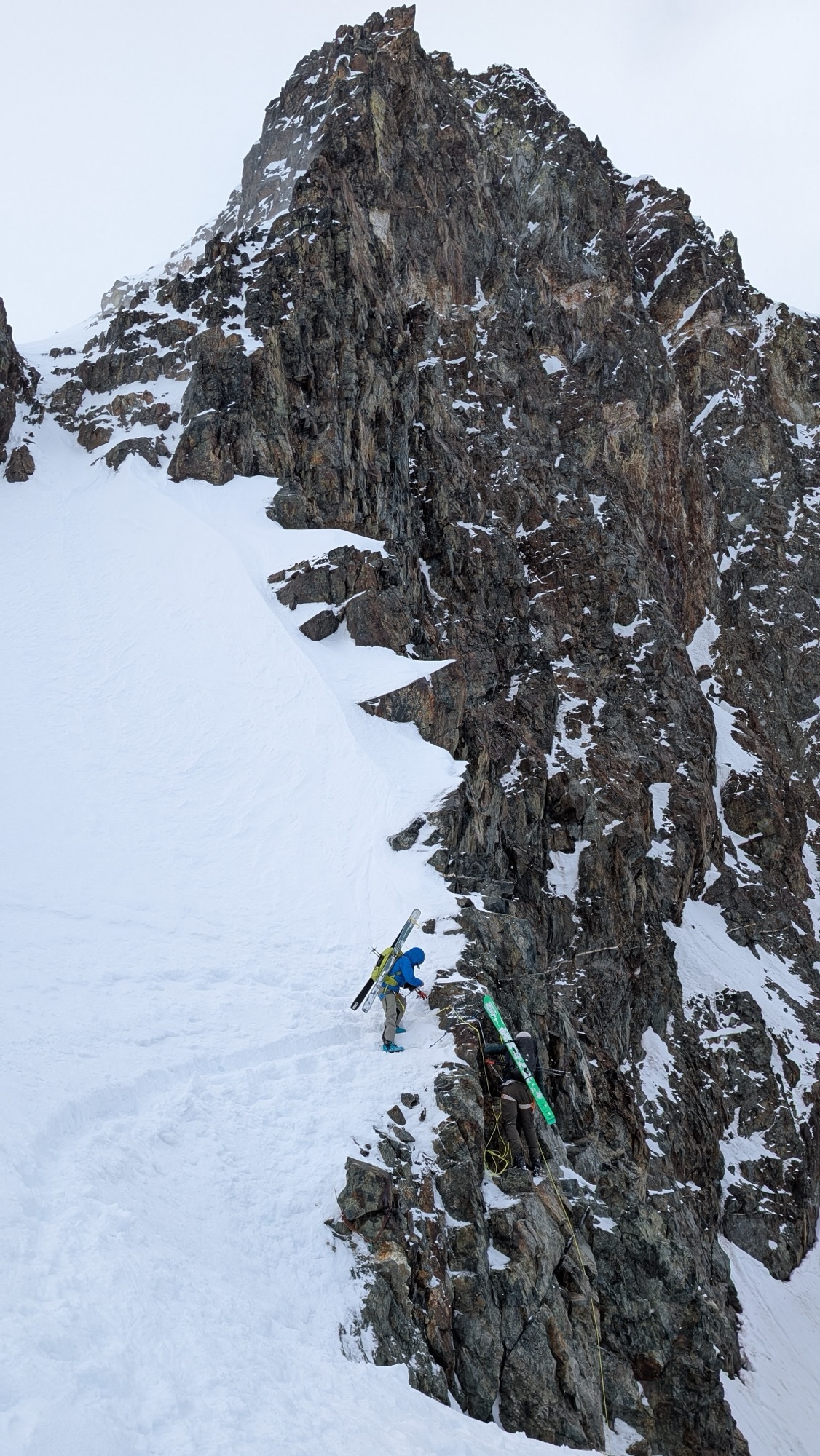
Upon arriving home in late-April, Eric, Eric Munro (Ed.: “bad Eric”), and I decided to do our final Spearhead traverse of the season. This was, unfortunately, my breaking point for nausea. The day was overcast, sometimes whiteout, with terrible snow quality and lots of frozen avalanche debris. The combination of nausea and fatigue, compounded by bad visibility, fuelling mostly with cookies, and bumpy rubble robbed me of my will to live, and I vowed to withdraw from Kulshan Randonee and never eat cookies again. The whiteout conditions made my vertigo so bad that I feared for my life and made the Erics short rope me to the rappel station. Truly a new low. My 2024/2025 ski season ended that day.
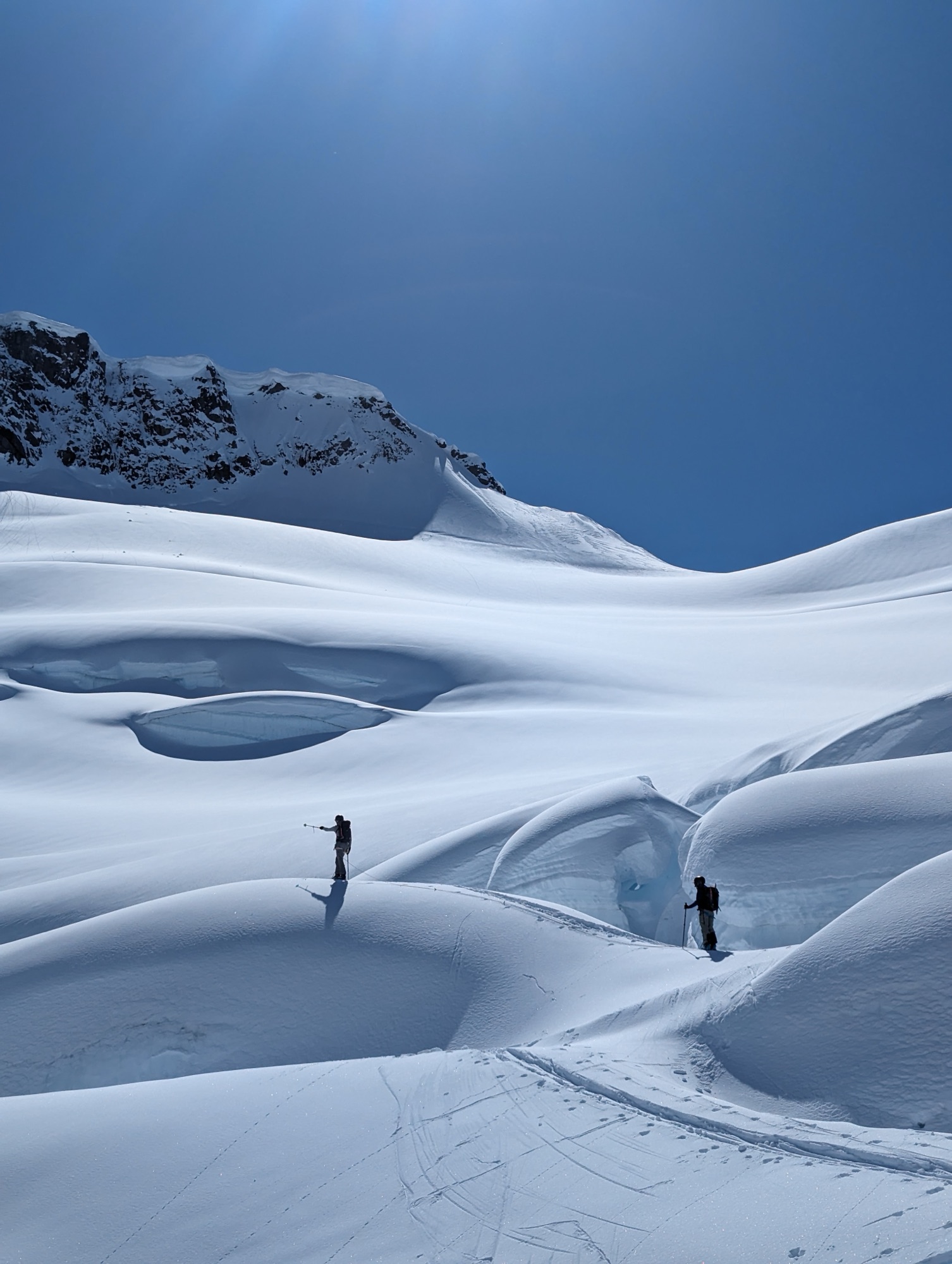
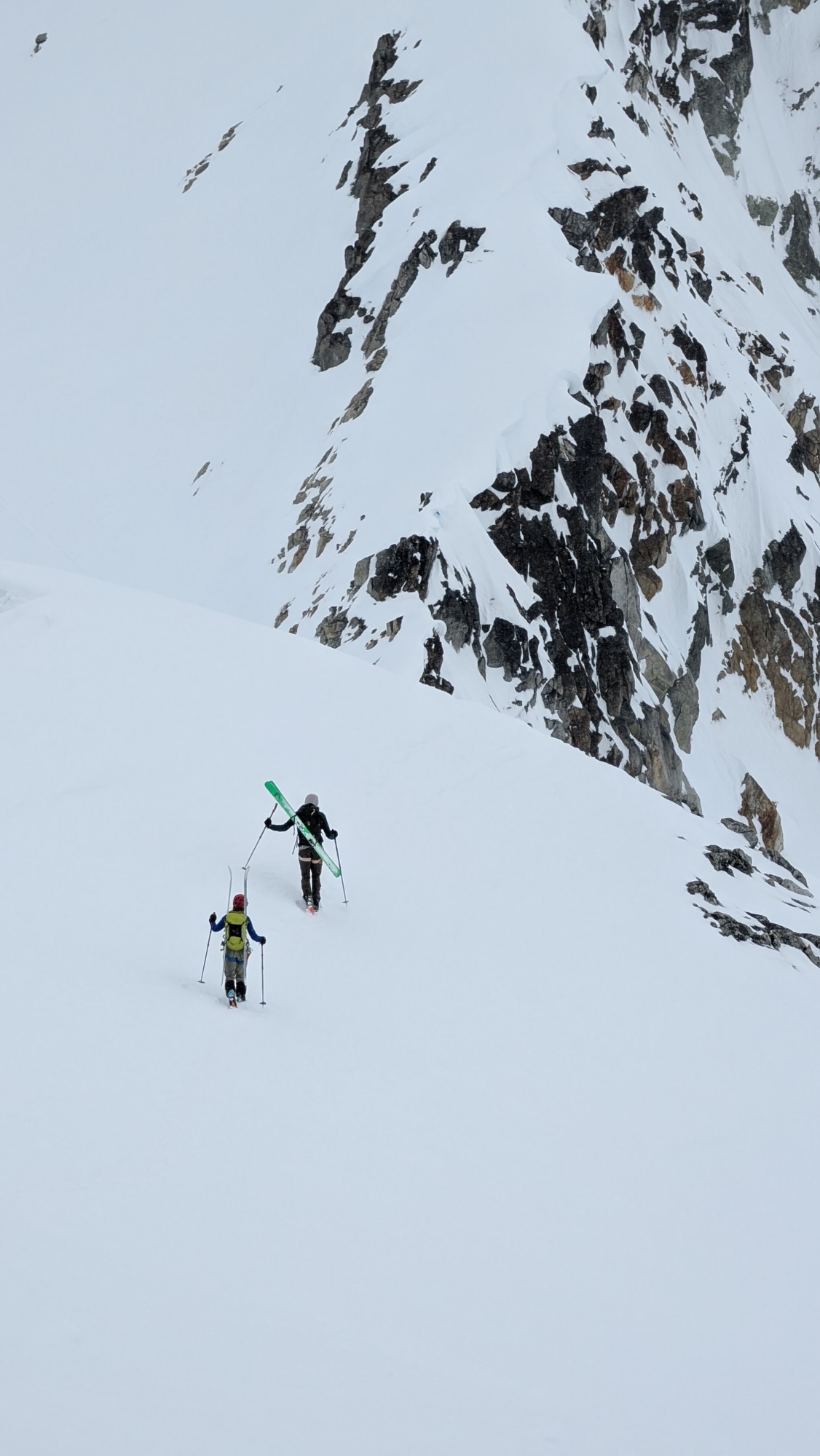
Images: Waddington for two (Vincent Boyer), Spearhead for two (Eric Munro), and the shortrope of shame (Eric Munro)

At the end of April my doctor suggested I start taking Diclectin (doxylamine succinate/pyridoxine hydrochloride for the nerds), a combination of vitamin B and an antihistamine that can help reduce nausea for some people with few side effects. It took half a week to start working but helped bring the pregnancy sickness to a reasonable level most days (ie it stopped me from puking daily, but didn’t get rid of the nausea). I ended up taking it until week 39 of pregnancy, reducing the dosage slightly in the second trimester when I felt marginally better, and then increasing it again in the third (boo!).

Craving the sweet release of death but eating hot dogs instead

I heard about all sorts of fun cravings while pregnant like ice cream and pickles. Sadly my main pregnancy craving was to be left alone in a freezing cold room to silently perish. I did develop a taste for Maurten gels (in normal life I find the flavour to be fine, but while pregnant the flavour became irresistible). I also woke up one night with an intense craving for a smokie from the old hot dog stand at the Biltmore (anyone?). We found some all beef hot dogs and I ate them for many dinners while silently crying tears of joy (this is unfortunately true). I was obsessed with fruit in the first trimester and once single-handedly housed an entire box of 15 mangos (not in one sitting, but over a few days) that Kalie kindly dropped off for me.
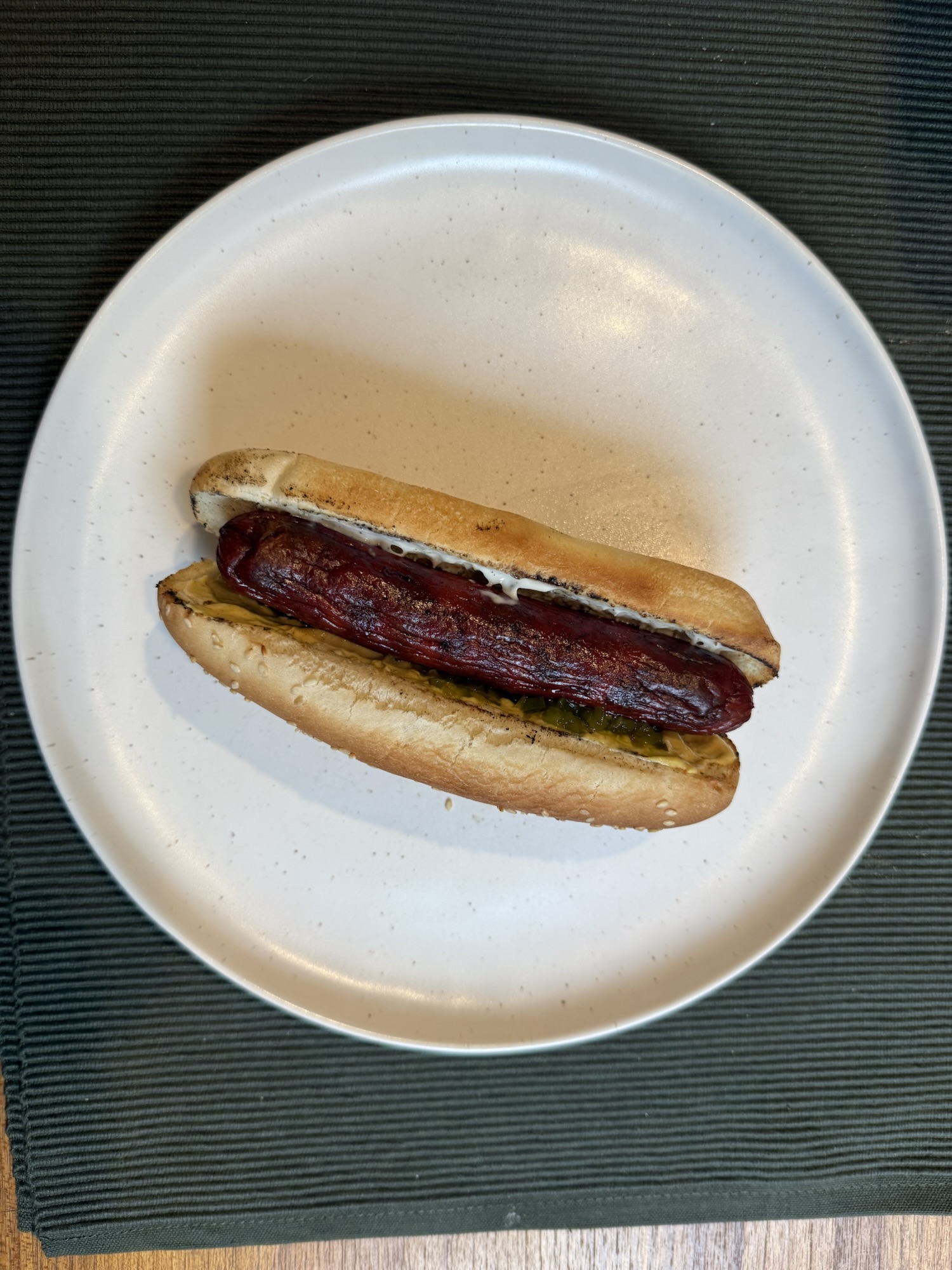
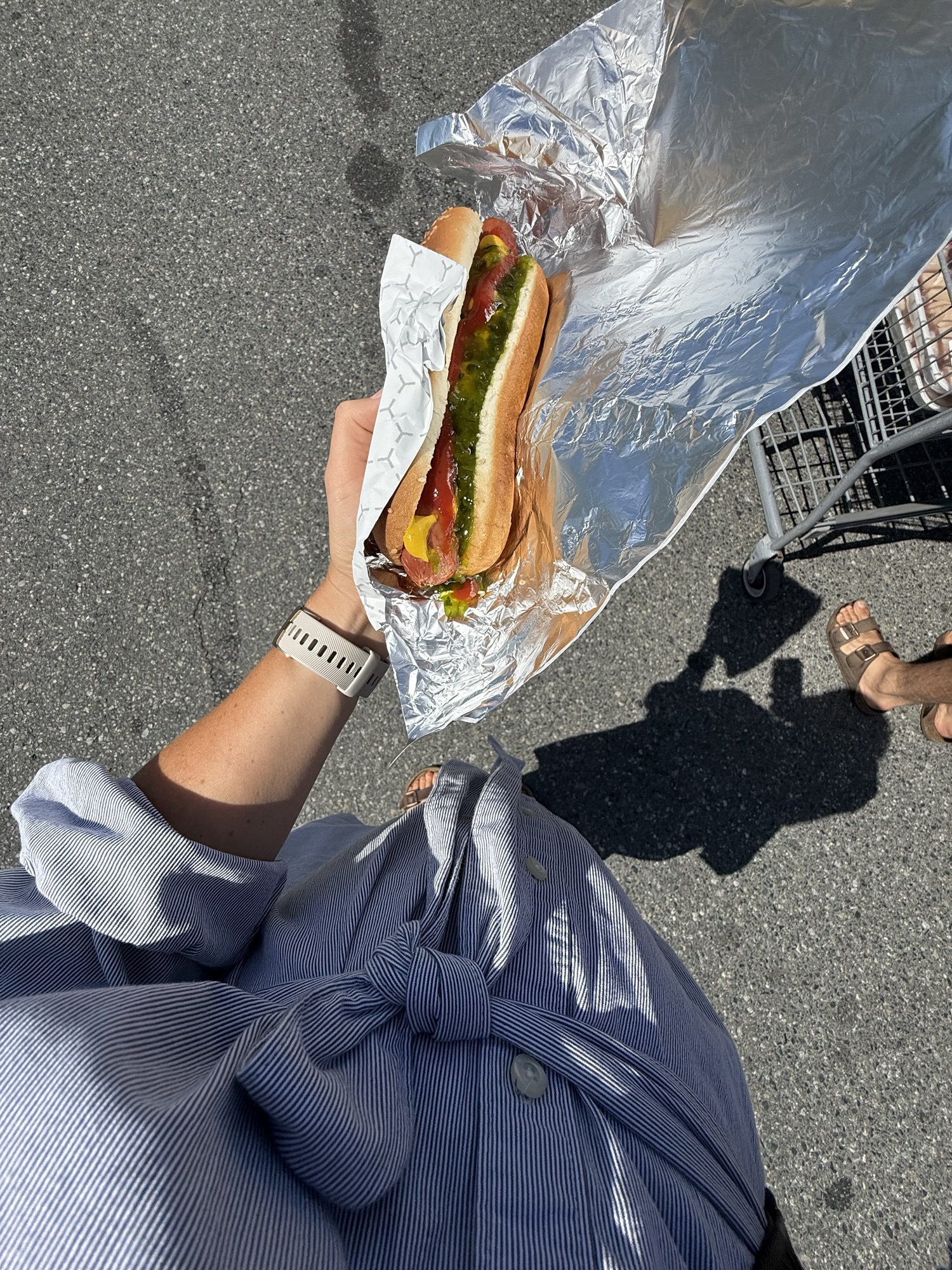
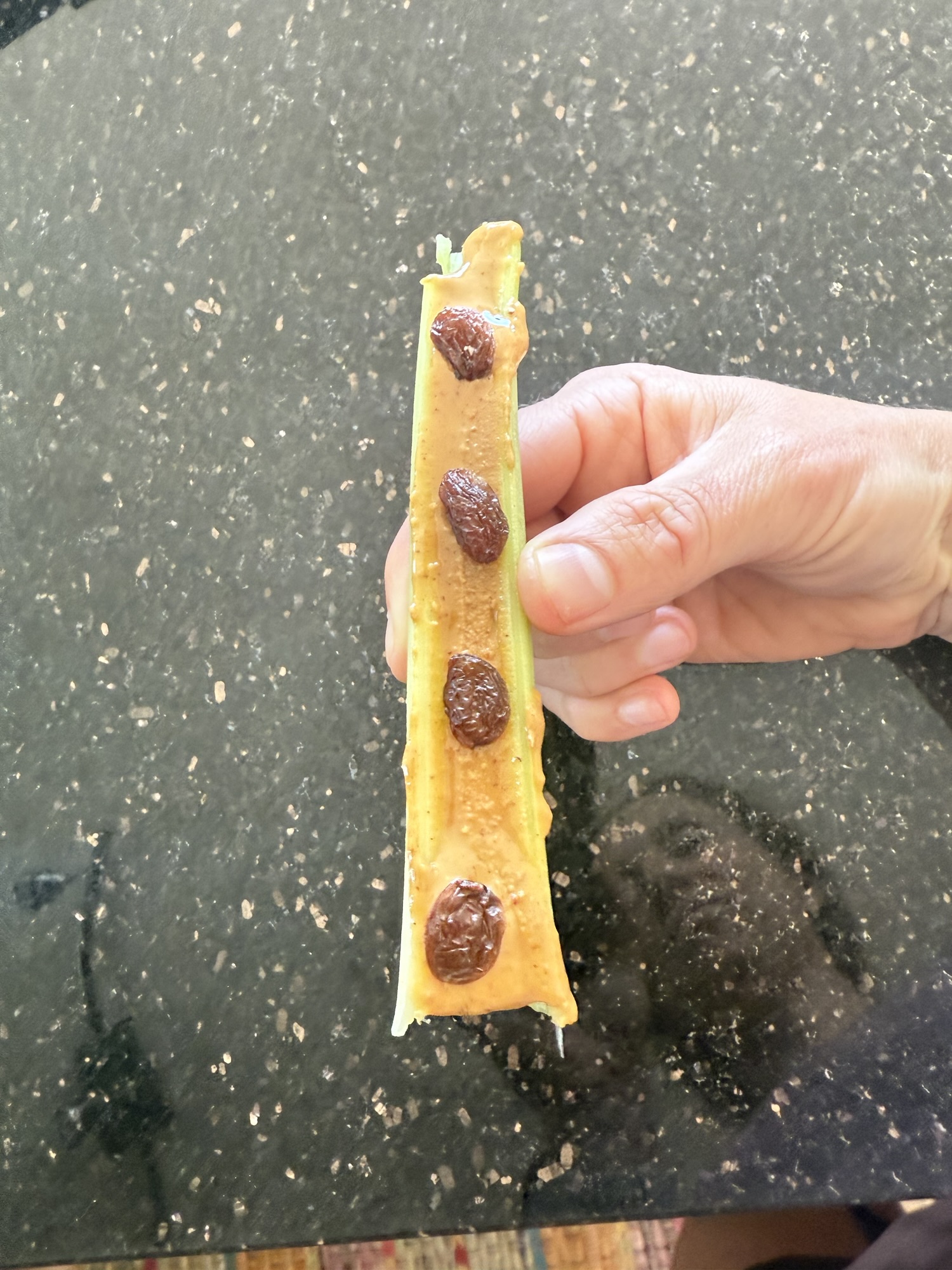
Images: Two Rivers all beef hot dog (not pictured: tears of joy), Costco hot dog, and the week I loved peanut butter

I knew there was some risk associated with not gaining enough weight in pregnancy. My dietician told me that pregnant bodies prioritize the fetus and if I wasn’t eating enough, my body would draw from my bones, putting me at risk of a bone stress injury. However, eating was pretty hard in the first trimester. I gained some body fat early on thanks to the hormones and I hoped that, along with drastically reduced volume and intensity of exercise, would prevent my body from cannibalizing my skeleton. So far, so good.

One other thing to note is that my appetite dropped in pregnancy. I am used to eating a lot to keep up with my high training volume, and the extra calories needed in pregnancy (300ish per day in the second trimester, 500ish per day in the third trimester) were nothing compared to my usual calorie expenditure from exercise. Because my volume and intensity of exercise dropped so much, so did my caloric needs and appetite. I ended up gaining 20-25lbs by the end of my pregnancy which felt like the right amount for me at that time. I didn’t force myself to eat and I didn’t restrict my food, I just took it day by day and ate when I could stomach it.

Troubleshooting loosey-goosey joints

Throughout May I tried to stay as active as I could but struggled with nausea and sacroilliac (SI) joint pain. Relaxin needs no introduction for people who have been pregnant. For everyone else, it’s a hormone that, among other things, helps your joints become loose and lax so that when the baby is ripe it can fall right out if you laugh too hard or sneeze (this isn’t how it works unfortunately, but a girl can dream). I found two things helped me manage my freakishly loose joints:

  • The first was pelvic floor physio (Marnie Tocheniuk, Pelvic Floor Physio). There were very few things in pregnancy that were within my control, but doing my pelvic floor exercises every single day was one of them. I was diligent about this and I think it paid off. The exercises gave me added stability, seemed to reduce my SI joint pain, and (according to some research) improved my odds of an easier labour and recovery (while I wouldn’t call labour easy, my outcomes were good and my recovery has been straightforward so far).
  • The second was a belly band. I used the Maternity FITsplint belly band which helped to stabilize my pelvis and reduce bounce as my belly grew. I used it throughout the second trimester and would have used it earlier if I’d had it. The belly band became less comfortable towards the third trimester so I stopped wearing it since I wasn’t running anyways (for those who are still running, I think it could help with the discomfort of belly bounce).

The 15-minute rule

I was sick most days but I found that more often than not, light exercise made me feel better. There were certainly some days when it wasn’t happening and I needed to become a couch vegetable. However, it was almost always worth trying to run, walk, hike, or bike for 15 minutes and then evaluate whether it was making me feel better or worse. If worse, go back home and become a couch vegetable. If better (and it nearly always made me feel better), continue. This was the main way I “listened to my body” to make decisions about exercise. An added benefit was that exercise also made me hungry and helped make me eat on days when eating was difficult.
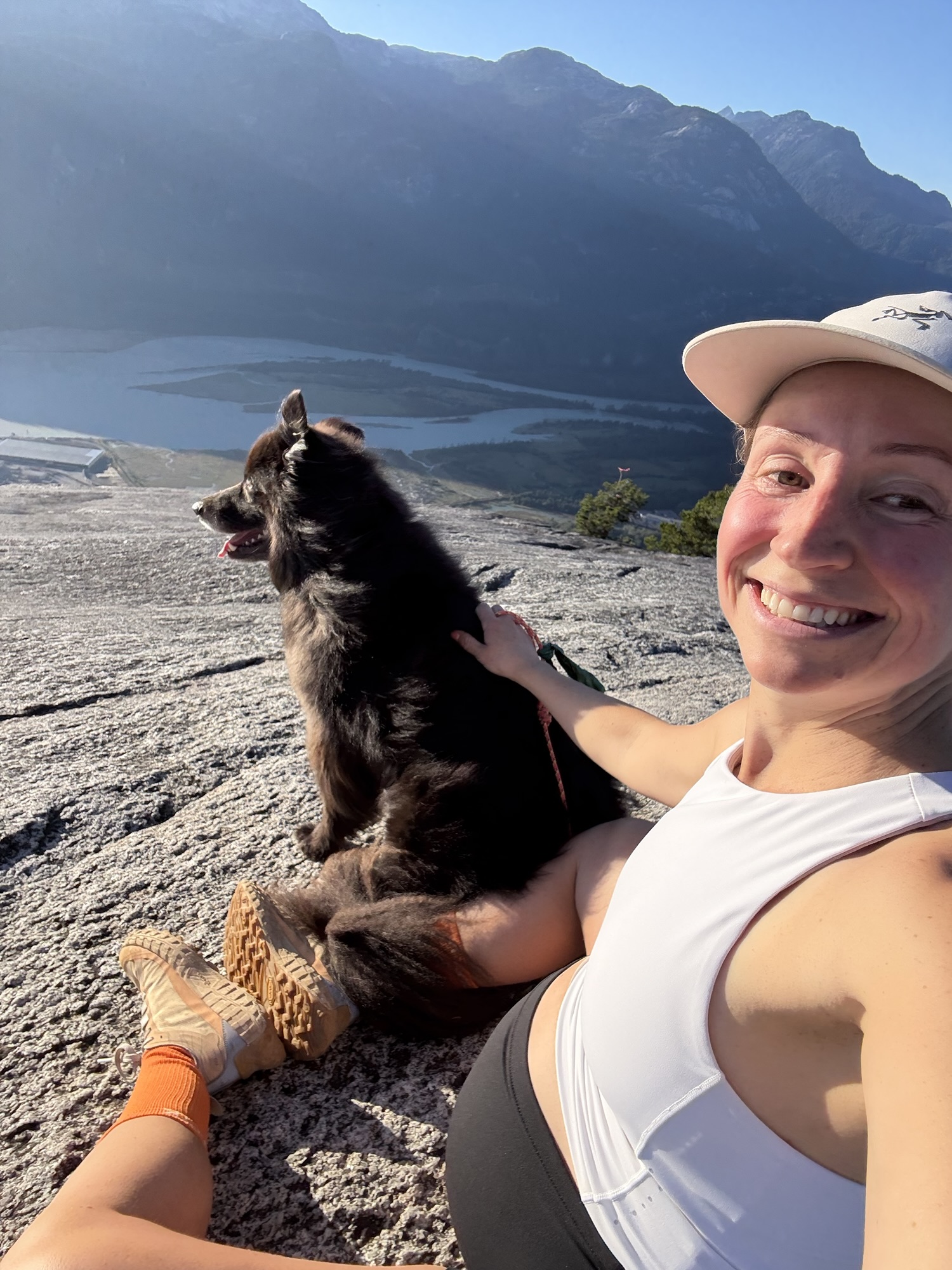
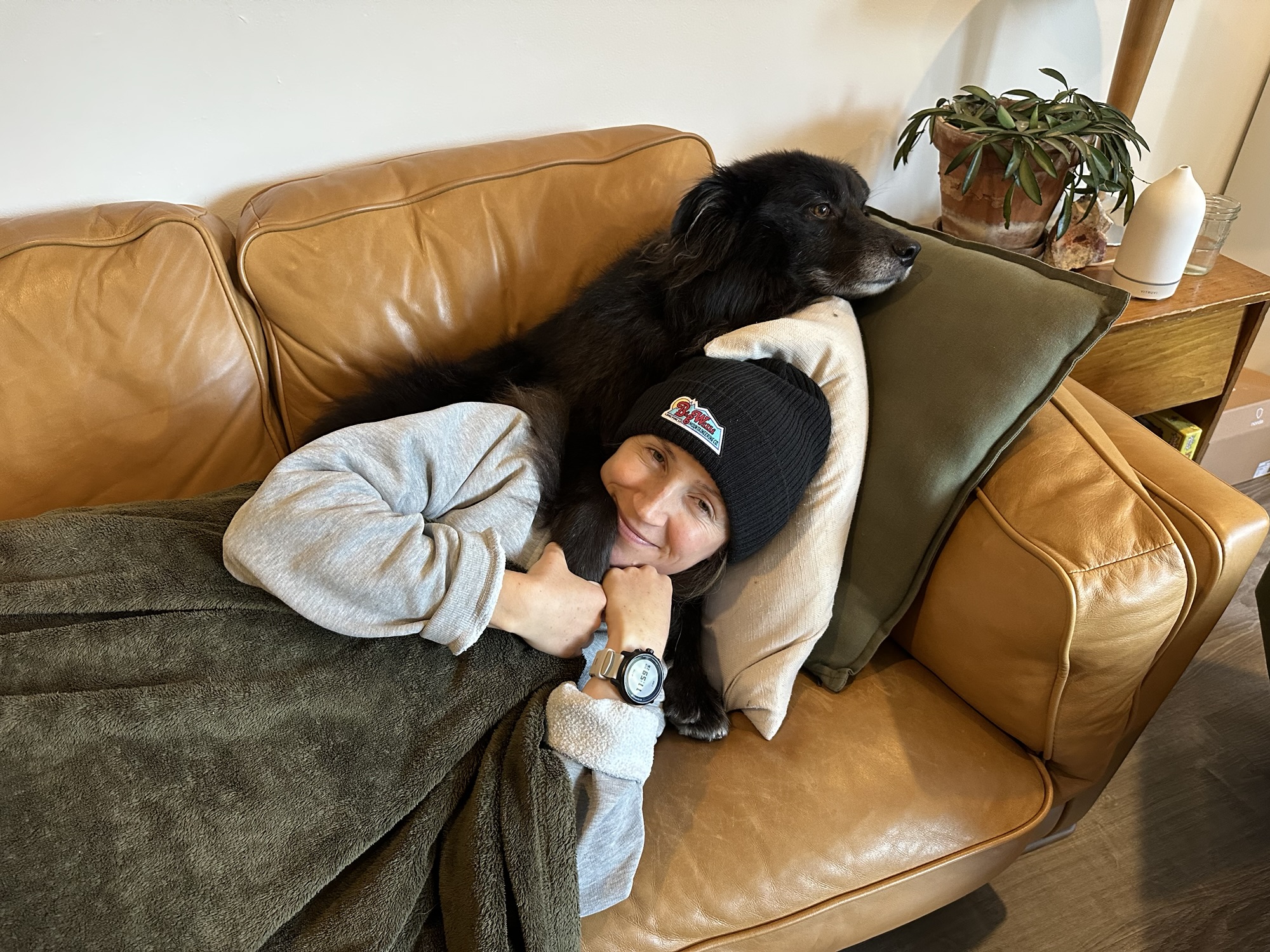
Images: Sometimes I won; Sometimes the couch won (Eric Buitenhuis)

I maintained maybe 80% of my usual running volume in my first trimester. I was pretty running fit leading into my pregnancy so I coasted on that fitness for a while. Each week I became slower and by May I was usually feeling too sick to do a running workout. I spent a lot of time hiking the Chief and did one moderately hard Chief effort in May to burn off some work stress. I also started to ride my gravel and mountain bikes more which felt a lot easier than running.

Takeaways

  • I found pelvic floor physio super helpful and it’s backed by research
  • I liked the Maternity FITsplint belly band and would have started using it earlier
  • Diclectin isn’t magic but it did stop me from puking daily 😀
  • Most days I found the 15-minute rule (If 15 minutes of exercise makes you feel better, keep going! If not, call it.) got me out the door and exercise made me feel better
  • I had to get a bit creative with my fuelling because of my food aversions but it worked out in the end

The Second Trimester: One good day, one great day

June to September

At the beginning of my pregnancy I was optimistic. I had seen other pregnant women compete in races while pregnant, surely I could too! Don’t things get better in the second trimester? No and nope. My nausea and fatigue faded slightly for a few weeks in my second trimester and I had one good day (Sky Pilot & Habrich) and one great day (Harvey & Brunswick, June 15, a day to remember), but overall it was not the fun and carefree second trimester I envisioned.

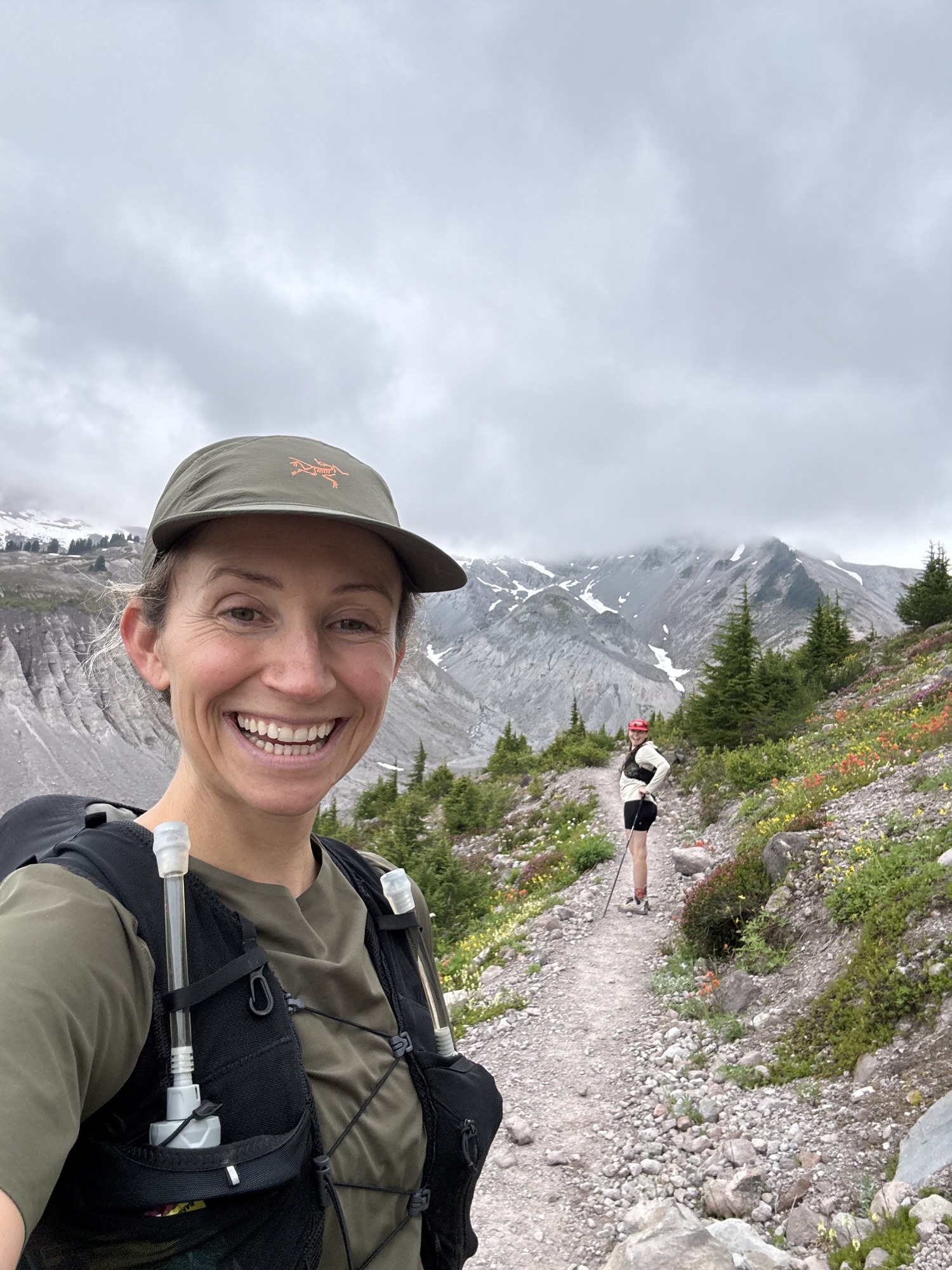
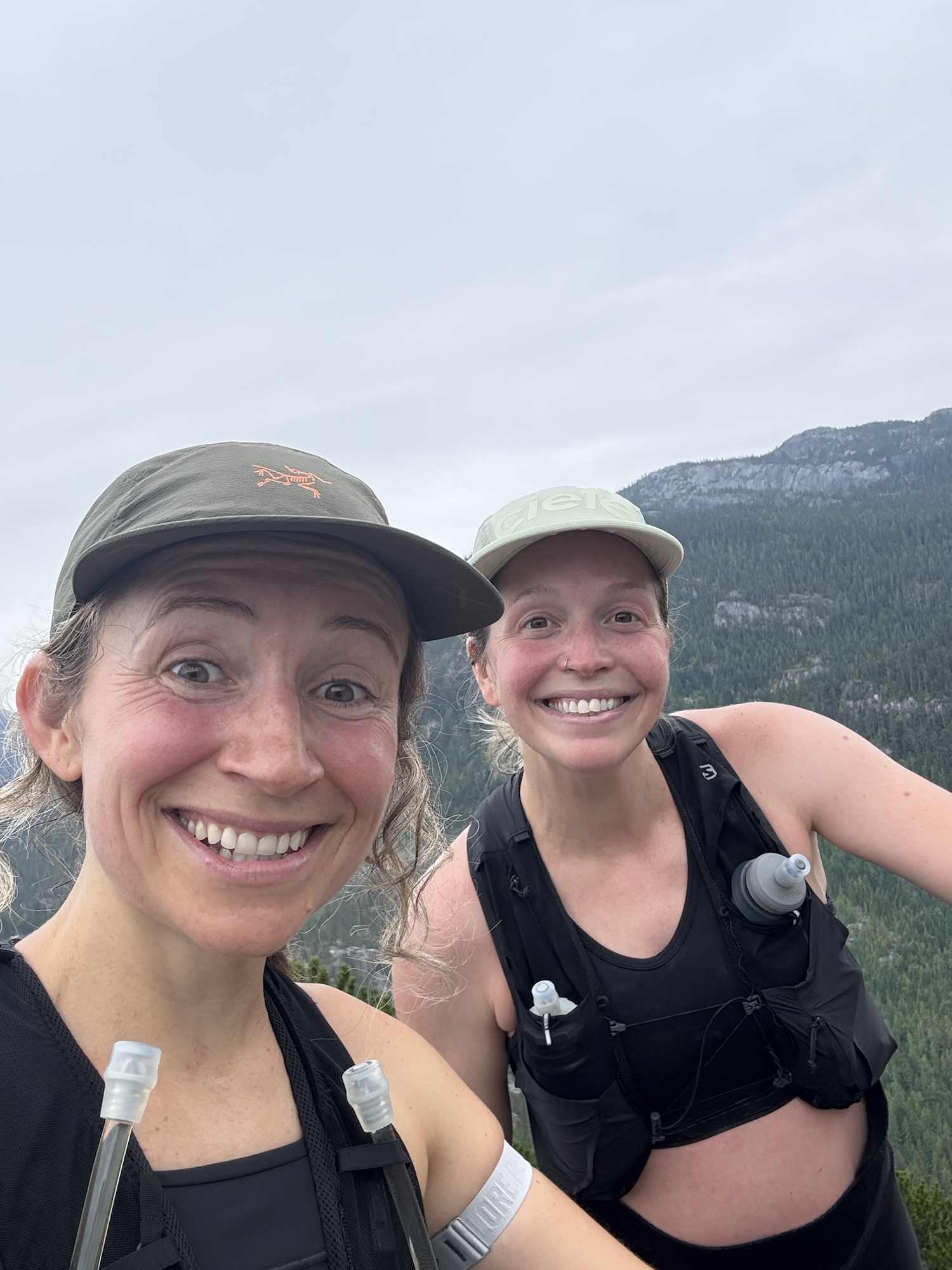
One highlight of my second trimester was spending quality outdoor time with other pregnant pals. We moved slowly together, stopped frequently for water and snacks, and commiserated over shared experiences. Chatting with other pregnant and postpartum people made me feel less isolated in my experiences and helped me understand what to expect. I also have many supportive non-pregnant friends who were happy to share some time in the mountains with me, even if it looked a bit different than our normal outings.
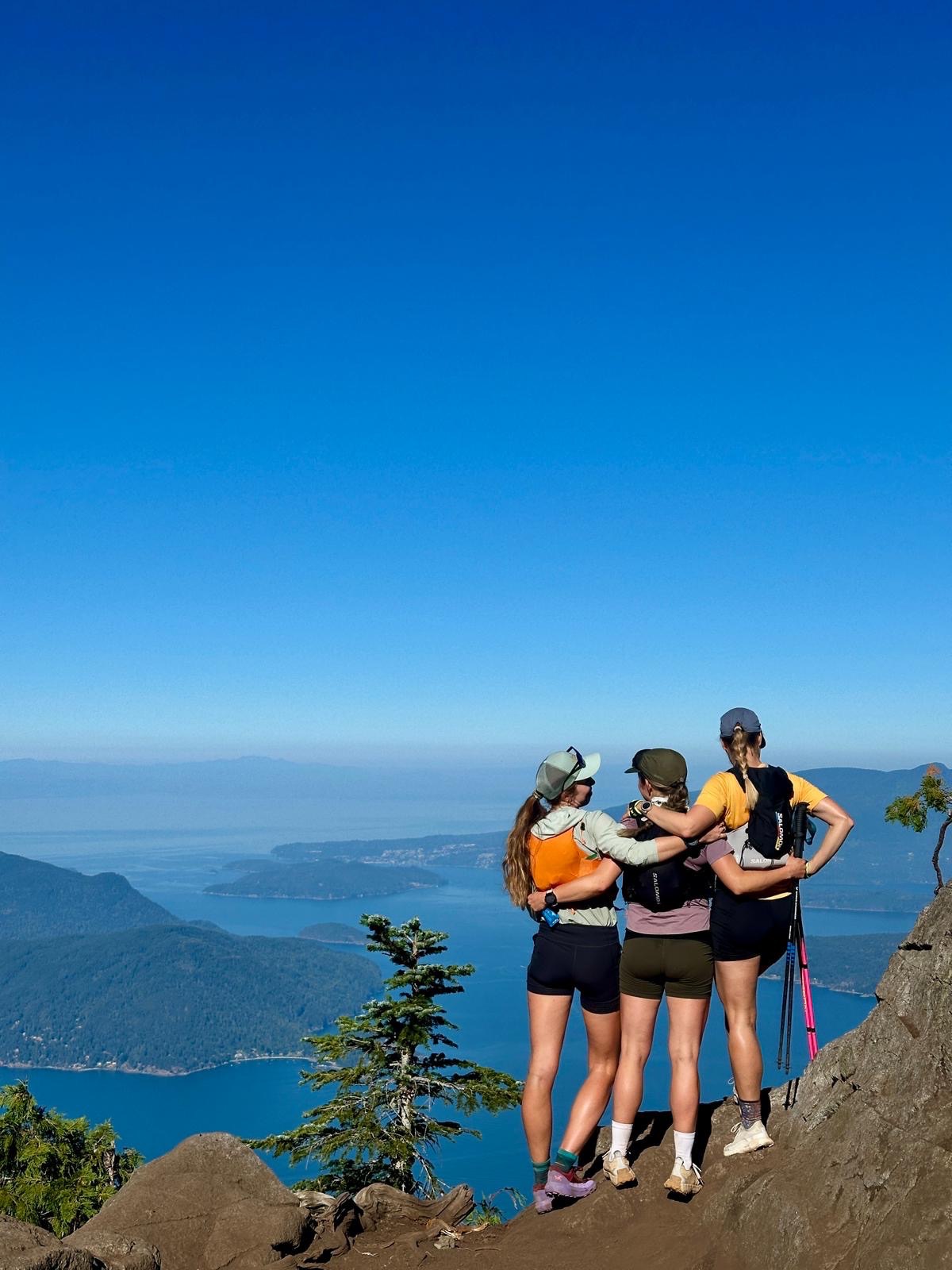
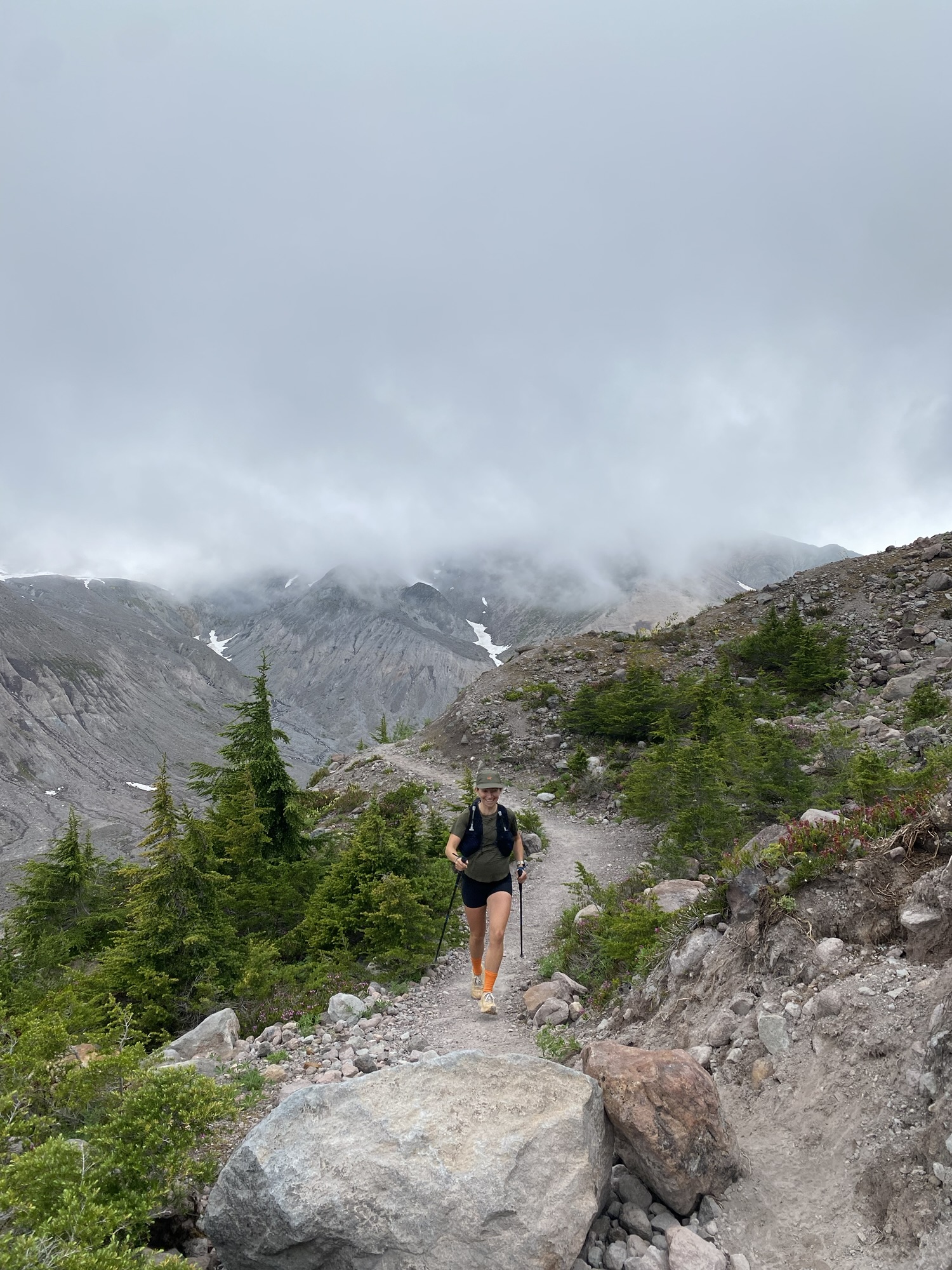
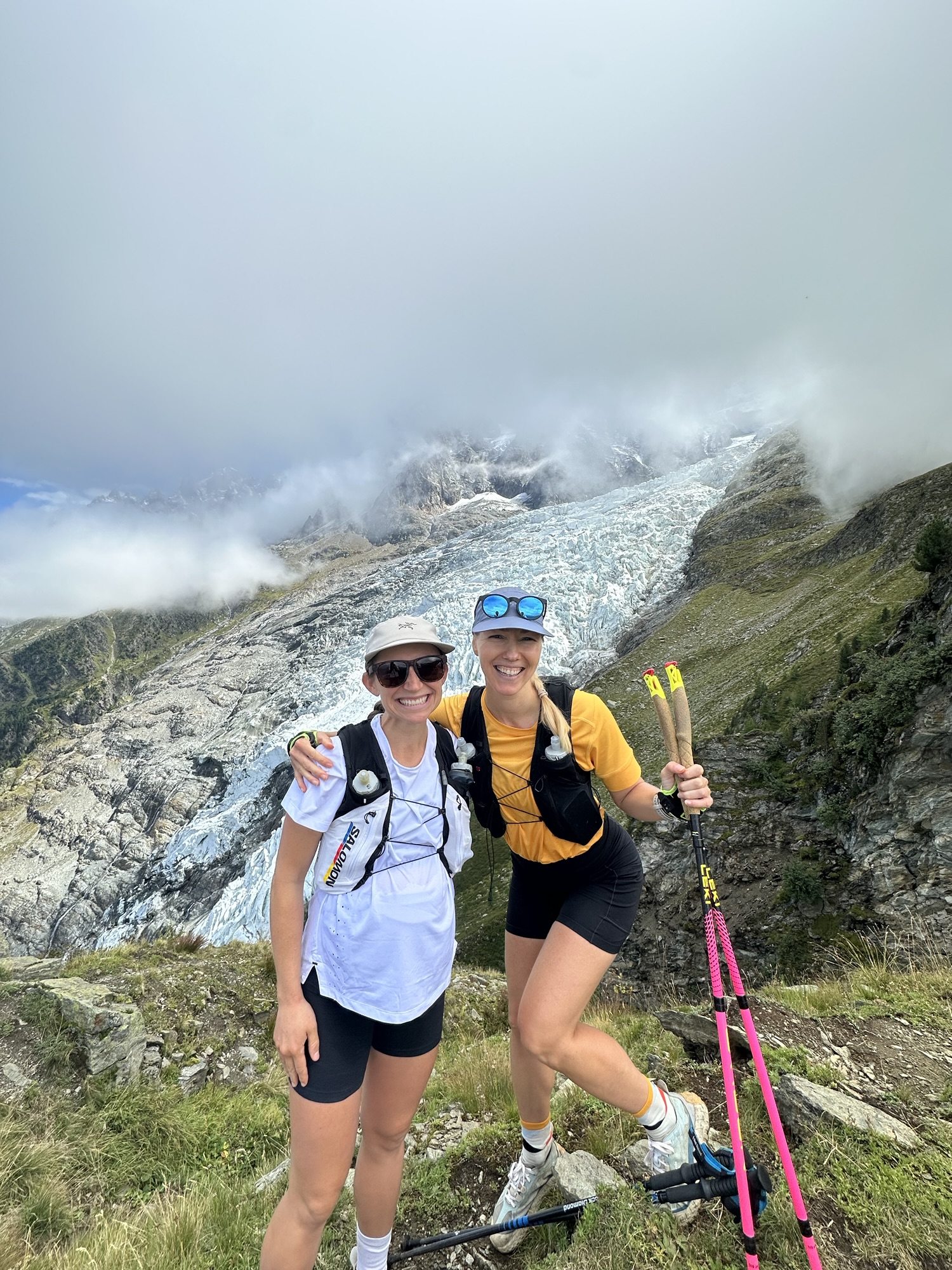
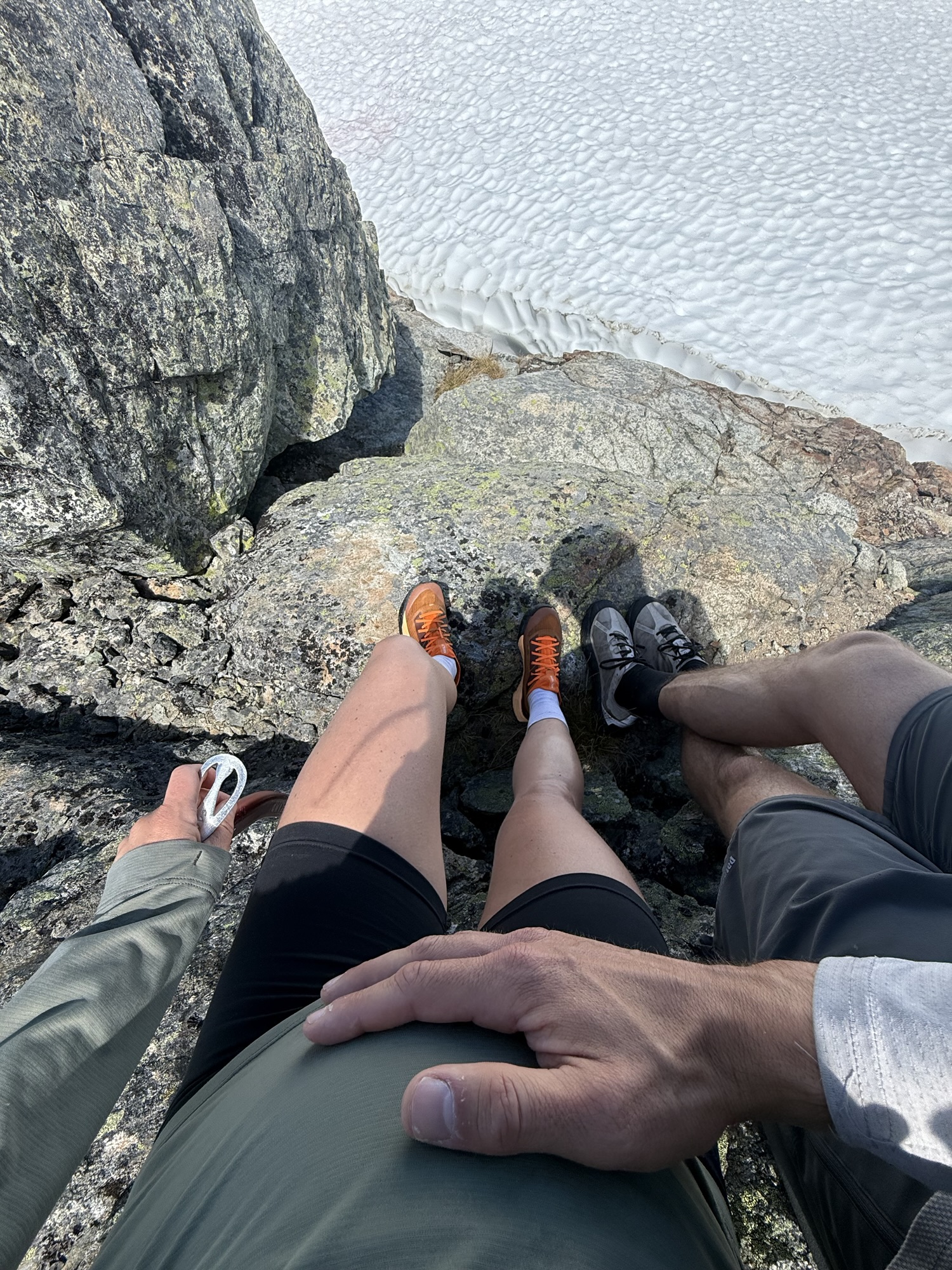
Images, clockwise from top left: Howe Sound Crest Trail (Jeff Pelletier); Opal Cone (Jackie McKinley); La Jonction (Eric Buitenhuis); Train Traverse; please just leave me here to perish on the Train Traverse (Eric Buitenhuis); The Brain off Habrich (Eric Buitenhuis).

Balancing risk while losing my balance

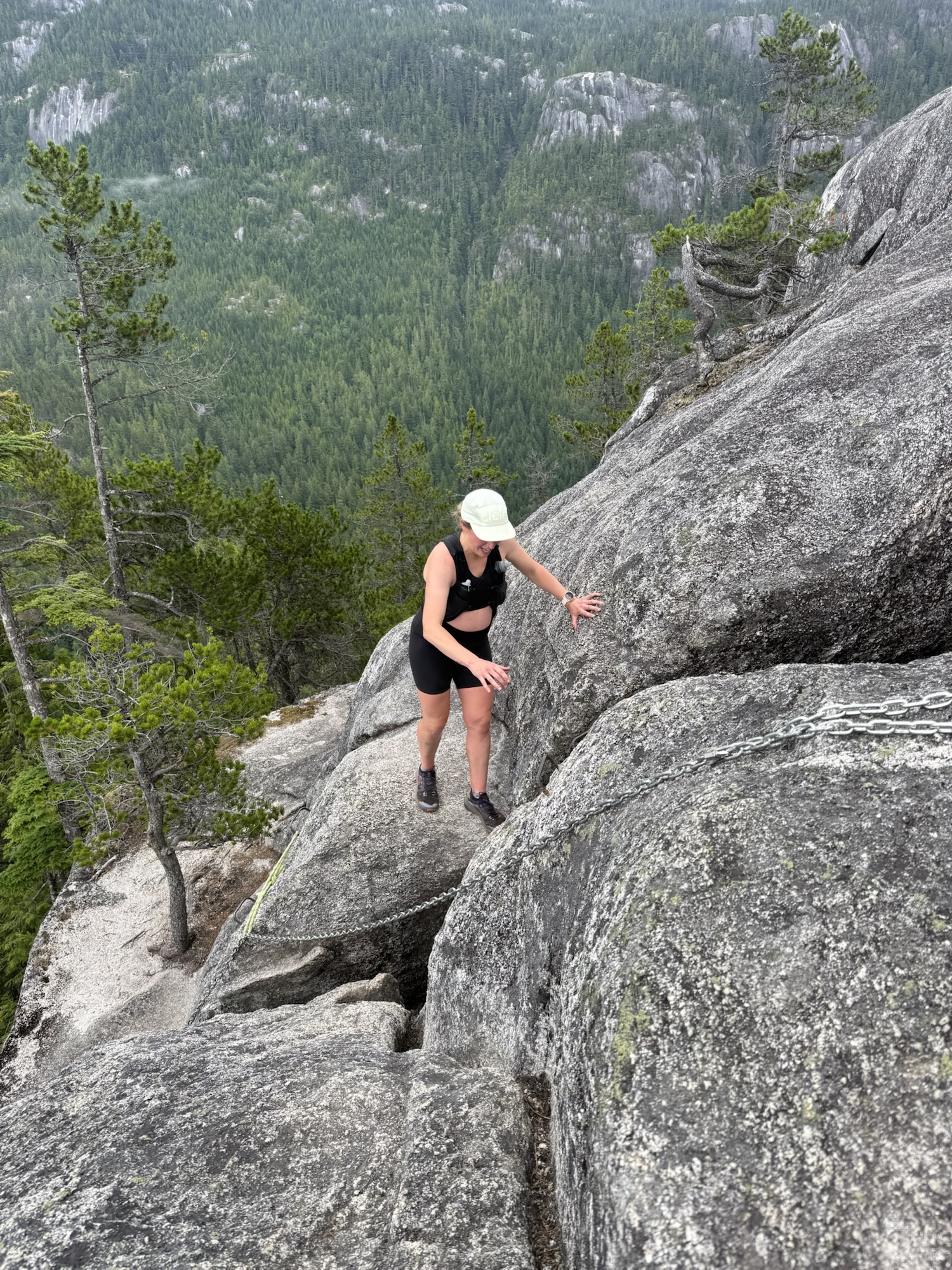
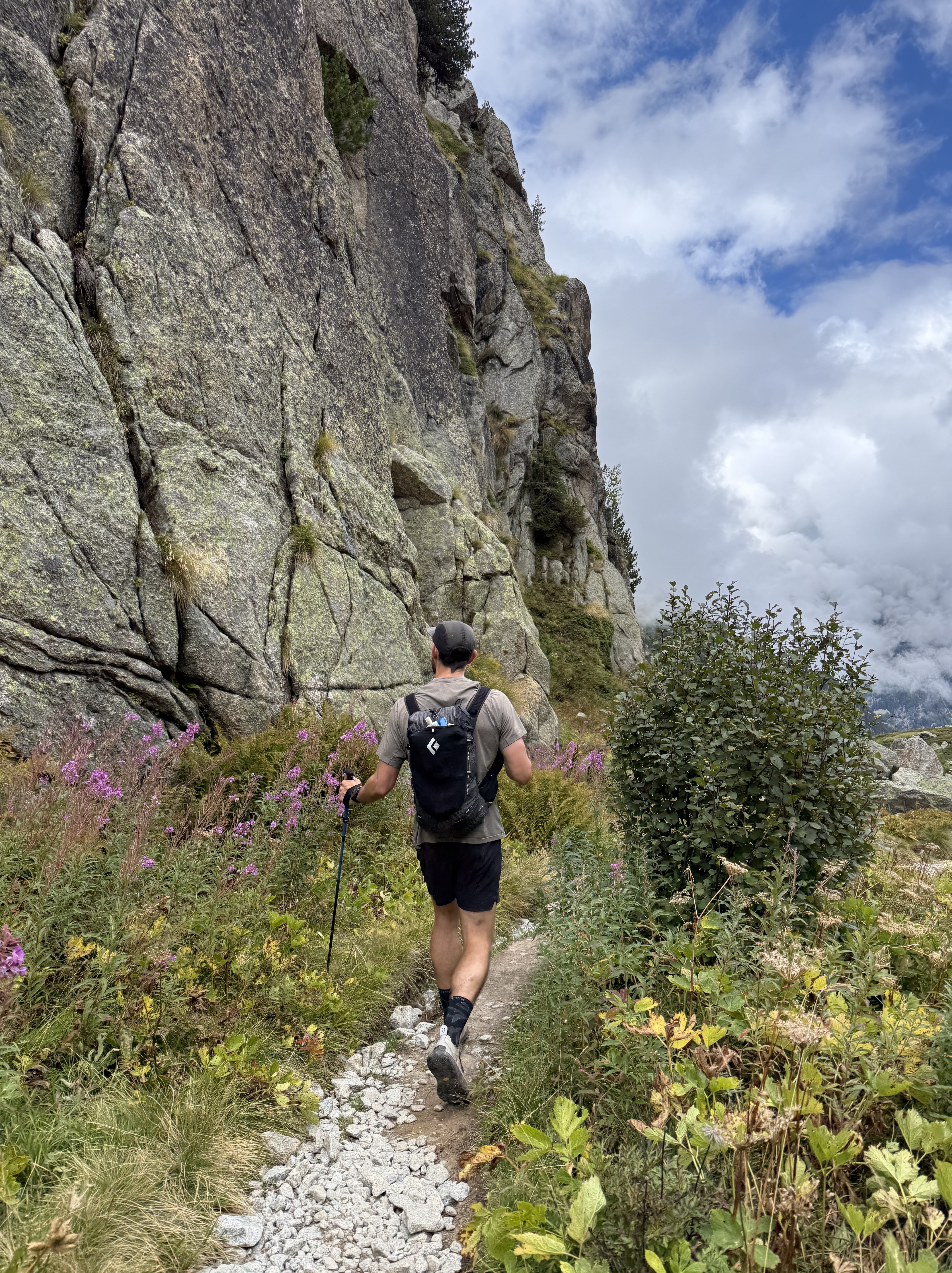
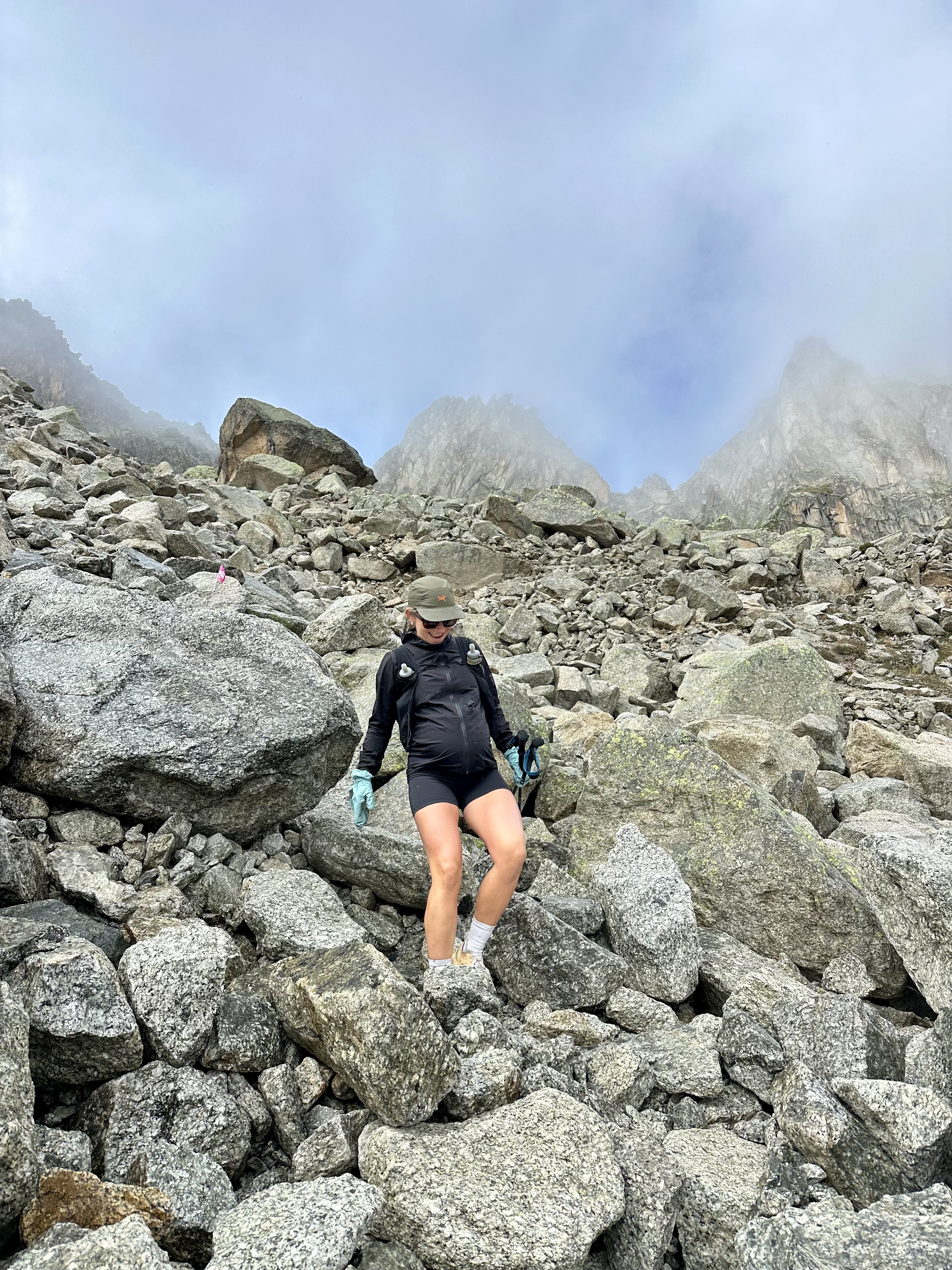
Throughout the summer I sought out interesting objectives that struck the right balance of technicality – a bit technical because I was too slow to really enjoy moving across non-technical terrain (see my report on the Tour du Mont Blanc for a dramatic take on hiking non-technical trails while pregnant), but not too technical because my balance and coordination were getting worse by the week (this was me dialling it down with the high risk sports). For me, some of these objectives were Sky Pilot, Habrich, Al’s Habrich loop, Brunswick & Harvey, Cypress, Howe Sound Crest Trail, Demon Peak near Watersprite, Tenquille, Train Traverse, Opal Cone and the Gargoyles, Aiguilles Crouches, Via Alpina, and Brandywine.

I also found some of the above mentioned routes to be more pregnancy friendly because they had a fair amount of access to water and snow for drinking and cooling (on the Howe Sound Crest Trail, Jeff muled some extra water for me as there’s a long section without water).

Since I was nearing maximum discomfort at all times, it was important to me to at least feel comfortable in what I was wearing. I invested in some bigger and more supportive bras (note for those of you at this stage: my bust and band measurements kept increasing throughout pregnancy and postpartum and my bust size is now a full 7 inches bigger than normal. Many of the bras I bought in pregnancy no longer fit), maternity shorts (these Amazon maternity shorts), and size L shirts.

While I had a rough second trimester, it was still the best trimester of my pregnancy and I would recommend planning trips and objectives for this time. Again, see the Tour du Mont Blanc post for more detail on trip planning for pregnancy. The key for me was to have a lot of food, water, and contingency plans. Having an easy bail out option was important both mentally and physically. I am so glad that I did big and small days in the mountains while pregnant, and I encourage anyone who is pregnant to try to do the same but approach it with an open mind. You never know when you’ll need your pals to short rope you to the rappel station on the Spearhead.
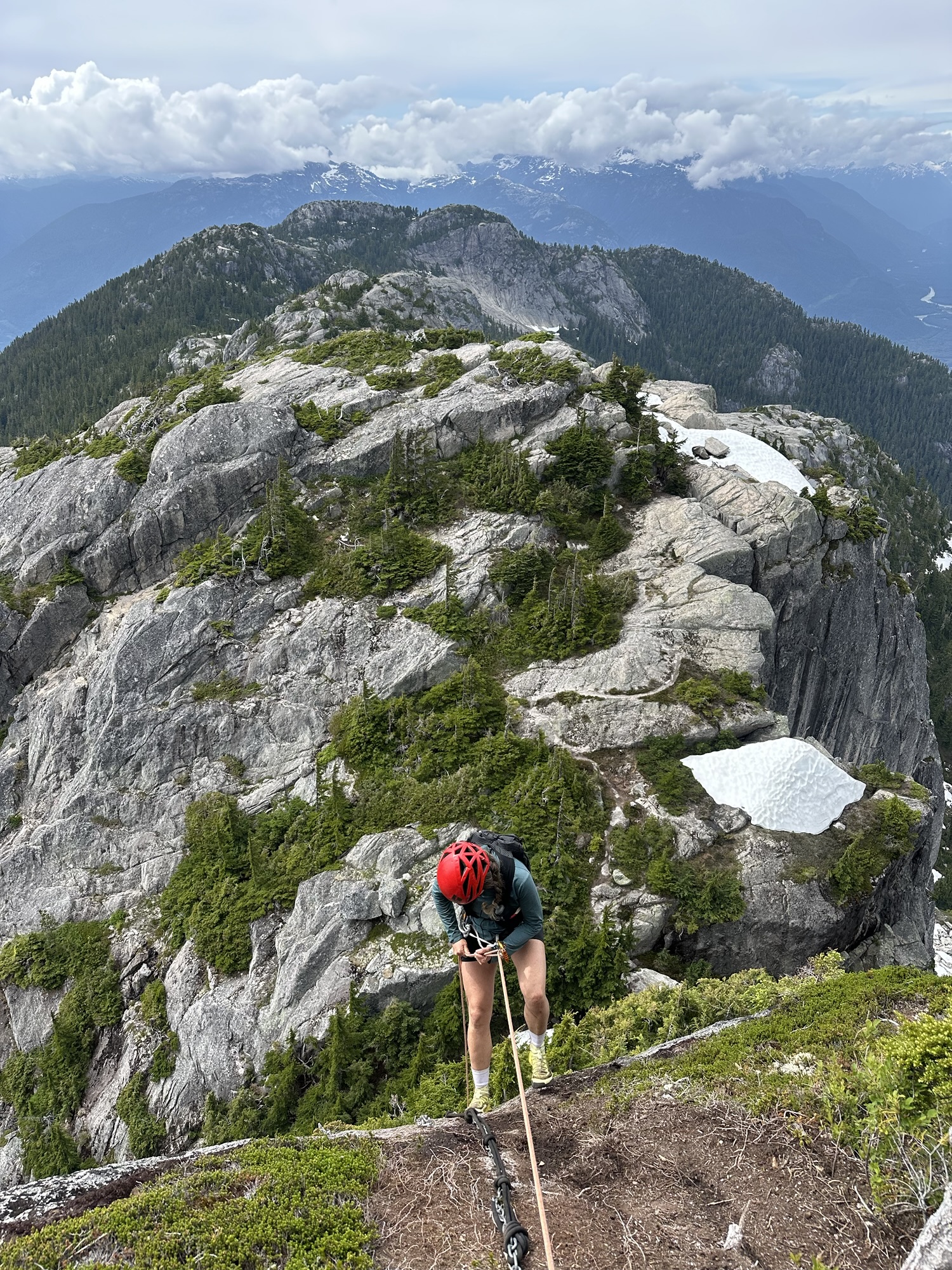
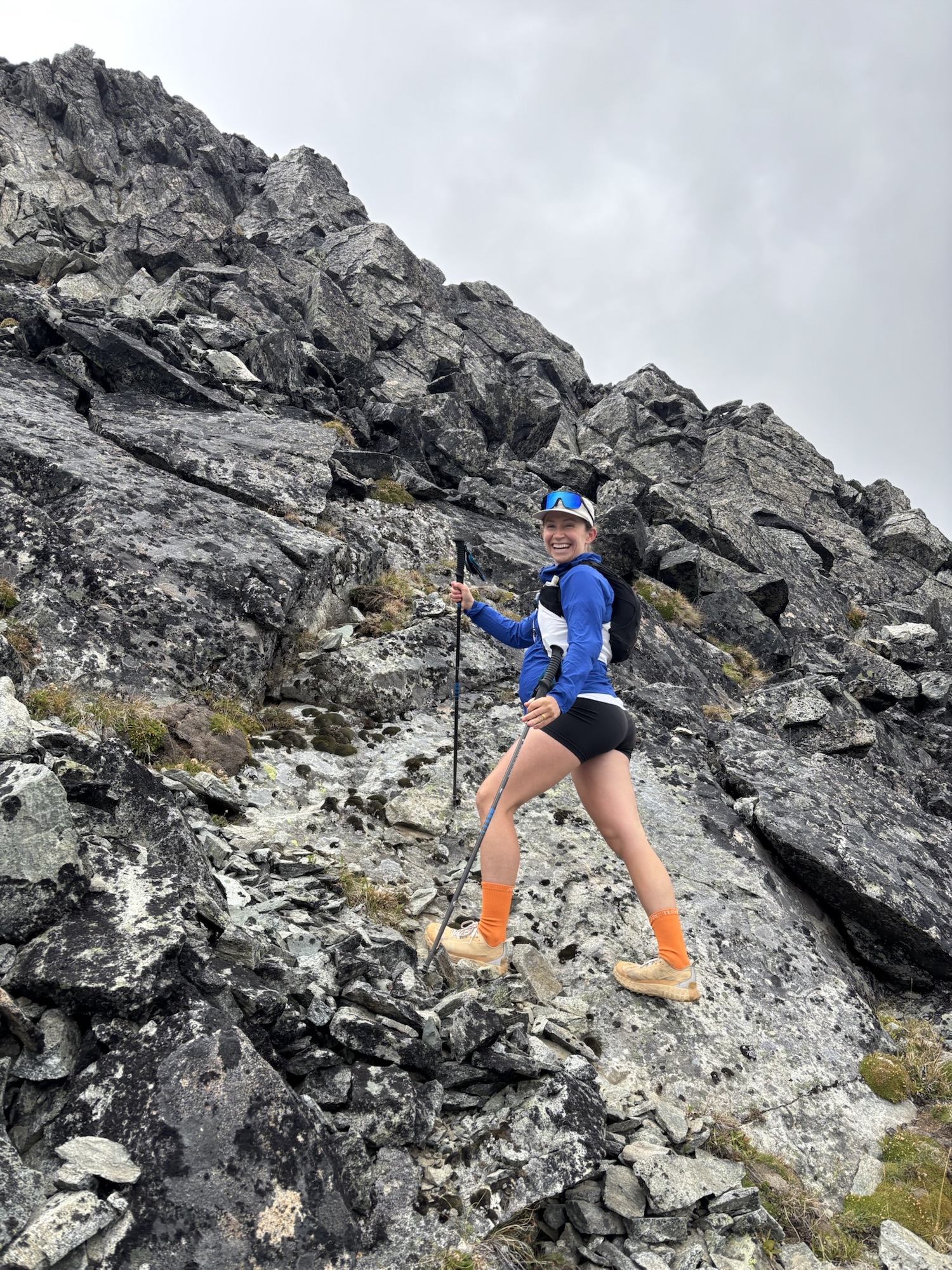
Images: Habrich (Eric Buitenhuis); Blackcomb (Brett Trainor); Le Brevent (Eric Buitenhuis); once again too warm on Tour du Mont Blanc (Eric Buitenhuis)

It’s getting hot in here

I started to feel too warm early in my first trimester. It started in the Waddington range (when I had to stop while skinning up a steep slope to remove my long johns from under my soft shells – not easy!) and lasted until the very end. Being too hot made me more nauseous, fatigued, and gave me Braxton-Hicks early in the second trimester. Some ways I managed heat:

  • An ice bandana. I bought a Rabbit ice bandana at Skiuphill and used it anytime it was 20 degrees or warmer.
  • Ice in general. Putting it in my soft flasks, water bottles, shirt, bra, hat, and sometimes just holding ice cubes in my hands. During one hot day, I filled ziplock bags with ice and put them in my pockets while on a Zoom meeting (pregnancy is overall an undignified experience).
  • Using snow. Early in the summer, I cooled with snow on some of my long runs by putting it in my hat and shirt.
  • Dressing appropriately. Never wearing a shirt, only wearing shorts. My Naked belt became too tight in my first trimester so I bought a few bras with pockets in them to store my phone, water, and snacks. My favourite is the Lululemon Swift Speed Crop Tank which has a massive pocket in the back (it runs small by the way).
  • Avoiding the heat. Exercising when it’s cooler in the mornings. Using an air conditioner and fan at night. Lying in the fetal position on a cool floor while quietly crying. Even better, lying on on a glacier while quietly crying.
  • Bringing my ice water-filled gigantic Yeti water bottle with me everywhere. This is especially important while exercising.

Takeaways

  • I dialled down my risk exposure but kept things interesting by choosing fun but safe feeling objectives with built in contingency plans (ie rappel stations, options to shorten the route, extra water sources, etc).
  • I used every heat management tool available and still felt too hot most of the time. See the above list for my best tips.
  • I’m glad I made some big plans (like doing the TMB, going to Europe, doing local scrambles and runs). I’m also glad I had contingency plans so that it was easy to pivot when things started to go sideways. Part of this was doing activities with people who were cool with pivoting and moving slow.

The Third Trimester: Sitting, waiting, wishing

September to December

Overall the third trimester was a bit of a haze. I hardly slept at all because of restless legs syndrome, insomnia, and general discomfort. I slowed down in all aspects of my life from running and hiking to brain function and reaction times. I felt like my brain wasn’t working (maybe from lack of sleep?) so work became pretty tedious – being paid to use my brain but not really having access to my brain was frankly a little unsettling.

Slowest Known Times and Personal Worsts

I closely monitored the health of my pelvic floor throughout my second and third trimester, looking for any signs that I should stop running. While I never got any clear signals of pelvic floor disfunction, I decided to stop running because I was worried about the impact to my pelvic floor, I had persistent round ligament pain, I was tired all the time, and the size of my belly made running overall unpleasant. I wasn’t too sad about stopping running – I felt like it was time. My last day of running was on September 26.

I still remained active after I quit running. I spent a lot of time at the gym, the yoga studio, and on the trails walking and hiking. I kept hiking the Chief and Evac until the bitter end (week 39) and went on long walks almost daily. I found poles were super helpful for hiking starting in the second trimester but especially in the third. The belly is heavy and you may as well use your arms as well as your legs to drag it uphill.

I went to the gym 2-4 times per week (which is how much I normally go) until the end of week 38. I also kept doing yoga 2-5 times per week throughout my pregnancy both at home and in studio. Keeping my body strong and flexible helped me to adapt to the strain of my growing belly. I didn’t go to any special prenatal classes, I just adapted the things I was doing to meet my needs with the support of my coaches. I credit Squamish Barbell in general and Jesse in particular for helping me stay strong and avoid back pain.
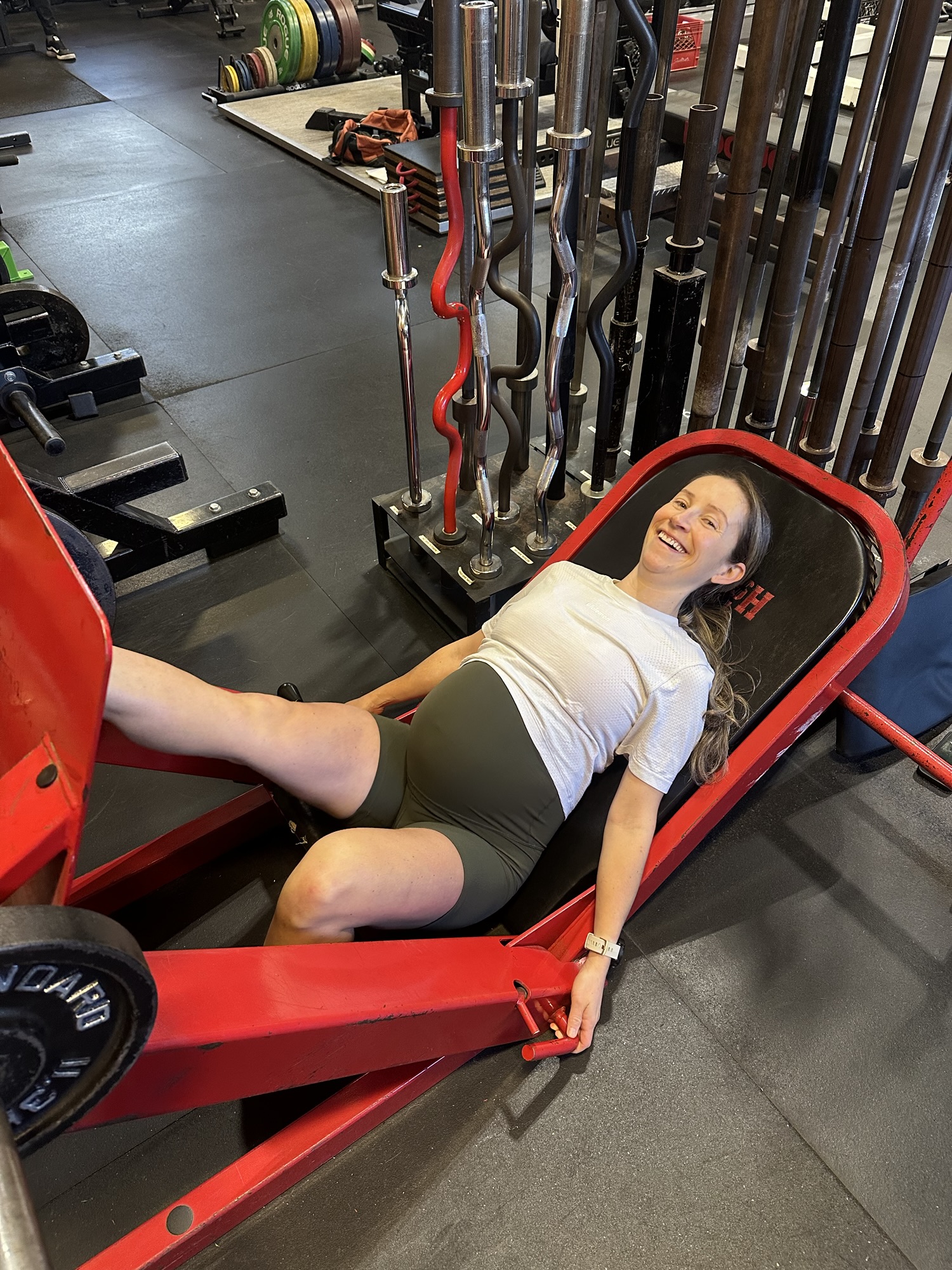
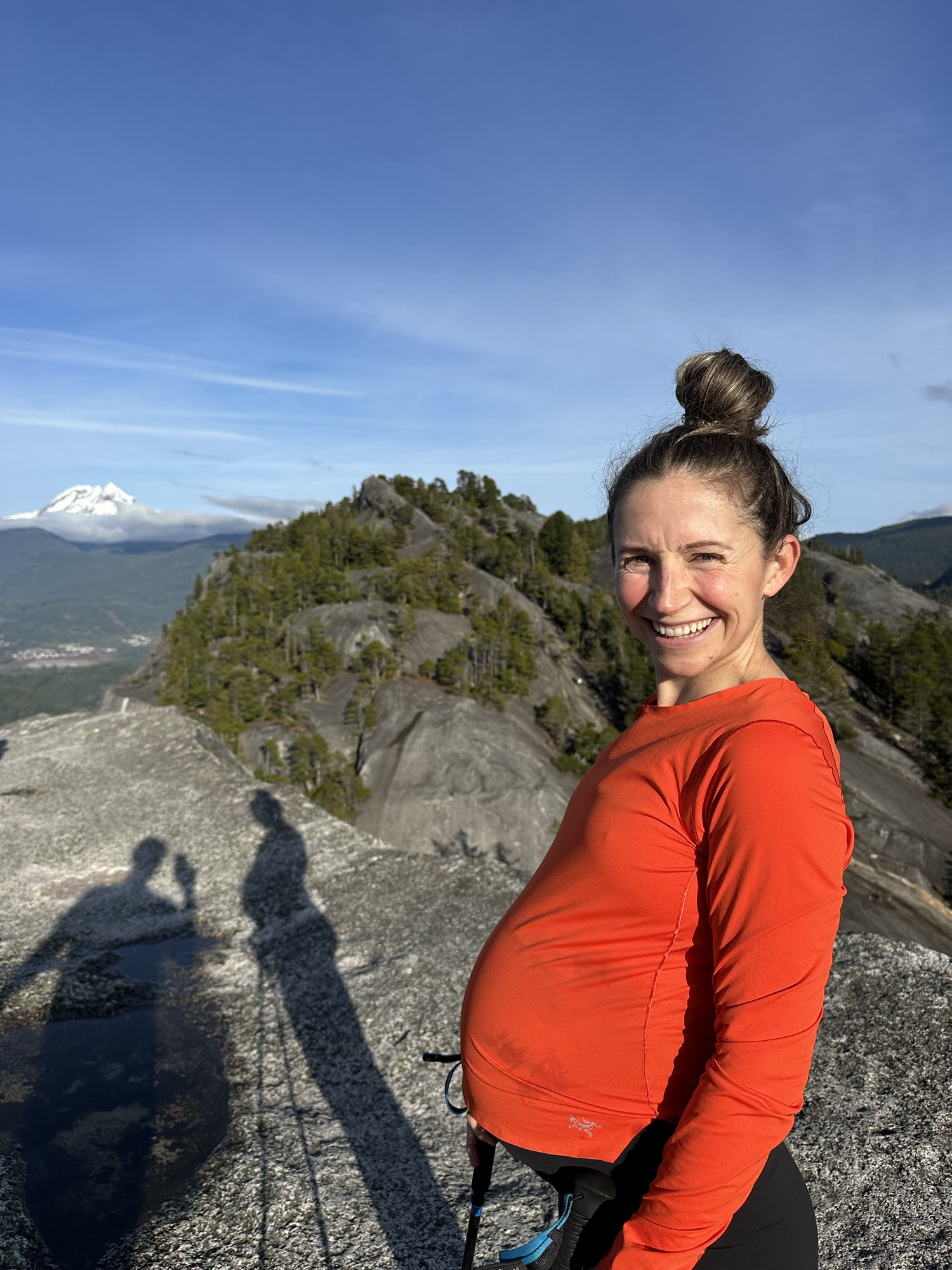
Images: Single leg leg press at Squamish Barbell (Eric Buitenhuis); One of over 50 pregnancy Chief hikes (Eric Buitenhuis); How I always look at the top of the Chief (Sam Schonewille)

But I’m too young to be a mom

One thing I didn’t spend almost any time doing was preparing our house for the baby’s arrival. We got the basics (carseat, bassinet, diapers, burp cloths, Ergobaby Omni 360 carrier, and a few clothes) in the weeks leading up to my due date but didn’t make a nursery (she still doesn’t have a nursery, actually) or get all the baby gear. If this speaks to you, I encourage you to not worry too much about preparing. Get the basics and get the rest on Facebook marketplace, Amazon, or from friends as you need it. We found that we didn’t quite know what we needed until we were in it. Did we feel a little guilty for Priming so much stuff to our house? Yes, but as our midwife said, it takes a village to raise a baby and Jeff Bezos is part of that village. I am glad I spent my time getting outside, reading, and being alone rather than prepping for the baby.

Pregnancy is a great time to double down on any mindfulness practices you may have. I did a lot more yoga, meditation, and breathwork and I believe it helped me a lot in my third trimester, during labour, and postpartum.

I will only say a few things about labour and delivery:

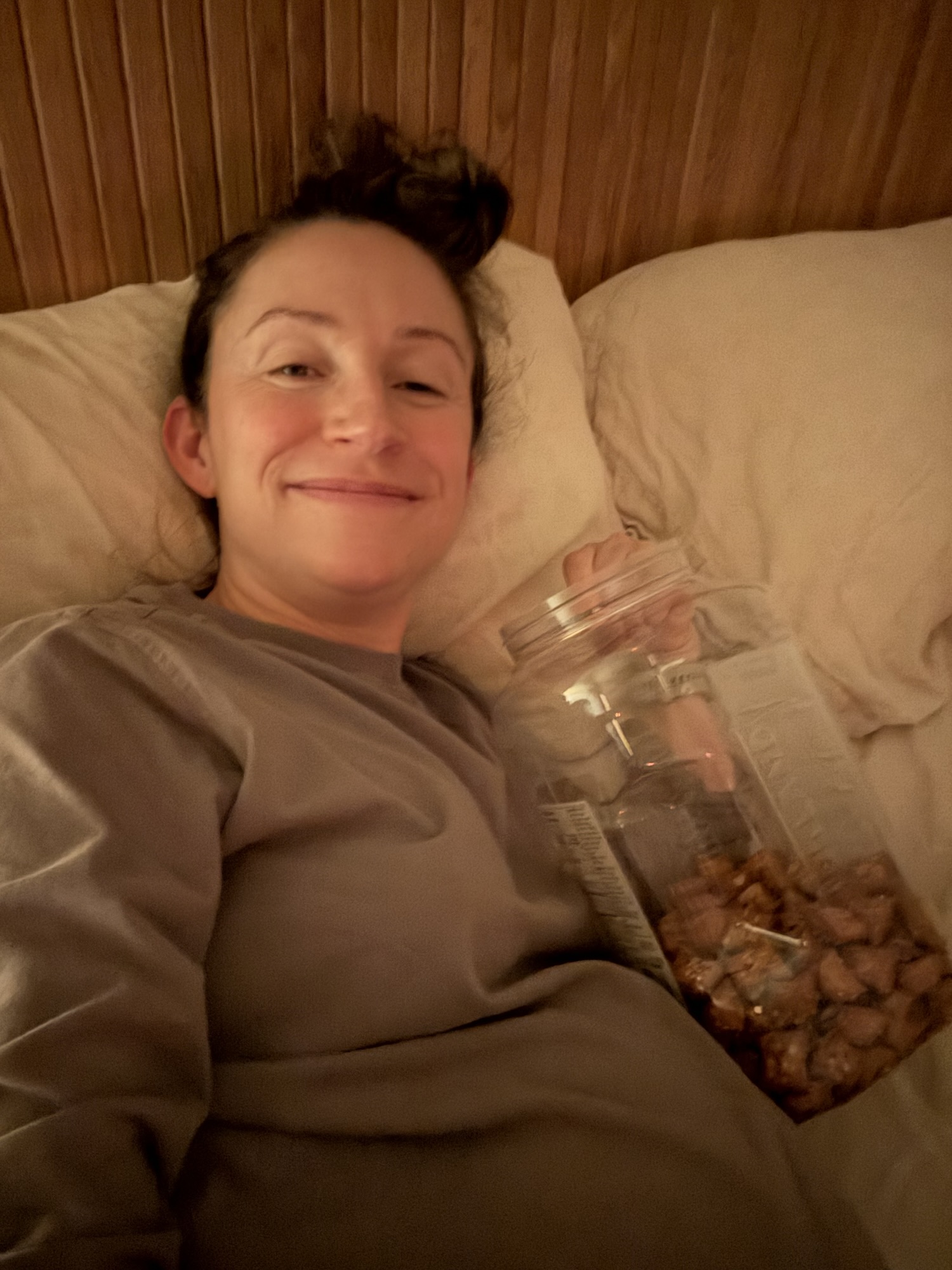
  • Labour is tiring and I found it helpful to fuel like I was racing. Unfortunately I ended up fuelling like I was at mile 90 of a 100 mile race. If you’ve paced someone at the end of a long race, you’re likely familiar with the kind of nutrition negotiation that takes place. The runner becomes a picky toddler who refuses to eat and the pacer resorts to bribes and threats to ensure that the runner doesn’t keel over from hunger or dehydration. Eric did successfully get me to eat Skratch raspberry chews, Precision carb chews, a Maurten gel or two, and several bottles of Precision carb & electrolyte mix. I also ate some peanut butter pretzels in the middle of the night before active labour began.
  • I tried to conserve my energy before labour. This only kind of worked because I wasn’t really sleeping (I went into labour on Wednesday morning and had slept a total of 2 hours in the 48 hours before), but looking back I’m glad I hadn’t also stacked the fatigue of a Chief hike or something similar in the days before labour.
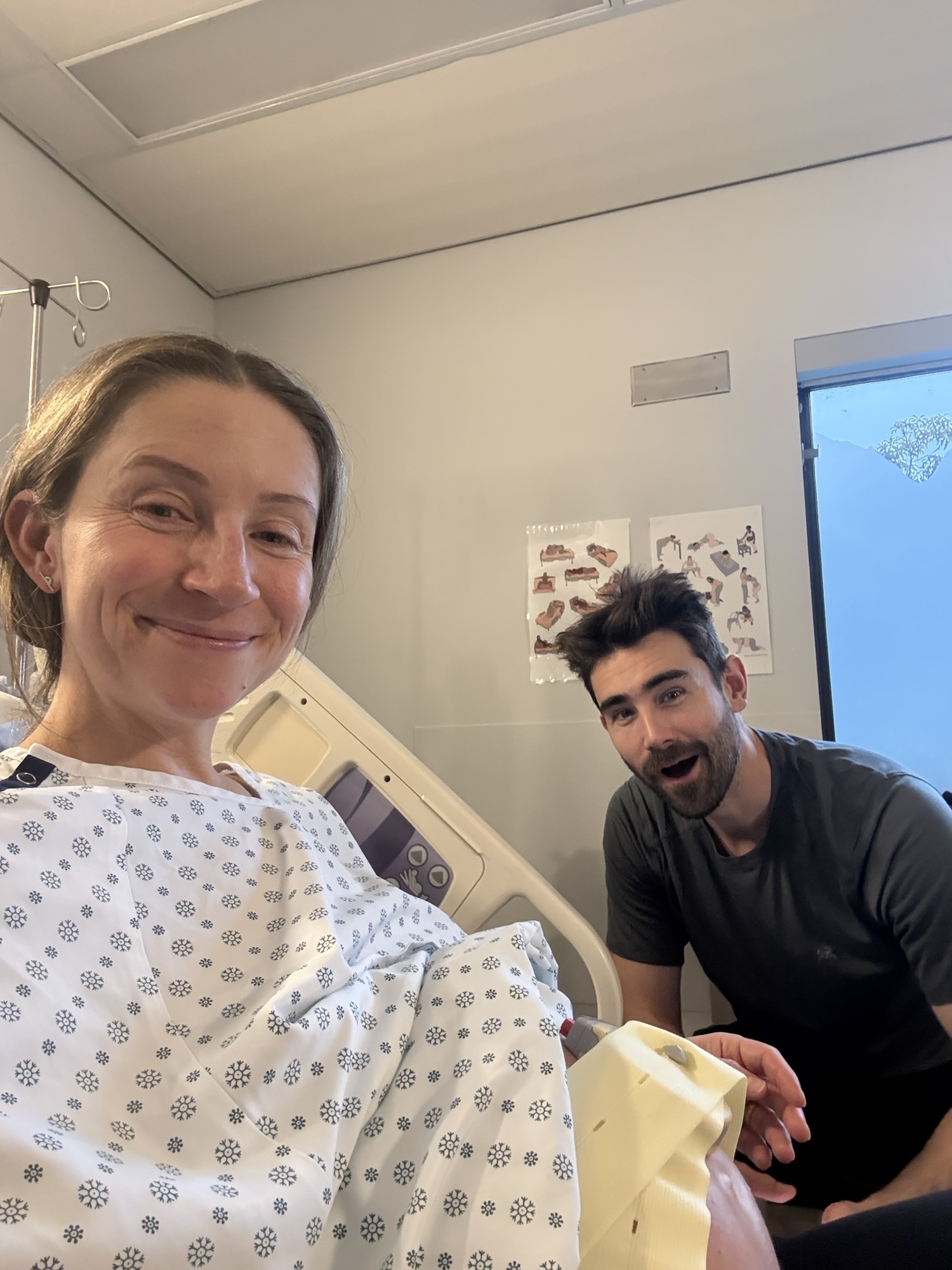
Images: Lots of hospital check ups the week of my due date; Walking while in early labour; Snacking on PB pretzels in bed at 2am just before active labour started.

Takeaways

  • I stopped running when it became super uncomfortable and no longer fun. It was a little sad and I was a little bit worried about taking so much time off, but I think it was worth it.
  • Continuing to hike helped with my mental and physical health until really late in pregnancy. Added bonus of carrying an increasingly heavy load uphill was that my legs were still pretty strong towards the end. I recommend using hiking poles while pregnant.
  • Going to the gym and doing yoga prevented and treated my pregnancy-related pain and made me feel just a little bit like my usual self.
  • Walks: they’re kind of boring, but better than nothing towards the end
  • I hardly slept in the third trimester, and I think this is a common experience. The good news is that I slept quite well within a few days of the baby arriving, despite frequent wake ups.

Looking Back
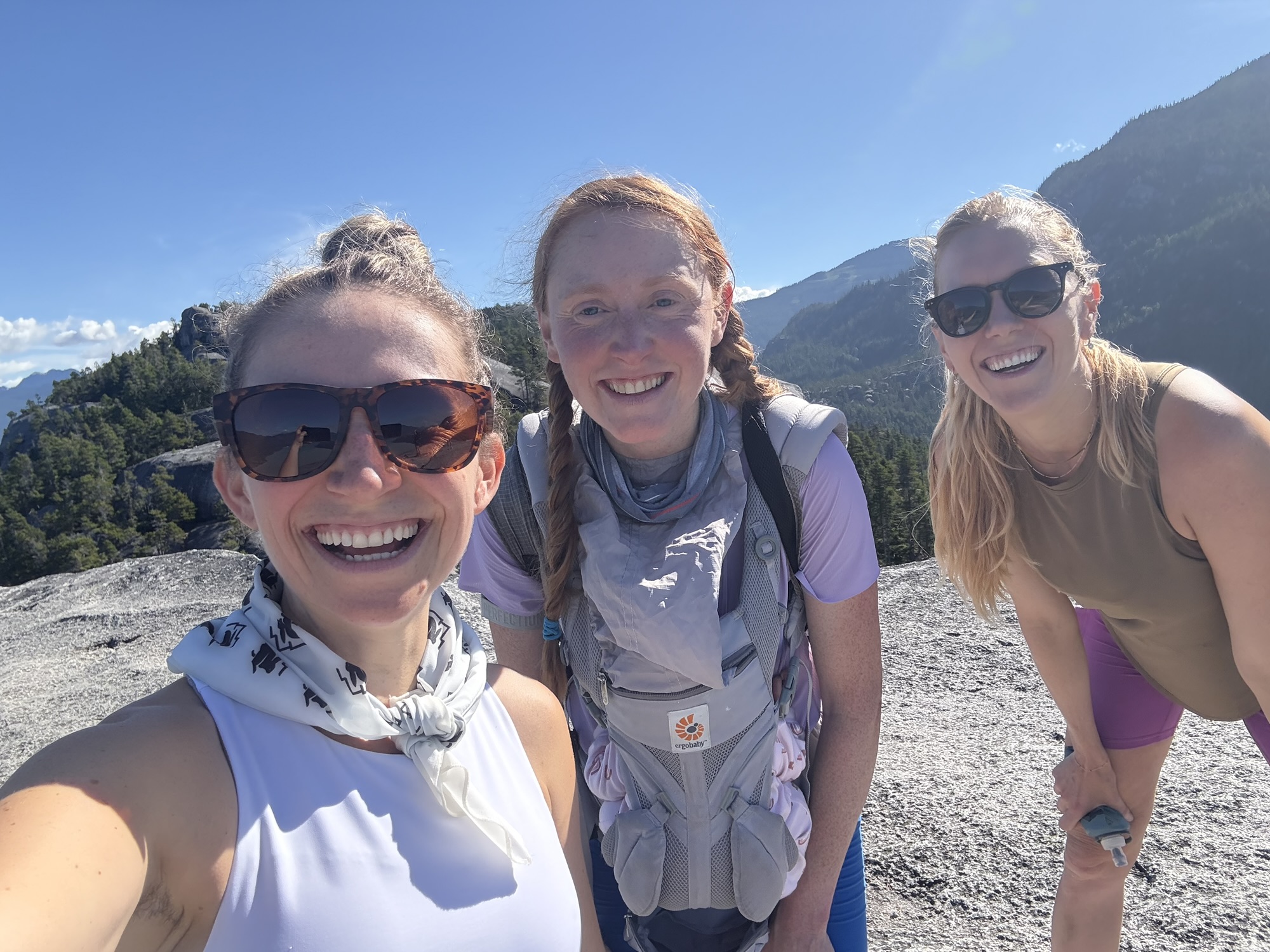
Images: Claire and I in our second trimester, Alicia in her 4th; Pregnant shuffle out to Opal Cone with Jackie; Alex & I doing 3-2-1 for probably the 3rd time that week.

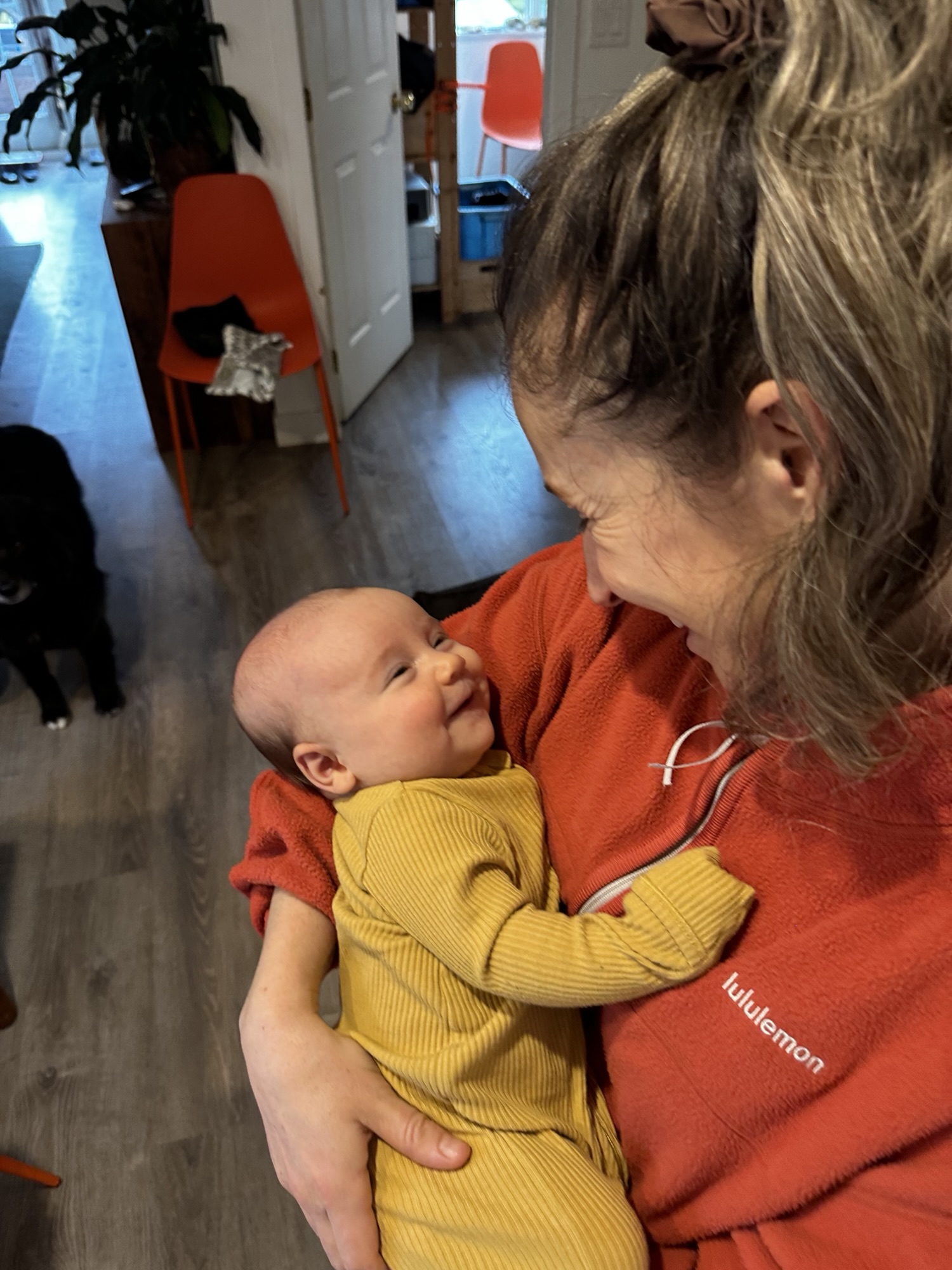
As we have established, I did not enjoy pregnancy. The good news is that I am loving parenthood. It has been an exceptionally joyful and fulfilling experience so far. I started to feel better immediately after giving birth and have been on a steady upward trajectory ever since. More to come in a future post about postpartum recovery, but for me, the ‘fourth trimester’ has been by far the best.

A quick summary on how I “listened to my body” to personalize my own pregnant athlete journey:

  1. The 15-minute rule: Give it a shot for 15 minutes and call it if you feel like crap.
  2. Contingency plans: Plan fun things but also plan easy escape routes just in case.
  3. Watch for red flags: New or unusual pain, back pain, leaking (from anywhere except maybe your eyes), pelvic floor heaviness, RED-S symptoms.

This post was long as hell, but if you’ve made it this far, I’ll summarize my main takeaways from pregnancy for you:

  • I was lucky to be able to stay active throughout my entire pregnancy. It made me feel better and I think it made my labour, delivery, and recovery easier and smoother.
  • Maintaining strength by going to the gym frequently helped a lot with back pain and general discomfort. I think it also helped me in the pushing stage of labour.
  • I worried a bit throughout pregnancy that I would lose all of my fitness and struggle to get back to sport. I’m certainly less fit than normal right now but it isn’t nearly as bad as I worried.
  • I’m happy I still made ambitious plans, travelled, and got out there during pregnancy. It was (mostly) enjoyable at the time and it’s fun to look back on all of the places I took my baby before she was born.
  • It was all worth it.

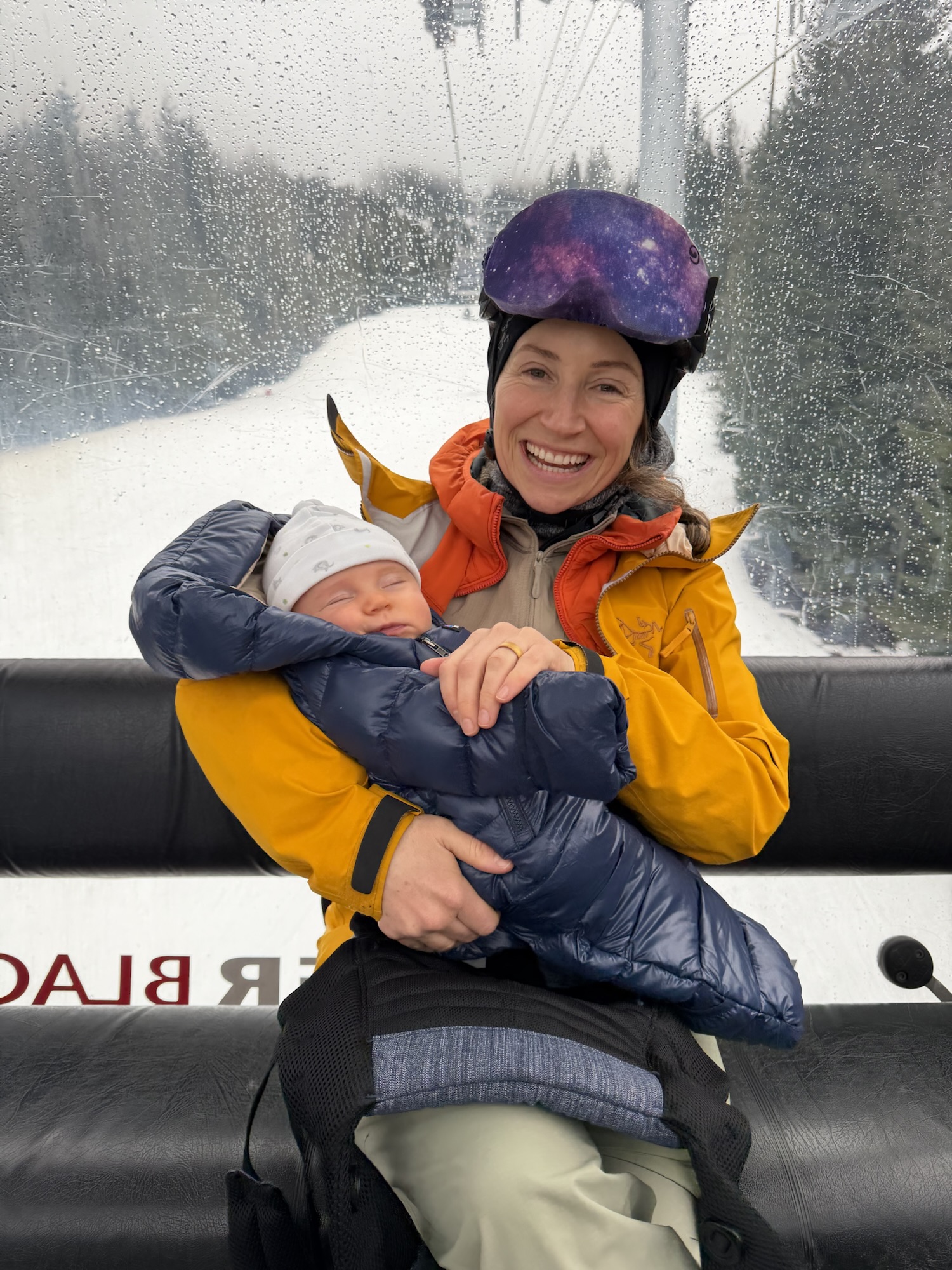
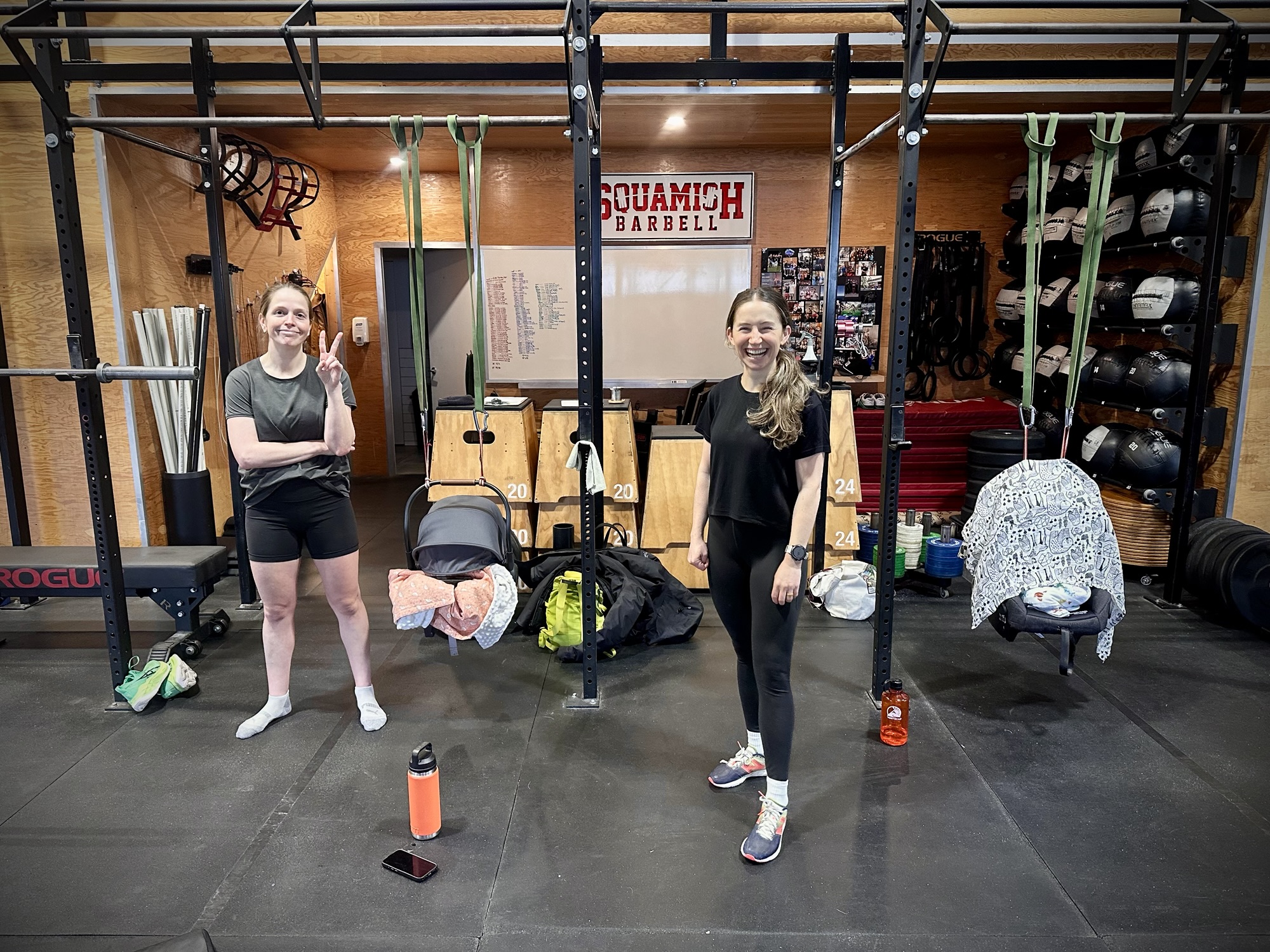
Images: Worth it for the smiles (Eric Buitenhuis); Family ski days (Eric Buitenhuis); Lifting stuff with the babies (Sabrina)

Timeline of Milestones & Activities

  • April 4 (4 weeks): Positive pregnancy test
  • April 21 (6 weeks): Last ski day (but this is pretty close to end of ski season anyways)
  • June 7 (13 weeks): Start of second trimester
  • June 15 (14 weeks): The one day I felt great
  • August 14 (23 weeks): Last mountain bike ride
  • Sept 1 – 7 (25 weeks): Fastpacking the TMB
  • September 13 (27 weeks): Start of third trimester
  • September 26 (29 weeks): Last run
  • October 30 (33 weeks): Chief round trip approx 1h40 (twice as long as normal)
  • December 4 (38 weeks): Last time at the gym
  • December 6 (39 weeks): Last Chief hike
  • December 13: Due date
  • December 17: Baby’s birthday
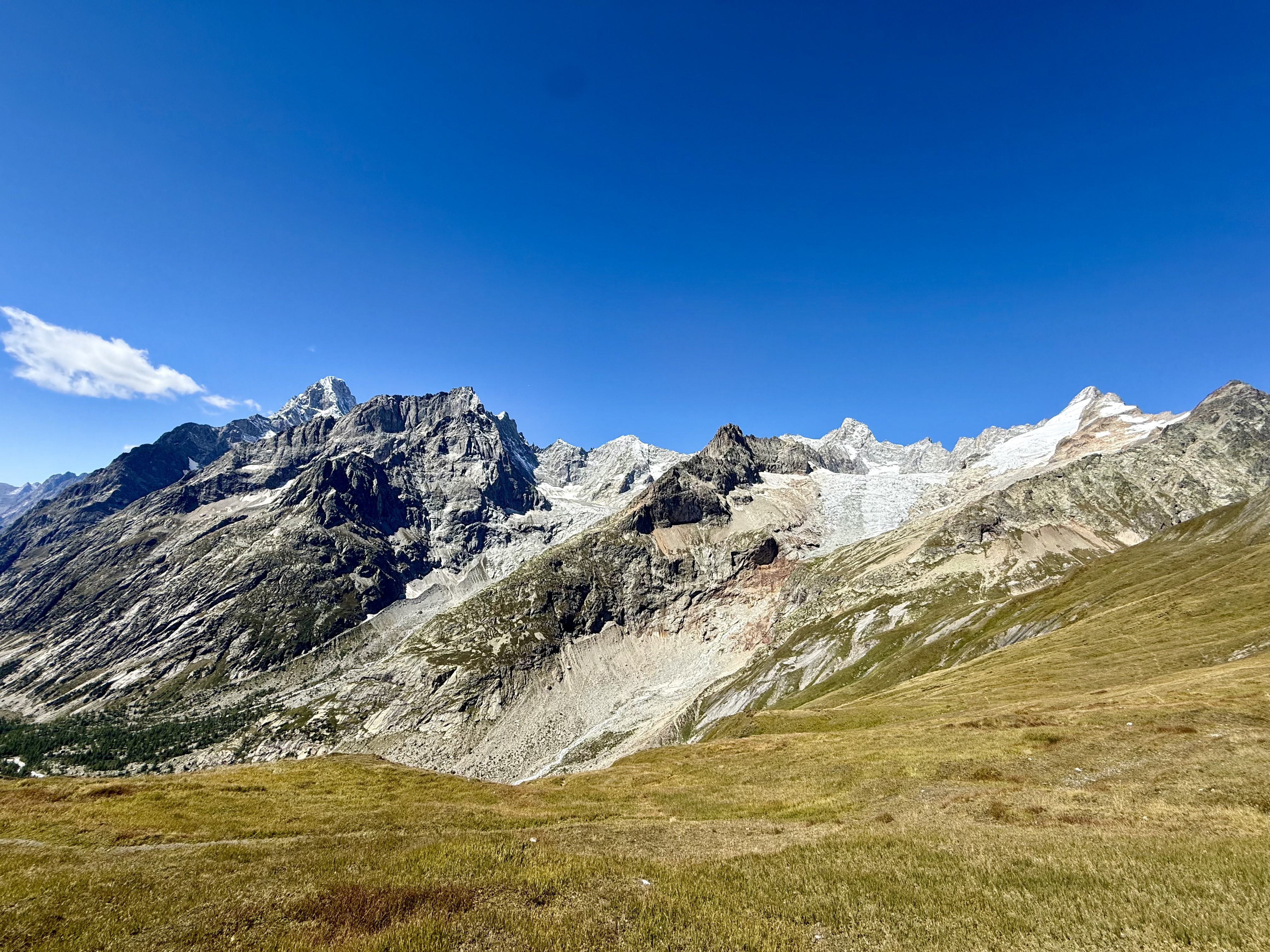
Tour du Mont Blanc: Hiking for Two, Crying for Two

September 2025

Note: There is very little information about how to be a pregnant athlete. Everyone has a different experience with pregnancy. By sharing this information my intention is to be transparent about my experience in the hope that it helps other pregnant athletes. Also note that this post has a negative tone because I wrote most of it while pregnant. I kept the tone negative because that was authentic to my experience of pregnancy.

I’ll share a post soon summarizing my experience with pregnancy & sports overall.

Background

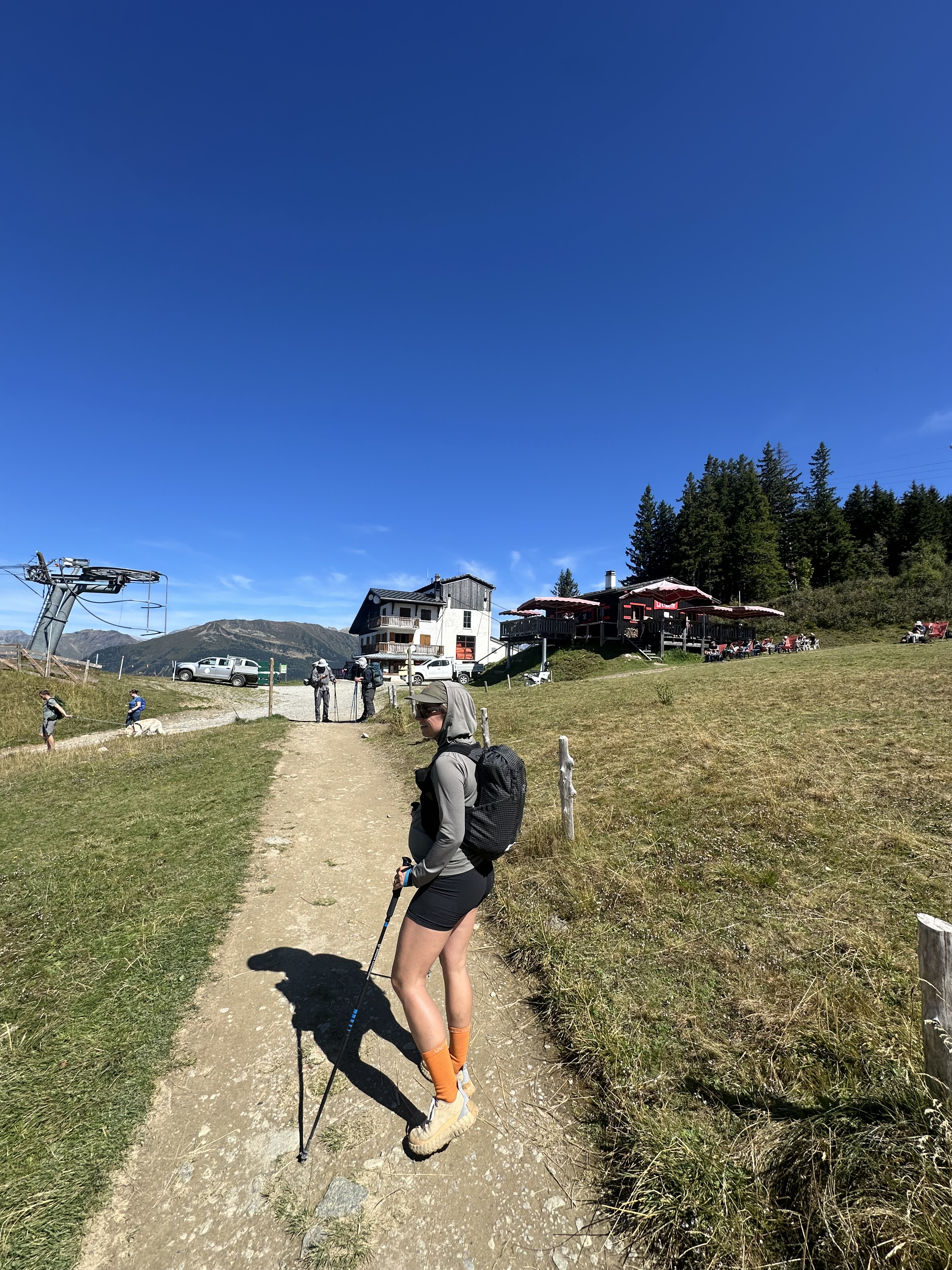
One of the races I was registered for in 2025 was Ultra Trail du Mont Blanc (UTMB) 100 mile. I won an entry into UTMB at Kodiak in 2024, and UTMB would have been my second 100 miler. However, life had other plans for me and by the time UTMB rolled around I was 6 months pregnant and mostly unable to run. I deferred my entry in June when I entered my second trimester but we decided it would still be fun to go to Europe for two weeks around the time of UTMB and try to fastpack parts of the Trail du Mont Blanc (TBM), the 175-ish km course around Mont Blanc that makes up the majority of the UTMB course.

For context, I had a low risk pregnancy but suffered from nausea from week 5 to week 38. This is within the range of normal but pretty unlucky. I also had fatigue, food sensitivities and aversions (including strong aversions to cookies and butter 😥 ), and pelvic pain in my first trimester. I had a few nausea free days in my second trimester but it came back almost full force in my third, along with congestion, heartburn, insomnia, restless leg syndrome, and more pelvic pain. Pregnancy is certainly the least enjoyable endurance event I’ve ever participated in, and unfortunately also the longest. Mercifully, one of the only things that helped me feel better was exercise, including hiking, skiing, running, gravel and mountain biking, yoga, and the gym.

When I planned this trip in June 2025, I had us doing the entire TMB over 7 days and I envisioned us running the route (slowly). However, by the time September rolled around I was TIRED. We had a few fun outings in Chamonix (Aiguilles Crouches, Via Alpina, La Jonction) but I had to take multiple rest days after each, which is unusual for me. Also, running became pretty uncomfortable for a few weeks starting the week we got to Chamonix (I was getting round ligament pain which is an uncomfortable sharp pain in the belly that only goes away when you stop running. Pregnant people will be familiar with this cursed feeling). As a result I was mostly hiking instead of running, which made everything slower than I’m used to, and I felt that 20-30km days on the TMB might be both too hard and too slow for me. I should also mention that I am NOT a hiker. The last time I did a multi-day hiking trip was in 2009 when I hiked the West Coast Trail. All of this meant that we needed to shorten our TMB route a little. Audree and Jeff gave us some advice about which portions of the TMB would be best to skip and which shouldn’t be missed, so we did a bit of tentative contingency planning before leaving which came in handy later.

Day 1: Into the Mist

Bus from Chamonix to Le Tour, Le Tour to Col de Balme hut

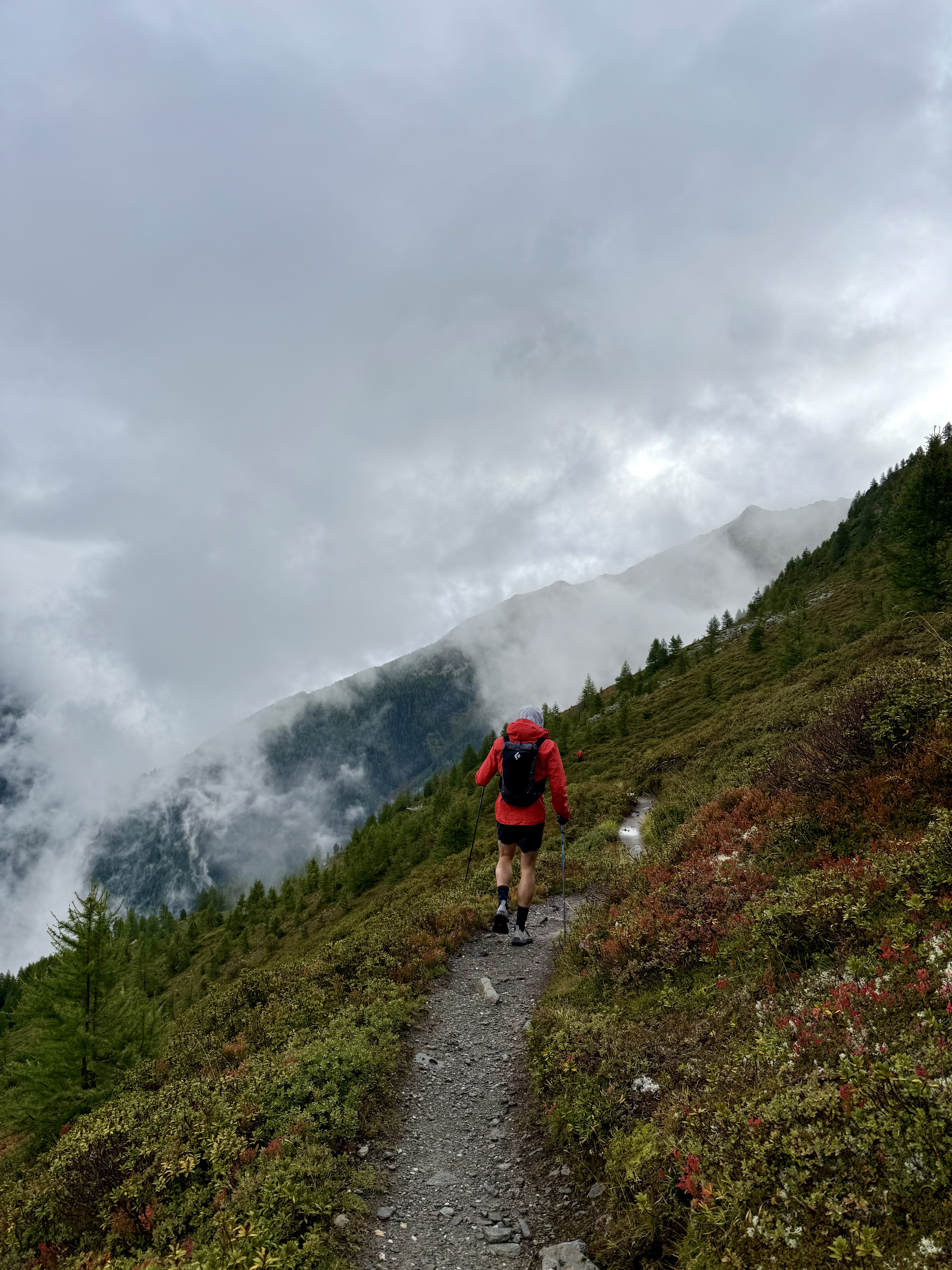
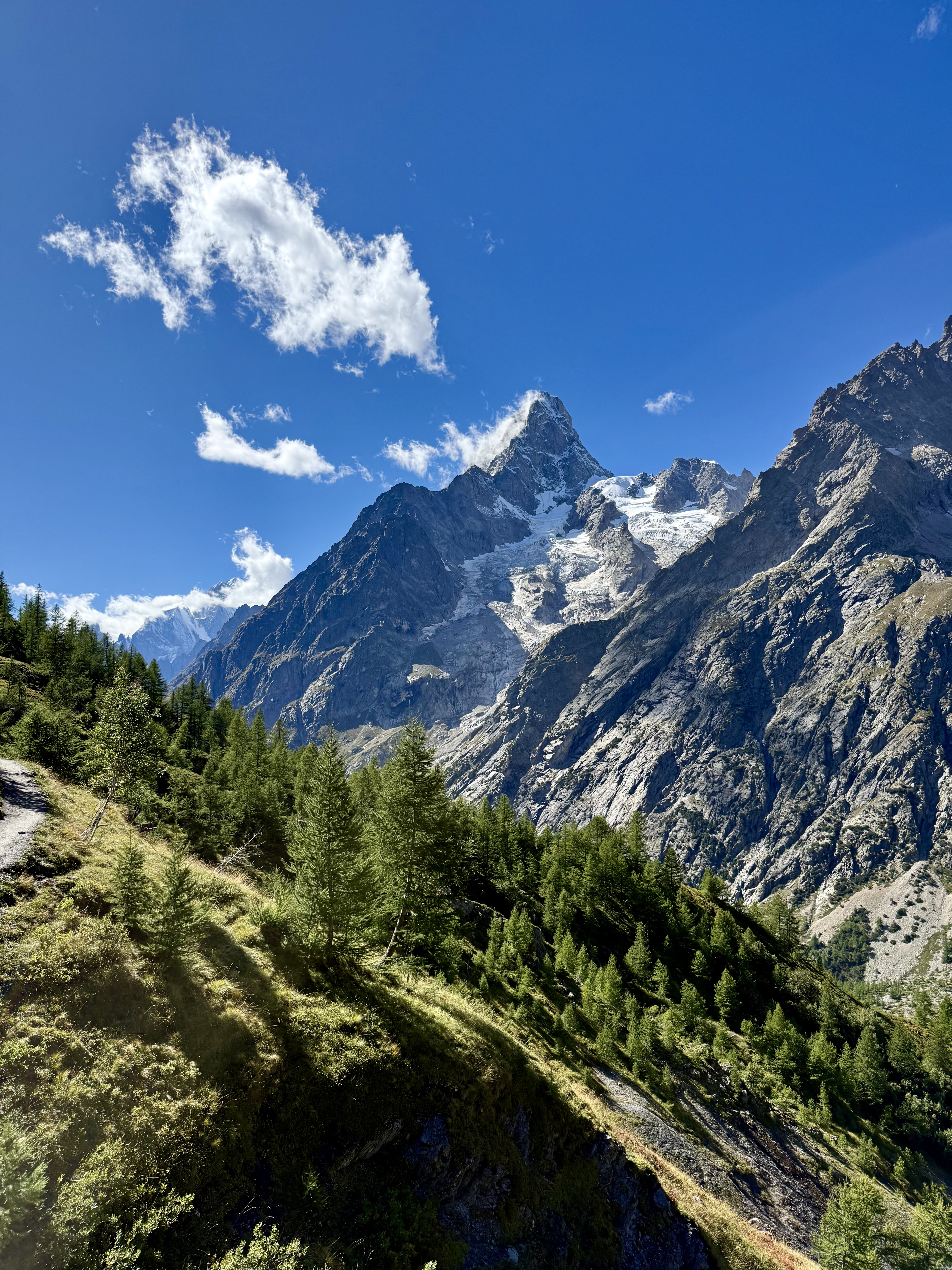
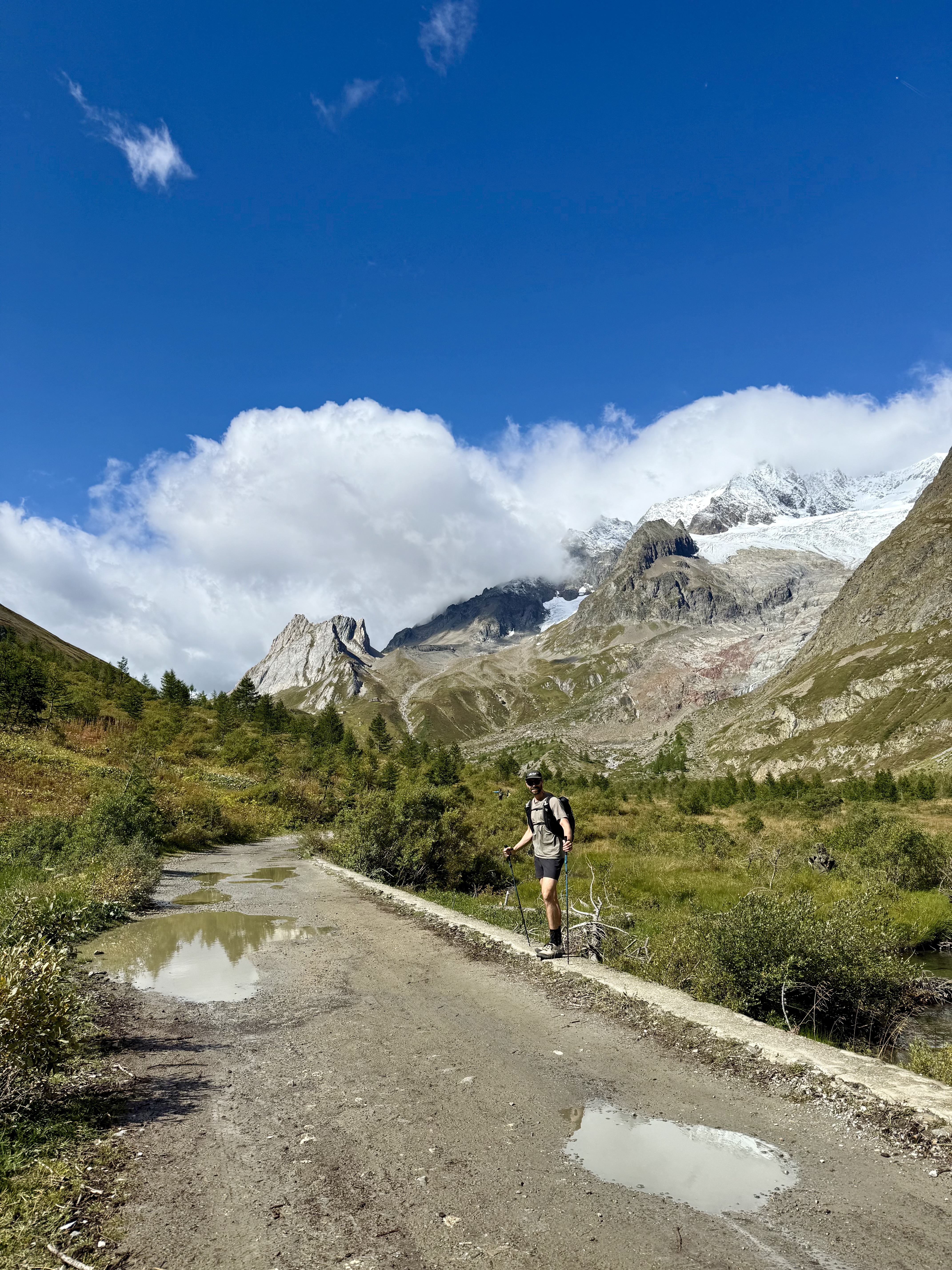
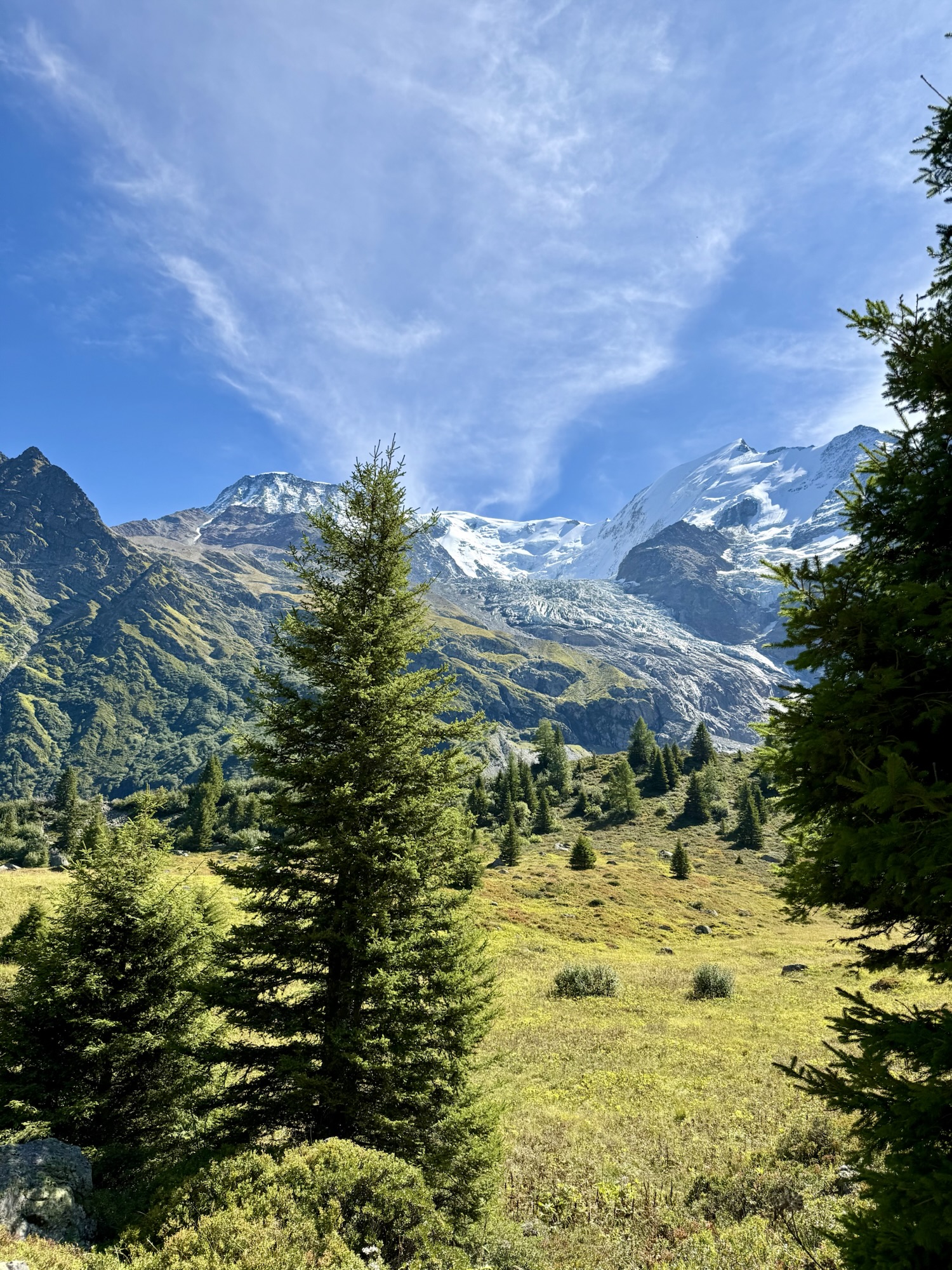
The first day was about 8km through mist, fog, and clouds from Le Tour to Col de Balme. We got a few glimpses of the mountains around and the views would have been stunning in better weather. Not too much to say about this day except that the trails looked exceptionally runnable and I attempted a few minutes of lumbering whale-jog before calling it and accepting my fate as a pregnant hiker.

Col de Balme is a beautiful refuge just barely on the Swiss side of the France-Swiss border with 30 or so beds in dormitories. The hut was fully booked and the staff turned down requests from several campers to stay indoors when the weather started to get bad in the evening (incidentally our dorm room had 4 extra beds, so the hut custodian may have just been trying to keep the loud and fairly drunk campers out of the hut). We had a dinner of chilli and went to bed pretty early. Sleeping on a 1000 year old bunk bed in a too-tight sleeping bag liner at 2000m while pregnant was hard, and I only got a few hours of sleep, but despite this, I thoroughly enjoyed my first refuge experience in the Alps.

Day 2: Oh fuck, chilli again?

Col de Balme to Champex-Lac via Fenetre d’Arpette

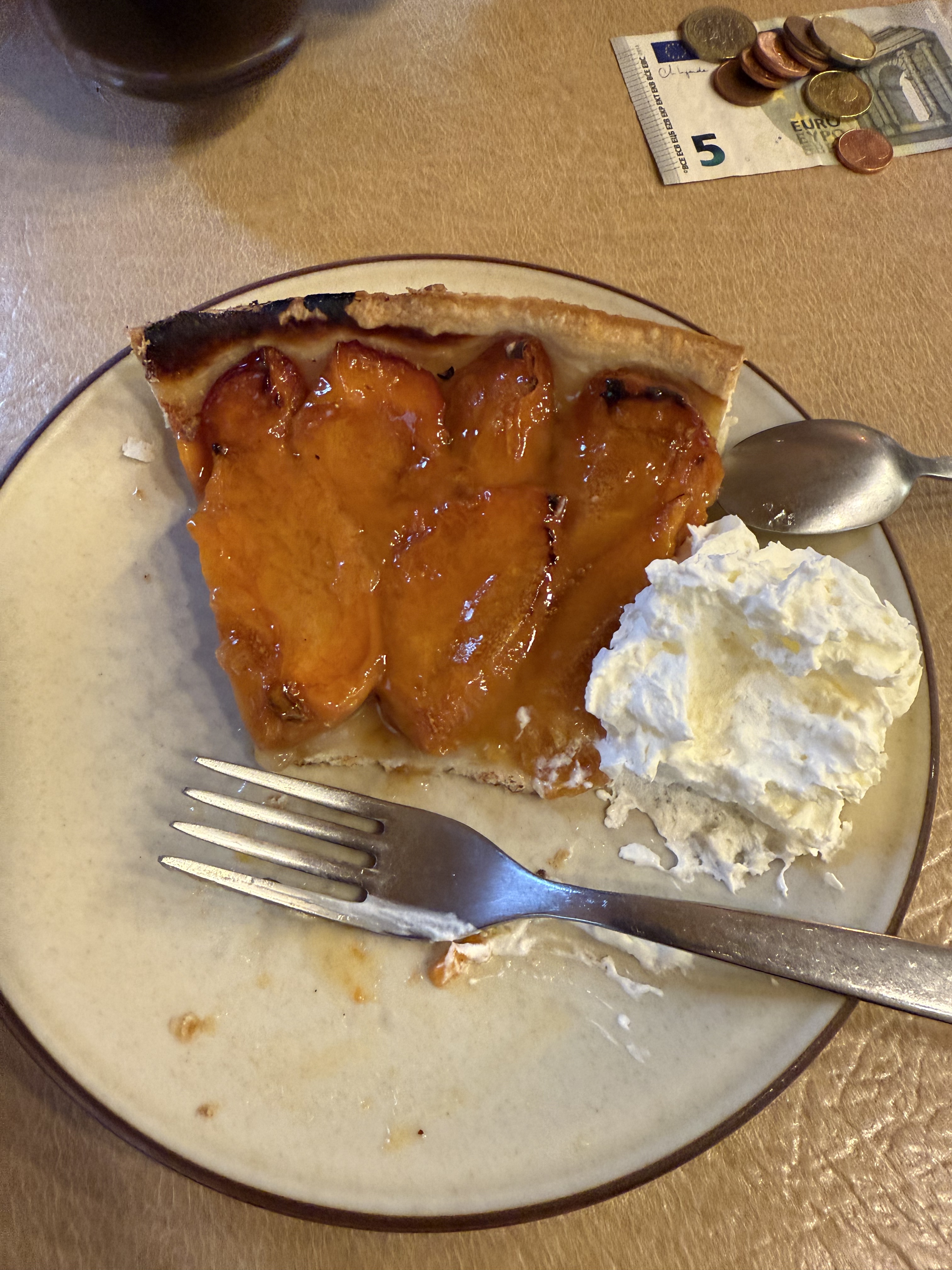
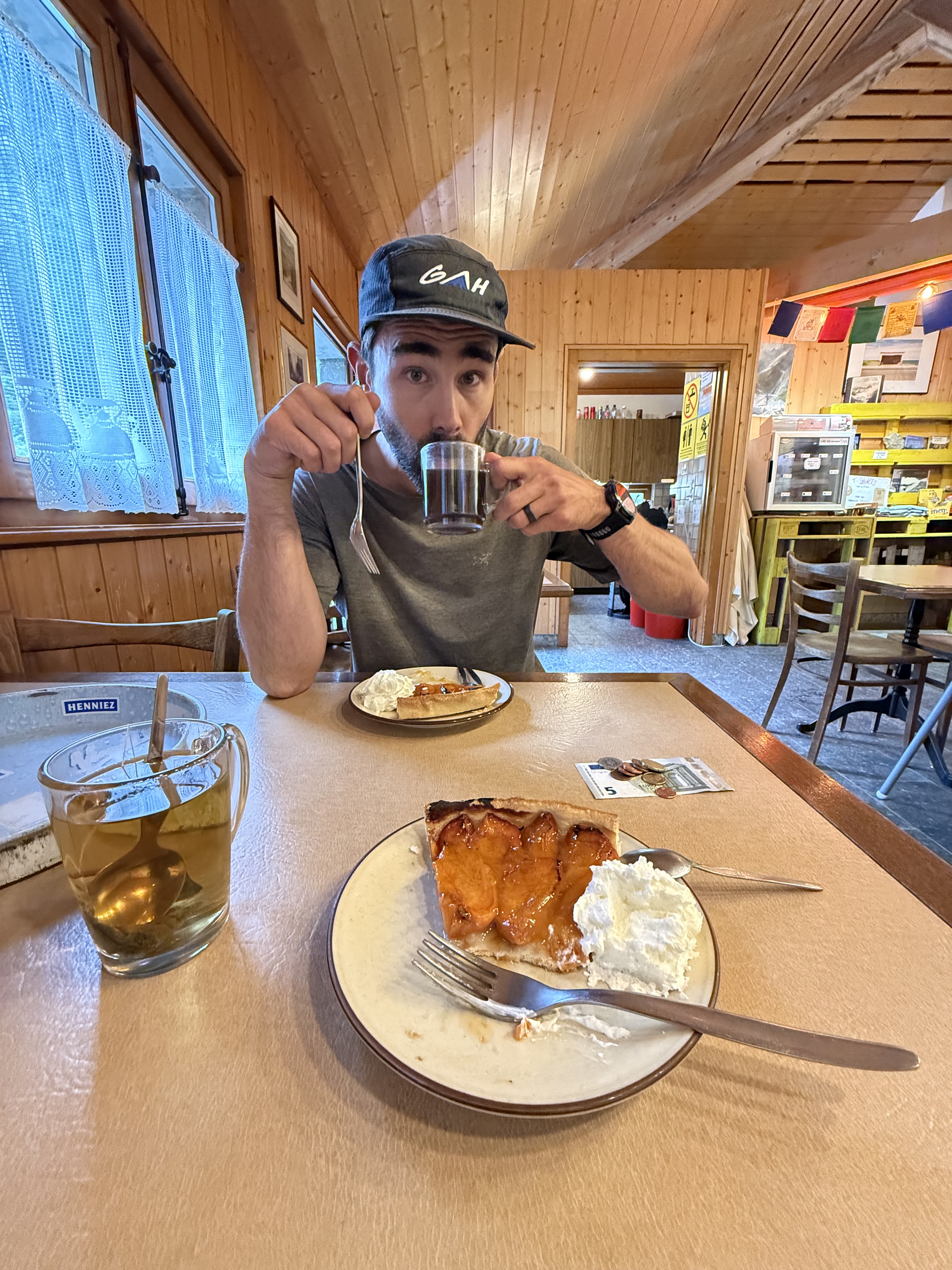
The next morning weather was better and we decided to take the Fenetre d’Arpette route through the mountains instead of the regular TMB, on the recommendation of the hut custodian. It was a bit shorter in distance but more technical and with better views of nearby glaciers. To get there, we descended into a valley (where we had an excellent slice of peach pie) and then out the other side, beside a big glacier. Weather was a bit mixed with some rain and snow near the pass, but overall pretty good. We arrived at our next refuge, Relais d’Arpette, midafternoon and enjoyed cold beverages and board games (we brought Quoridors, a fun and portable board game made locally in Squamish, gifted to us by our friends Myrika and Vincent) until dinner. We were surprised to once again be served chilli for dinner, and I secretly started to grow weary of the food in Switzerland (though they partially redeemed themselves by also serving picked beets in the salad, anything pickled being the key to my heart while pregnant). Relais d’Arpette was one of the few huts that still had availability when I booked in June, and a private room with a ‘private’ (but shared with the other rooms nearby?) balcony was over $400CAD per night. The private rooms had great showers and comfortable beds. Once again, my poor pregnant body resisted all attempts at sleep.

After only two days on the trail, I was already totally cooked and decided we needed to activate one of our contingency plans. We decided to cut out most of the section between Champex-Lac and La Fouly and head for Courmayeur, since we knew it was mostly valley walking. I was pretty over the Swiss cuisine (chilli??) we’d experienced so far, as well as the exchange rate.

Day 3: Crying in Switzerland

Champex-Lac to Issert, bus from Issert to Ferret, Ferret to Lavachey, bus from Lavachey to Courmayeur

On day 3, we left Relais d’Arpette early and walked down the TMB towards Champex-Lac and then a small town called Issert. We briefly crossed the Swiss Peaks 360 course and encountered a few utterly wrecked runners. We had to wait for about an hour for the bus so we paid $50 for some bad coffee and sandwiches and then walked through town to the bus stop on the far end of town. (The Swiss bus system caused us a bit of stress because we weren’t able to buy tickets online or in store, and couldn’t find much information about them. In the end, we were able to pay for our tickets on the bus with credit card.) I cried from fatigue and frustration as we walked, generally sick of being pregnant, done with eating chilli for dinner, and tired from not sleeping well from a combination of restless legs, heartburn, and being the size of a small whale. Though it was a perfectly sunny day, rain fell on us from the cloudless sky while we walked to the bus stop.

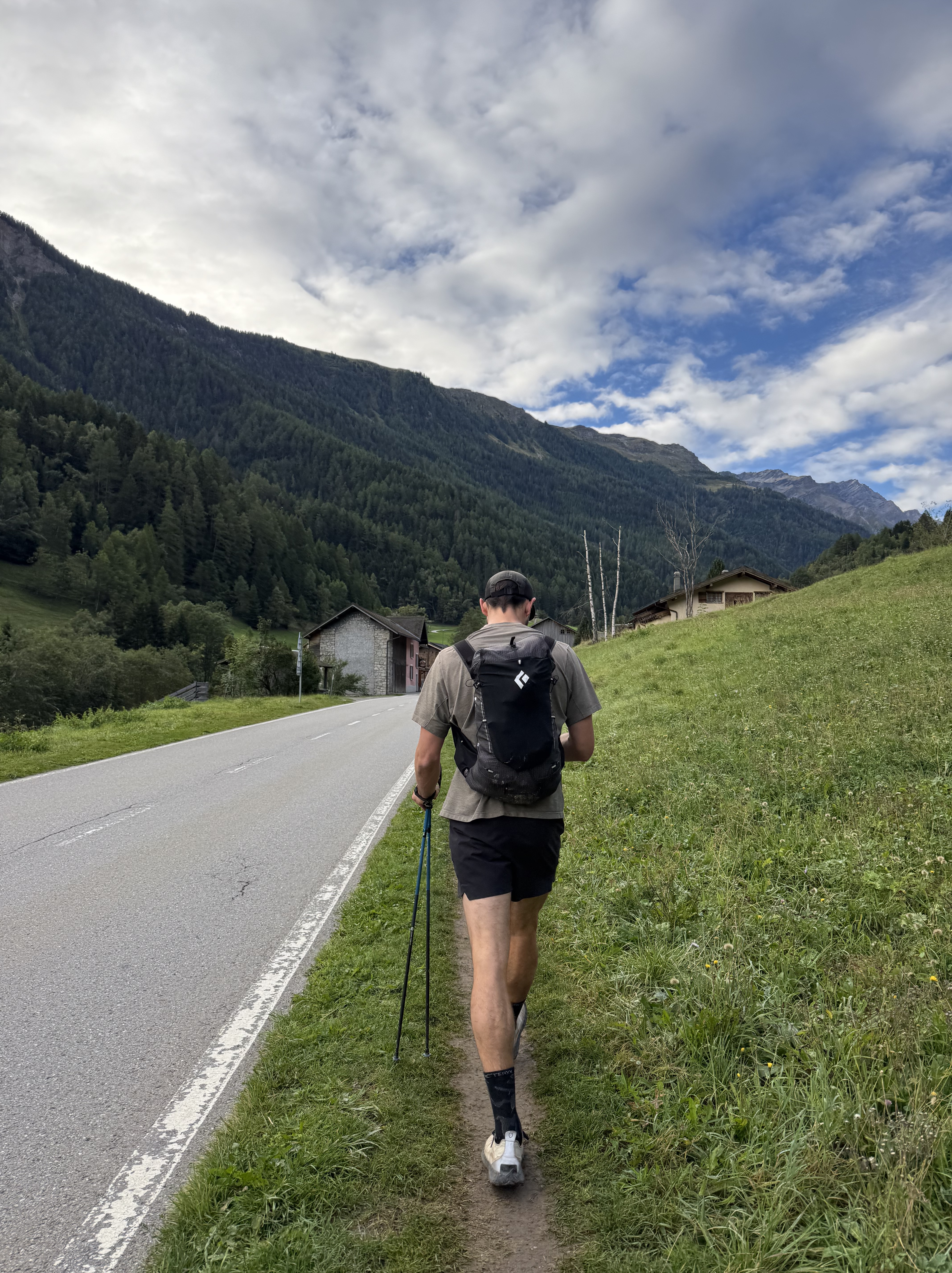
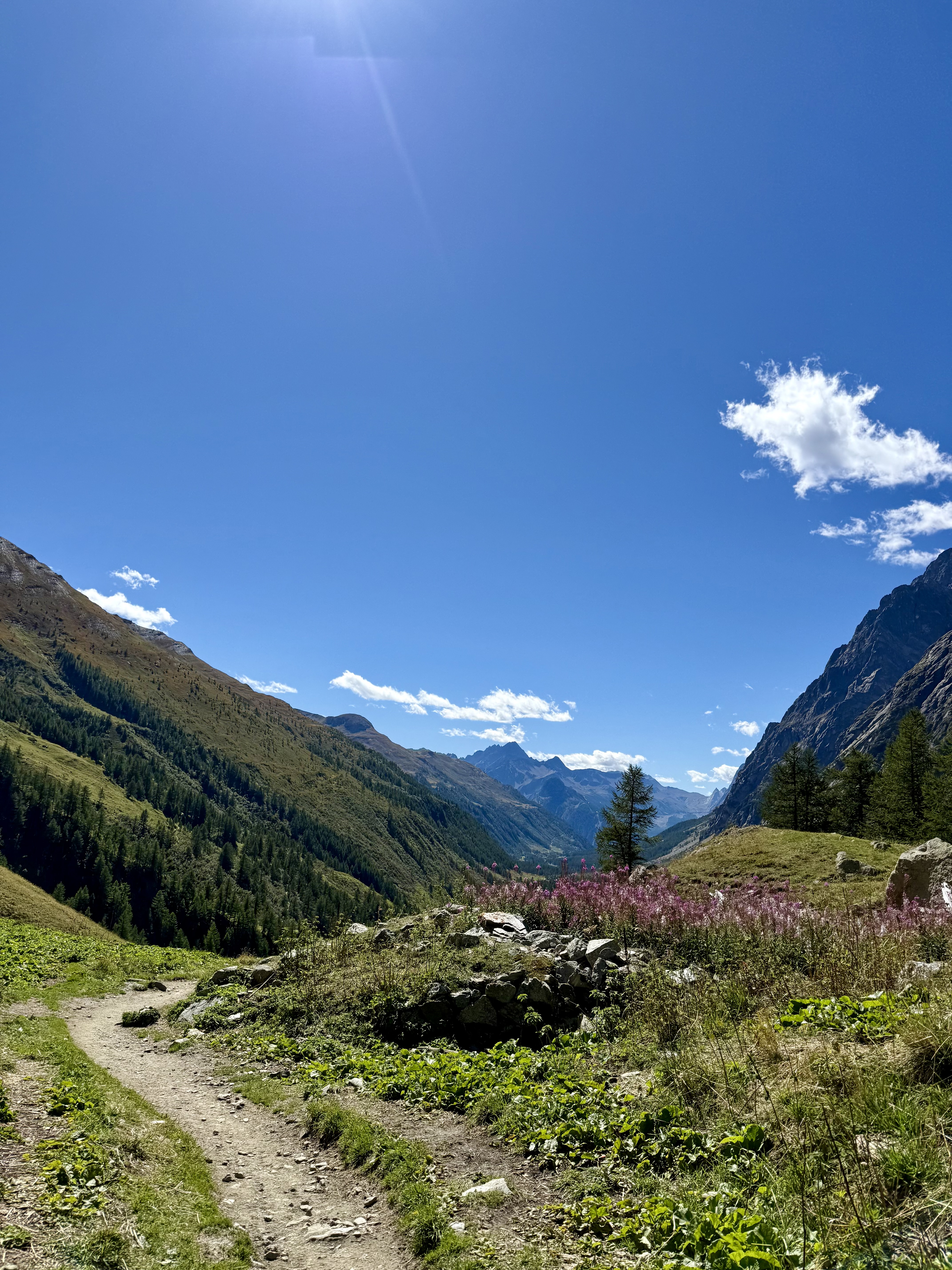
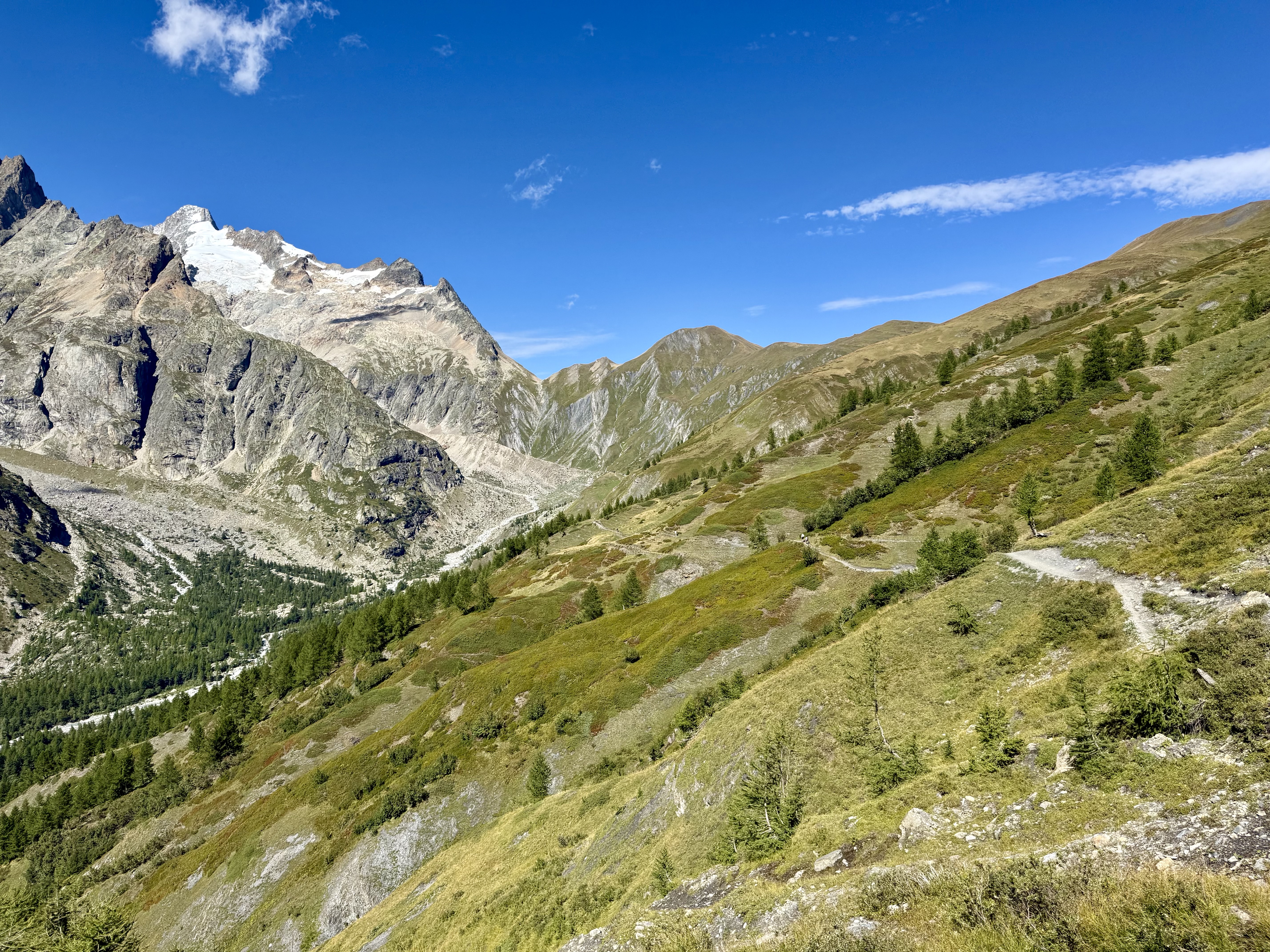
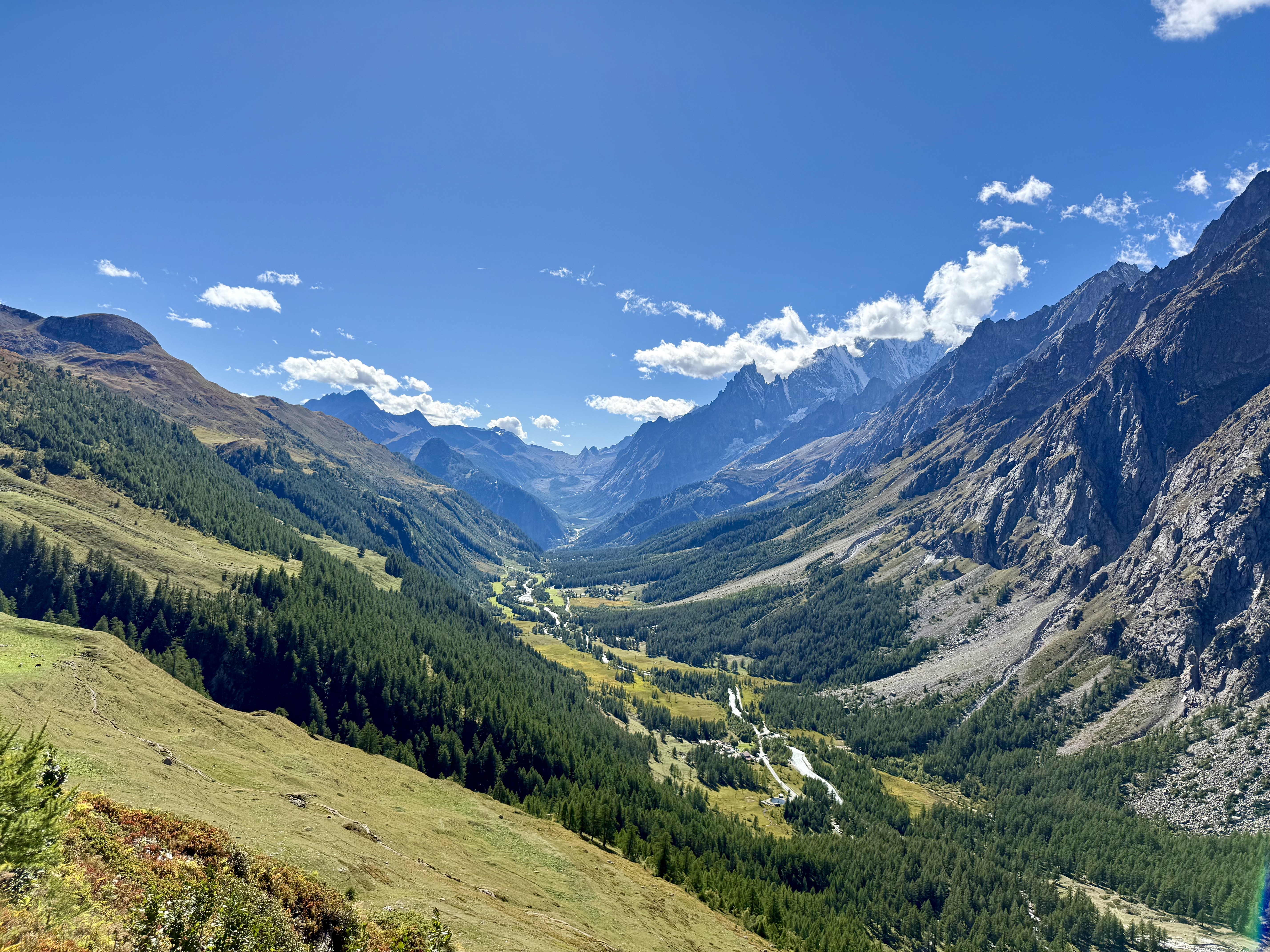
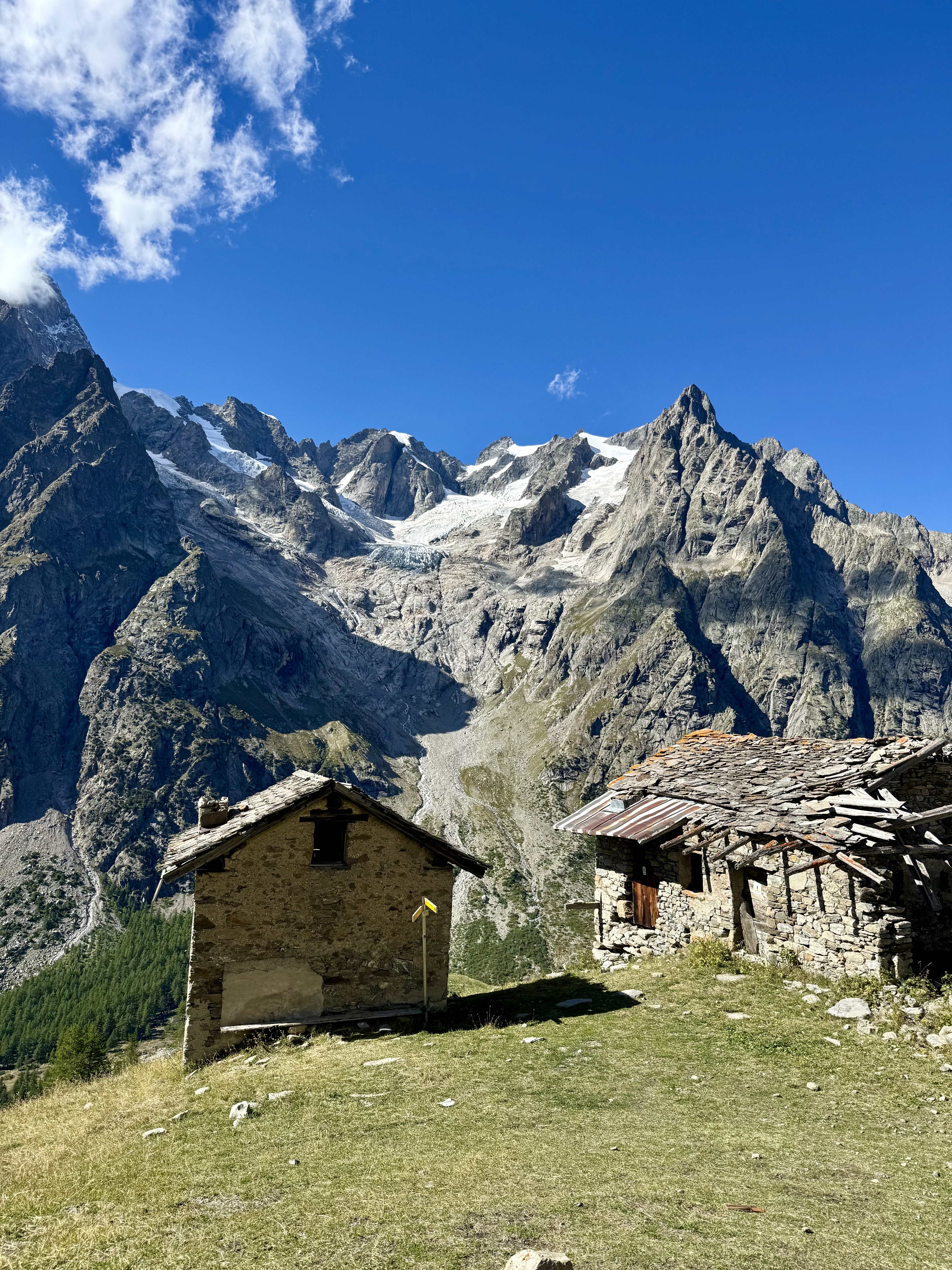
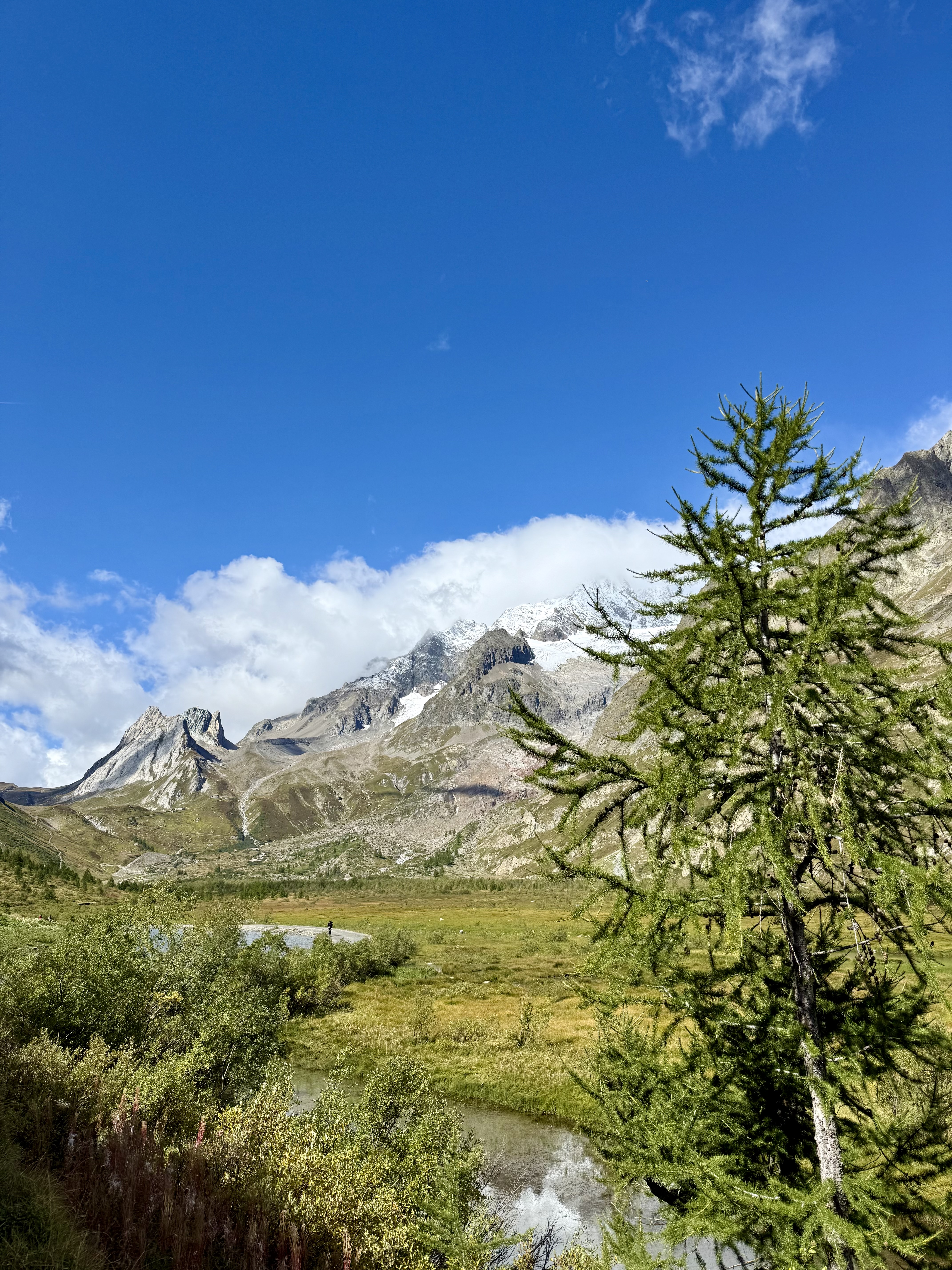
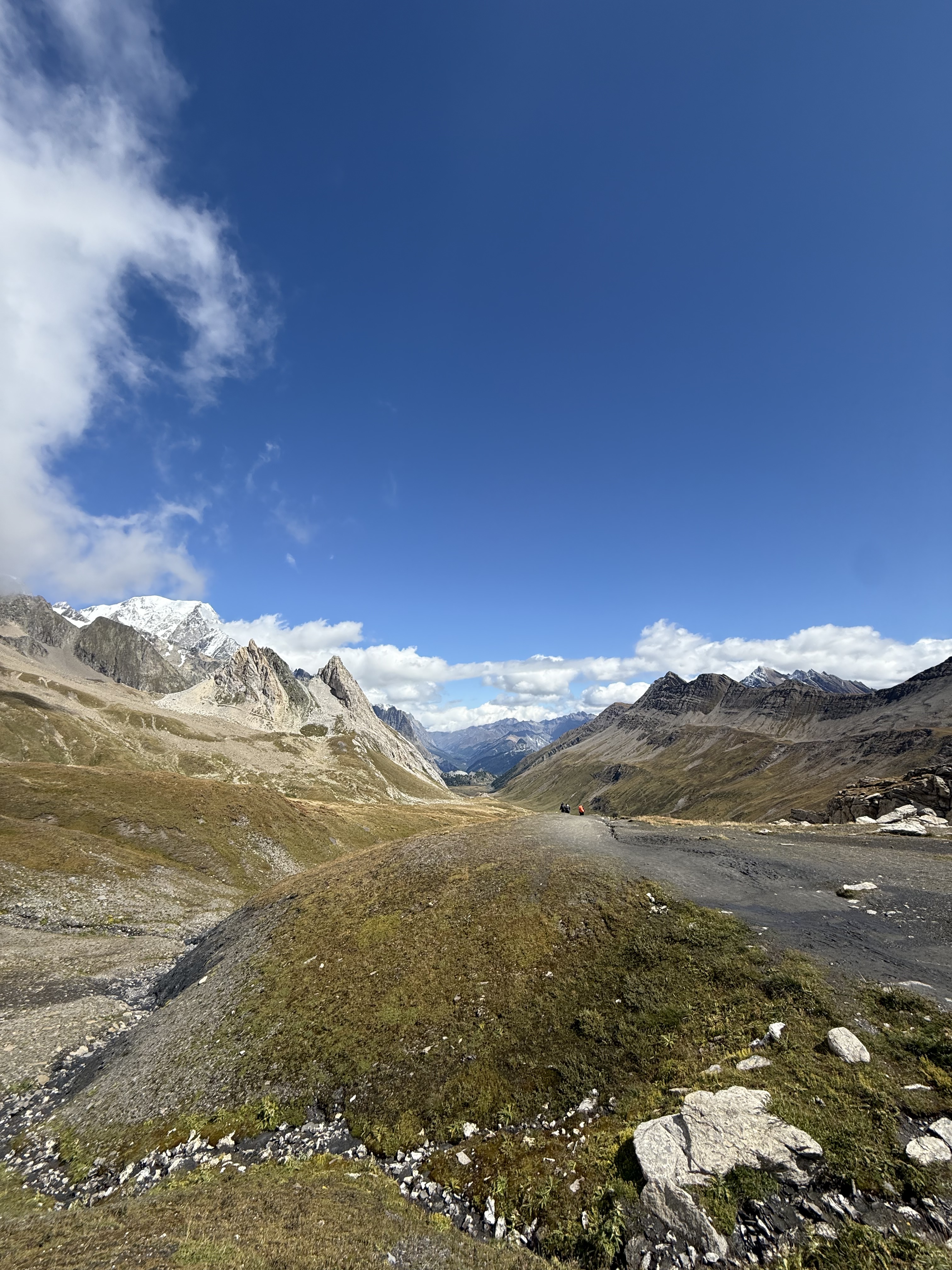
The bus took us a few stops past La Fouly to Ferret, and we began to hike uphill through cow pastures towards Grand Col Ferret, where we got our first view of the Italian side of the Mont Blanc (or Monte Bianco, at that point) massif. As soon as we got to Italy the people were friendlier, the food tastier, and the views better. This was one of my favourite sections of trail and I soon forgot my dramatics from the morning. I can’t wait to run here in the future, the trails are smooth and flowy and the views are some of the best I’ve ever seen. We stopped at a refuge or two for snacks and espresso and eventually made our way down to Lavachey where we caught a free tourist bus to Courmayeur. I couldn’t recommend this section enough and will definitely return here.

Day 4: The best breakfast buffet of my life

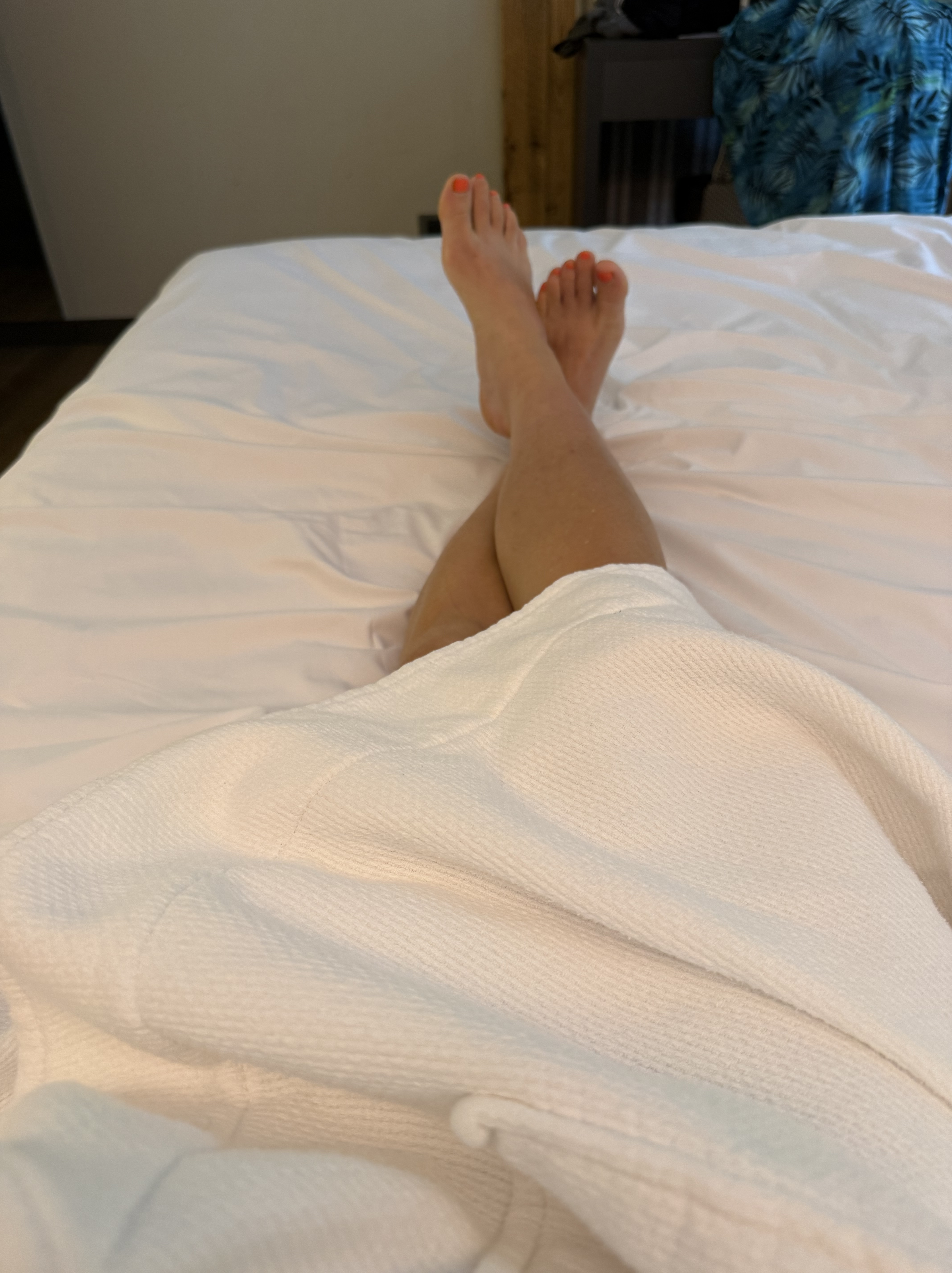
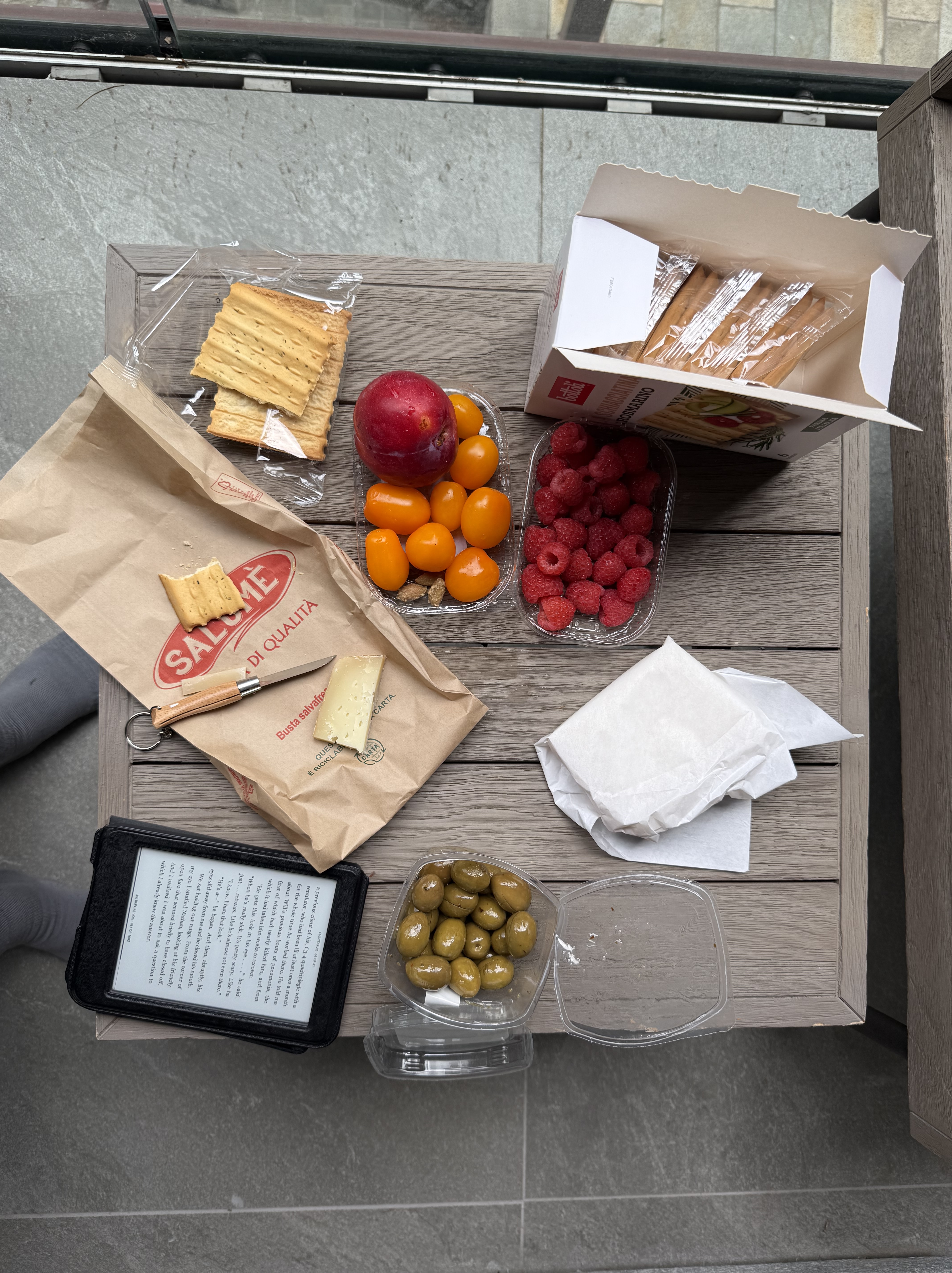
Because we’d cut out a huge section of the TMB in Switzerland, we were able to take a rest day in Courmayeur. Similar to Chamonix, Courmayeur is stunningly beautiful. I was immediately happy we had changed our plans and looked forward to two nights in the same bed and not chilli for dinner. We went to a nearby restaurant for dinner and (unsurprisingly) stumbled upon really good pizza. On the recommendation of our friends Mercedes and Nico, we stayed in Le Massif, a hotel near downtown in Courmayeur. The bed was super comfortable and the breakfast buffet was like nothing I’ve ever seen. If you’re in Courmayeur, go here! Our first morning in Courmayeur we spent over 90 minutes at the breakfast buffet enjoying good coffee, made to order omelettes, baked goods, and nearly every other breakfast item we could think of. I spent the rest of the day relaxing in the hotel room (pictured), with a goal to move as little as possible and sleep as much as possible (pictured), only leaving three times (all to get food), while Eric went on a 30k training run in the mountains South of town (partially following the TMB).

Day 5: Welcomed back to France by the perfect crepe

Bus from Courmayeur to Val Veny, Val Veny to Le Chapieux

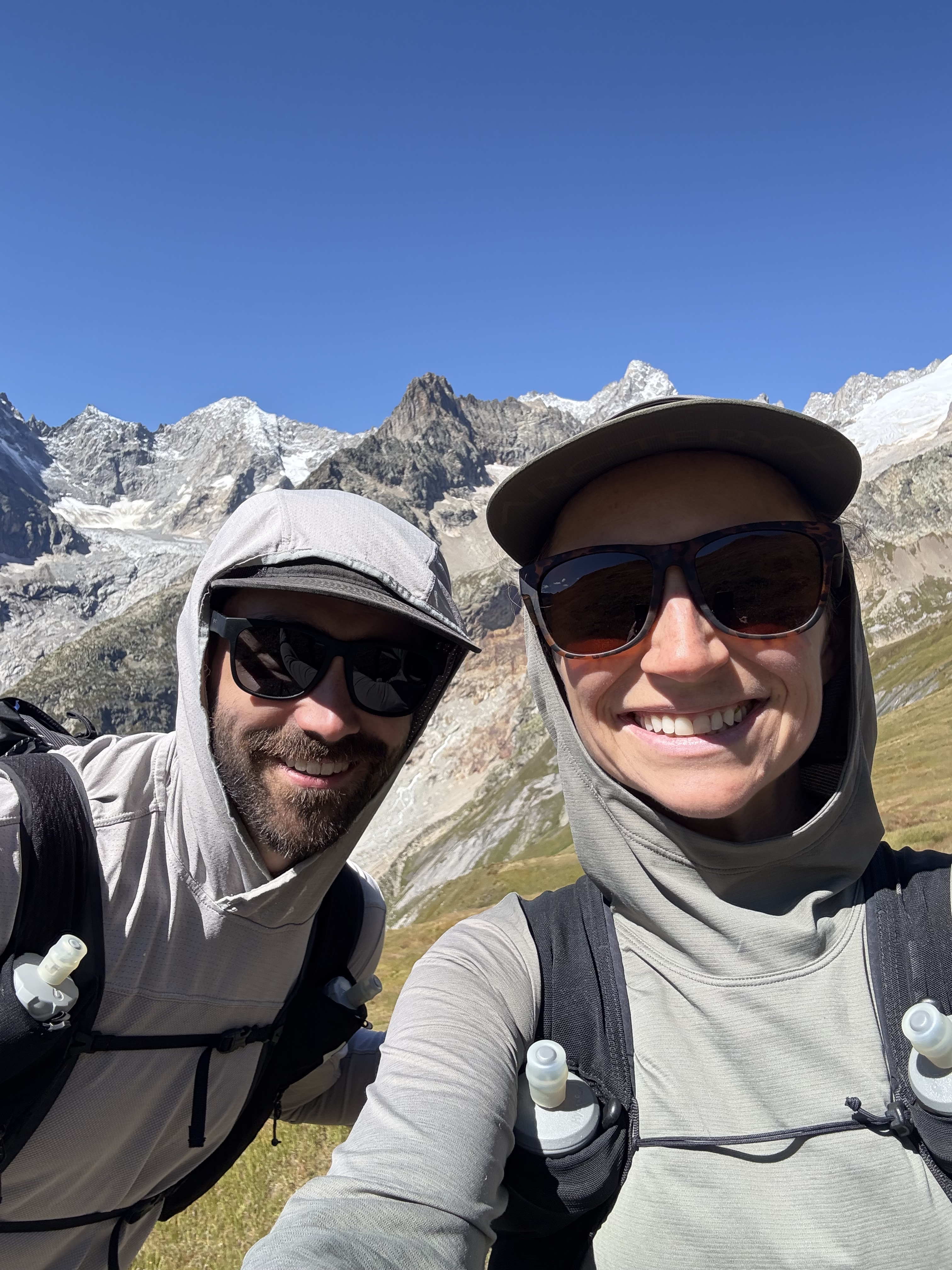
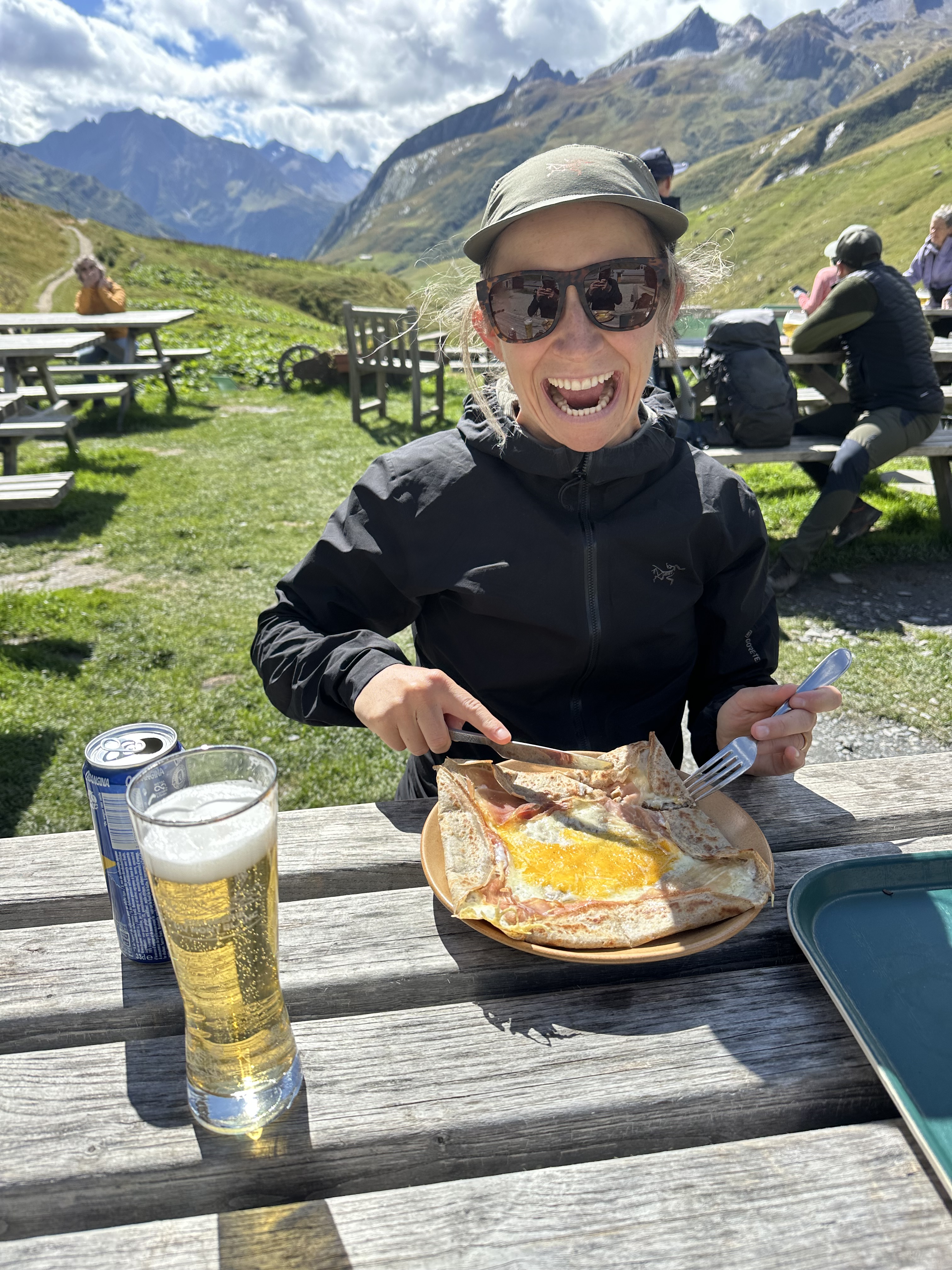
The next morning we once again enjoyed the buffet breakfast (just one hour this time) and then took a bus to Val Veny to cut a few km off an otherwise pretty long (30km) day. From there we began to climb and then descend towards the border with France, enjoying incredible views and great snacks at the refuges. This is an interesting section of trail with a lot of history from World War 2. There are tunnels in the mountains and visible foxholes. As we descended into France, we stopped at a refuge that served DELICIOUS ham, egg, and cheese crepes. That afternoon we arrived in the tiny village of Le Chapieux and checked into our hut, Refuge de la Nova. The hosts were friendly, the food was delicious, and the room was comfortable.

Day 6: “Oh wow she’s pregnant”

Le Chapieux to Les Contamines

The next day, our second to last, we climbed up to Col du Bonhomme and then down to Les Contamines. One of our favourite stops was at Chalet Refuge de Nant Barrant where we had great food in a lovely garden setting. This day had some more great views and was very busy, with nearly everyone going in the opposite direction as us (we did the route clockwise instead of counterclockwise because there wasn’t much hut availability when I booked in June). We realized most people would have been just a day or two into their TMB at this point, and people were definitely struggling on the climb. I had a lot of people look at me with wide eyes, asking if I was doing the whole TMB while pregnant. We wondered if they’d be able to close the loop. We arrived in Les Contamines midafternoon and checked into our accommodation, Le Pontet. A campsite/cabins/dorm situation with the vibe of an American KOA, which is to say I would not recommend it, but it was fine. Once again, no sleep for me.

Day 7: The faster I hike, the sooner I get to Chez Richard

Les Contamines to Bellevue Gondola, Bellevue Gondola to Les Houches, bus from Les Houches to Chamonix

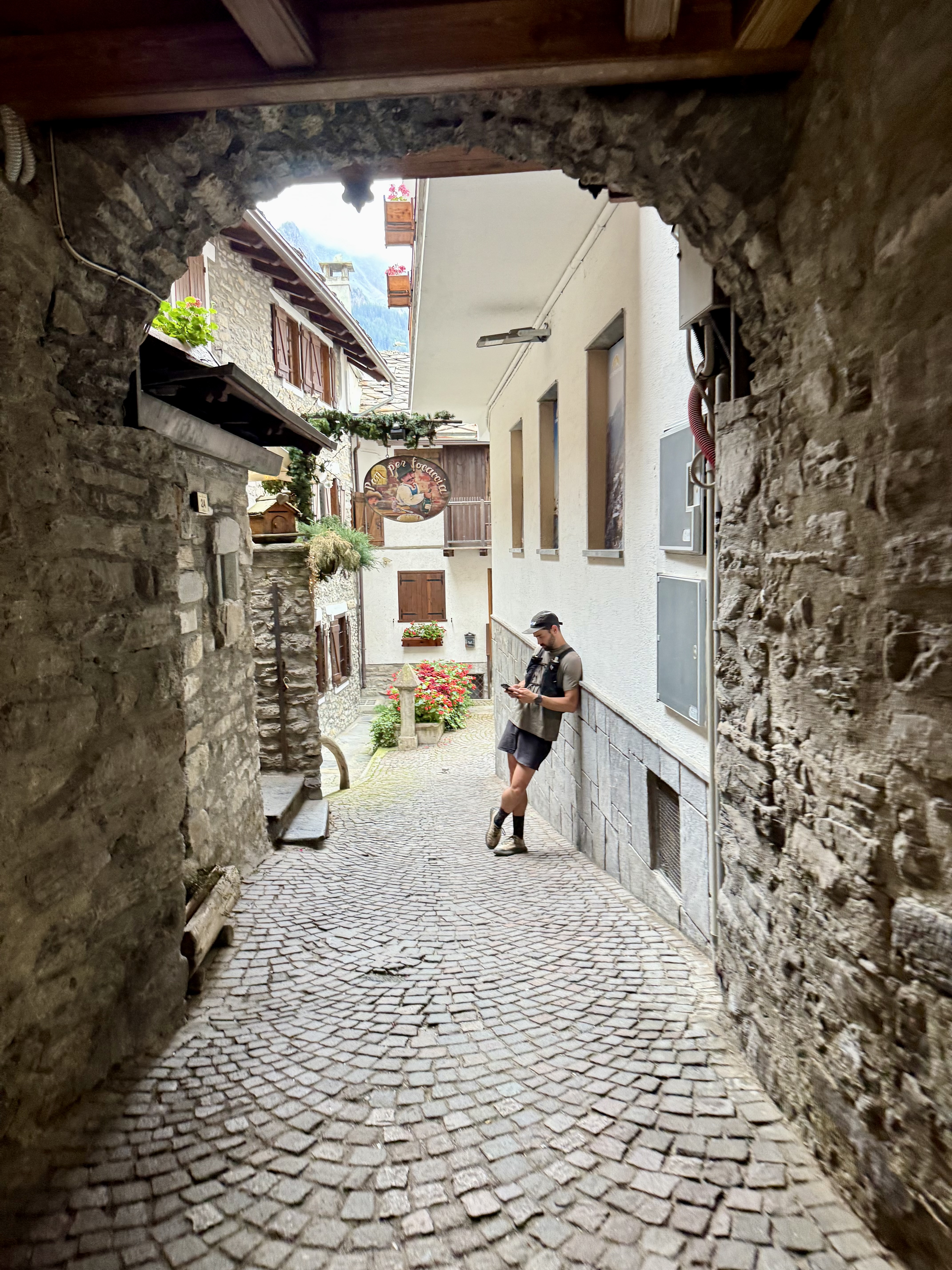
Our final day was from Les Contamines to the top of the Bellevue gondola above Les Houches and we did a variation over Col du Tricot. This was a relatively short day, 13km with 1300m of elevation gain. We stopped for food at two refuges, met a wonderful, floofy, and very dreadlocked dog, and made it to Bellevue gondola early in the afternoon. The bus from Les Houches to Chamonix stops at the gondola, so it was an easy trip. We headed straight for Couloir coffee for sandwiches and then Chez Richard for their heavenly croissants. We then headed up to our hotel, Auberge du Bois Prin, cleaned up, and went out for dinner (would highly recommend this hotel, we stayed here a few times during our trip. Auberge du Bois Prin and Le Massif were the only two places I could sleep while pregnant).

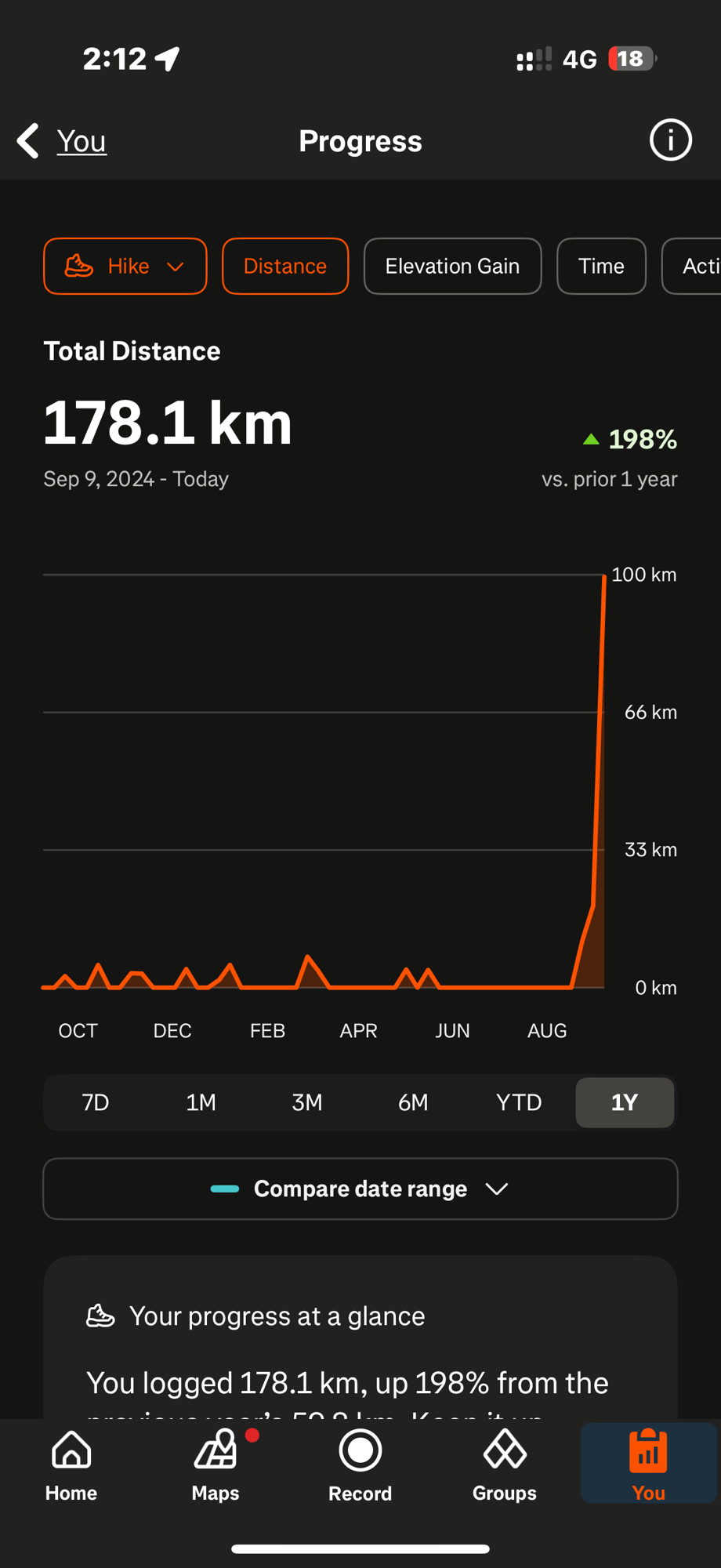
(Note the Strava screenshot showing that I pretty much never hike)

TMB while pregnant: Takeaways

Overall this was a great trip, even if I was so tired I cried every few days. There were a lot of great moments during the hike and I really enjoyed the views and the food. I often think about how cool it is that I took my baby around Mont Blanc on foot while I was pregnant.

What I’d do again:

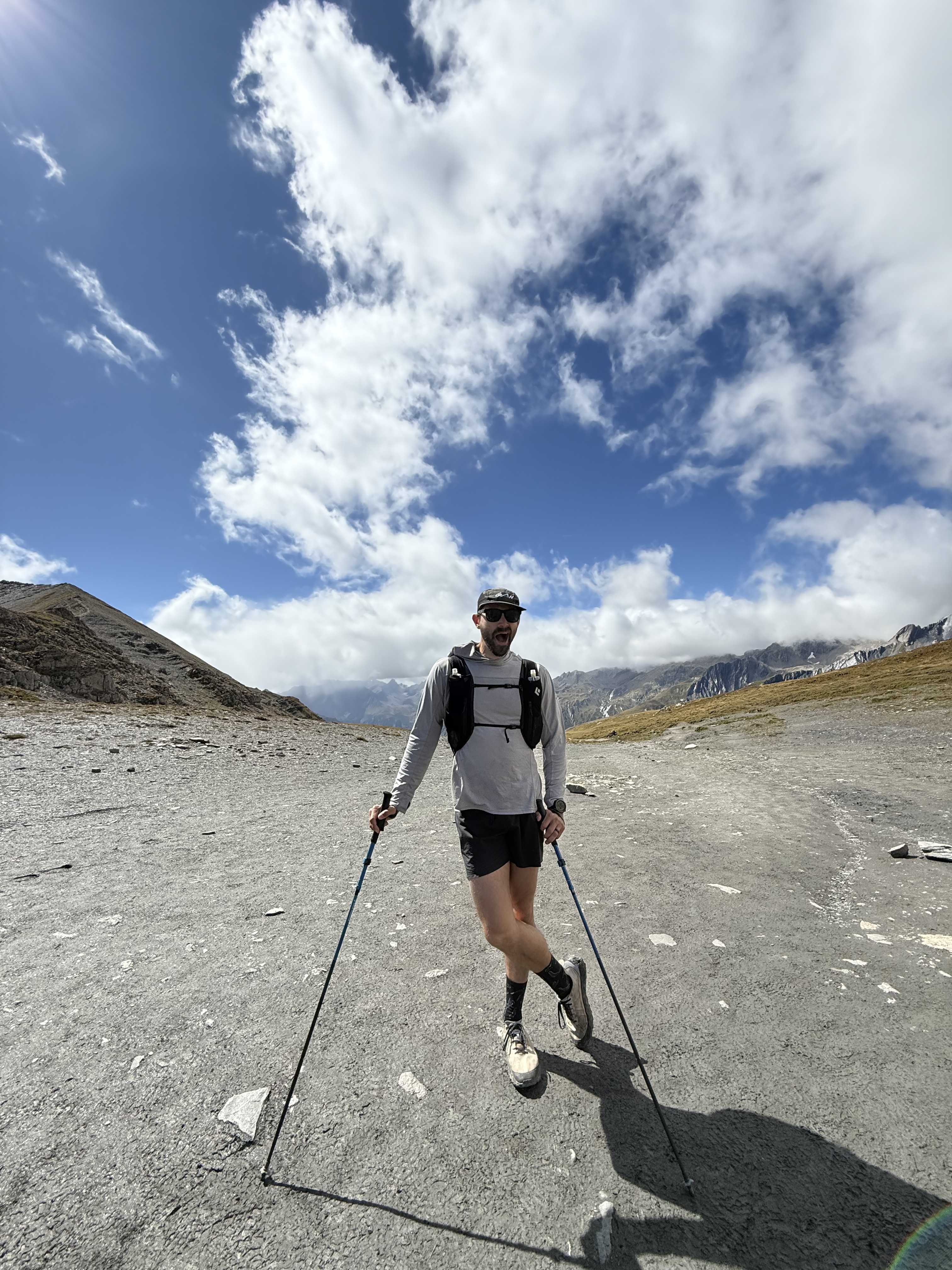
  • Use poles. They were essential.
  • The TMB route. It was a good option for me while pregnant for a few reasons:
    • So much food. I needed to eat frequently throughout the day, which was easy with so many refuges around.
    • Non technical trails. As I became more pregnant, my balance got worse. The TMB trails are not technical at all, so I was able to hike without any worries about losing my balance, tripping, or falling. The downside to this was that it was a little boring at times and I wished I was moving faster. I can see why this is a great trail to run.
    • Flexibility. This route has a ton of flexibility. You can skip sections and take a bus, you can stay in a hotel instead of a refuge, you can take an alternate route, you can take an impromptu rest day. We used a lot of these options and were super grateful for it.
    • Lots of amenities. We hardly had to carry anything (see gear list below) which was great for me because I was already carrying around about 15lbs of baby plus her accessories at that point

What I’d do differently:

  • Planned for more rest days, and/or planned a different approach where we stayed in one place and explored around, and/or adjusted our route and booked more hotels. I didn’t realize how uncomfortable and tired I would be at this point in pregnancy. Comfortable hotel beds were the only place I had a chance of sleeping. I found that while pregnant I could typically do 1-2 hours of exercise a day for a few days back to back, or one long day of activity, but not 4-8 hour days back to back.
  • Not stay in any dorms.

If you’re pregnant and planning to hike the TMB, please reach out! I’d be more than happy to share more information or chat about it.

Gear List

  • Pack: Arcteryx Norvan 14L pack
  • Poles: Black Diamond
  • Shoes: Norda 001
  • Daytime Clothing: Rabbit T shirt in size large, Crz Yoga maternity shorts, Arcteryx Taema sun hoody, Janji sports bra, Arcteryx aerios cap
  • Pregnancy belly band: Maternity FITsplint
  • Nighttime Clothing: Arcteryx merino T shirt and long sleeve T shirt, Lululemon Align leggings
  • Western Mountaineering sleeping bag liner (would NOT recommend using while pregnant, it’s too narrow)
  • Eye mask, ear plugs, and little comforts go a long way on this route

King’s Trench, Mt Logan, YT

Trip: May 2024

The plan was to fly from Silver City, the small airport 45 minutes from Haines Junction, to the Kings Trench on Friday, May 10, 2024.

A bad stretch of weather starting on May 1 meant Icefield Discovery, the one-plane operation serving Mt Logan and the surrounding area, was unable to fly for the first two weeks of May. We were in touch with Sian, the owner of Icefield Discovery, and changed our plans slightly in response to the weather, leaving Squamish a few days later and arriving in the Yukon on the weekend of May 11.

We spent a few days repacking and tying up loose ends in Haines Junction, and made our way to Silver City on Monday, May 13. Somewhere between Squamish and Silver City, a mouse made its way into our truck and was eating our snacks. We had to fully unload the truck twice before we found it, and it looked like it had been thoroughly enjoying our food.

After being grounded for 13 days, Sian and her team were optimistic that they’d start to work their way through the backlog of skiers and mountaineers waiting to get into the mountains. A few groups ahead of us had waited for a week or longer to fly and had finally given up, so we were lucky and were the second group in the queue.

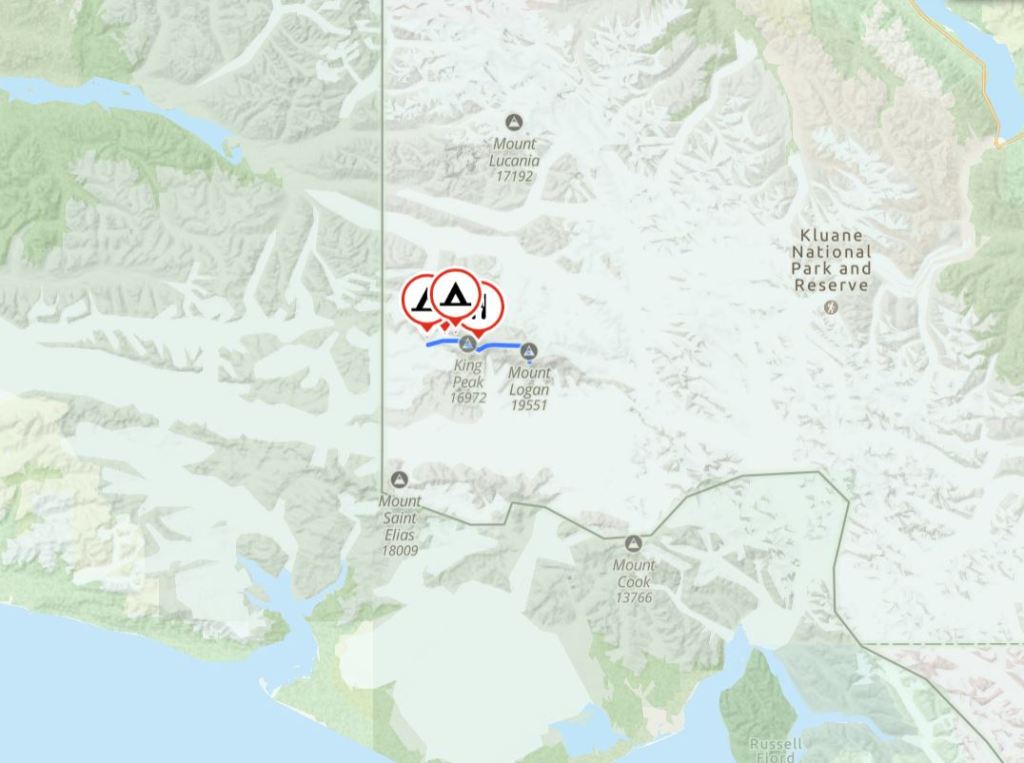
On Tuesday, May 14, we made it to basecamp on Mt Logan’s King’s Trench route. Our flight in took us over the first part of our route and we took advantage by taking photos from above so that we could better navigate through the crevasses on our way to Camp 1. Basecamp is at approximately 2800m and is just a few kilometers east of the Alaska border.

Basecamp: Day 1

We arrived around 1:30pm and immediately began to set up basecamp. We dug a platform for the tent and built a small wall to shelter the tent from the wind, which was coming from the west. Some clouds began to gather around the pass where we had flown in, and we heard a plane approach and then turn around as we set up camp. We later learned that our future friends from Montana were in that plane, which had to turn around just minutes from landing at camp because of the wall of clouds. This would become a trend.

Around 5 or 6pm, we carried a load of food and fuel up to Camp 1. As we worked our way up, fog rolled in and it began to lightly snow. The crevasses were enormous so navigation was relatively easy. We buried our cache around 3100m and skied back to basecamp with our sleds flapping behind us. It was now about 9:30pm and we began to make dinner. The original plan was quesadillas with chicken, peppers, and beans, but we quickly decided that just cheese would do. Best quesadilla I’ve ever had.

Enjoying hot quesadillas late at night.

Camp 1: Days 2-4

The next morning the sun was out and it was a beautiful day. We woke up at 7 and sent an InReach message to Sian with a weather report so that she could plan her flights for the day. There were several more groups booked to come to basecamp over the coming days. She reported back that unfortunately the plane had a mechanical issue and was unable to fly for a few days, so we’d get Logan all to ourselves for a few more days. We later heard that a fireball had shot out the back of the plane as the Montanans tried to fly in after us on May 14.

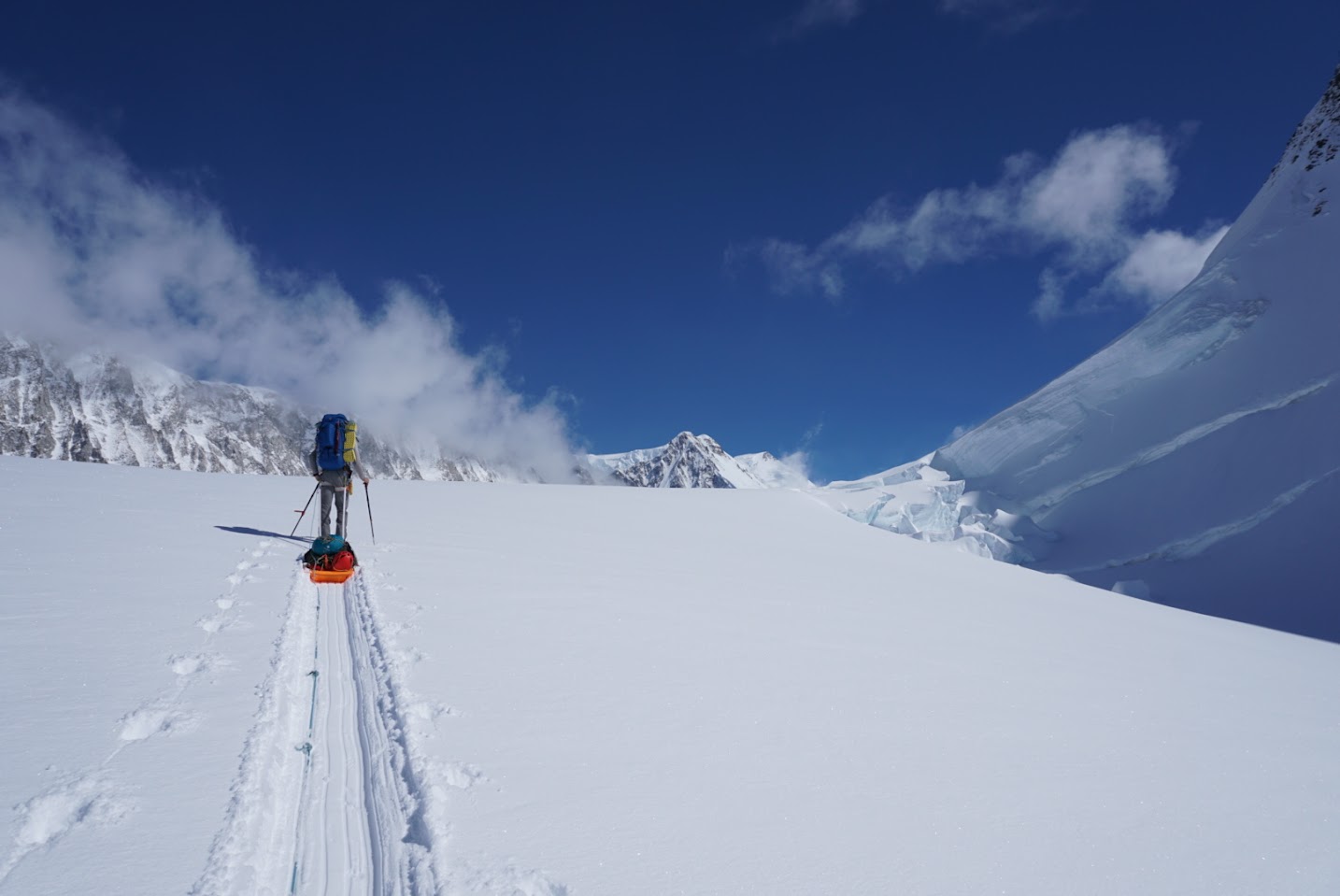
We packed up camp and were ready to start moving around noon, which was not ideal but necessary because of our late night. About 6-10cm of snow had fallen overnight and we moved at a crawl, breaking trail and pulling our heavy sleds. We ate and drank occasionally, and around the time we passed our cache, we were both feeling tired and hungry. We arrived at Camp 1 in the late afternoon, had a big snack (which greatly improved our wellbeing), skied back to pick up our cache, and then set up camp.

Breaking trail through fresh snow, beside house-sized crevasses.

Camp 1 is around 3300m and sits on a large patch of glacier, about 2km wide, between two 4000m ridges. The north-facing ridge to the south is heavily serraced, and the south-facing ridge to the north is exposed granite with small gravelly rock at the bottom. We decided we wanted to be farther away from the serracs, so we set our camp 1 closer to the north end of the glacier.

Throughout the afternoon we heard small rocks falling and sliding down the granite ridge, which felt quite close. When we looked at our map, we found that we were several hundred meters away from the ridge and safe unless there was a massive and unlikely rockfall. We had to balance our proximity to the rocks with our desire to be very far away from the serracs on the south side of the trench, but it still felt uncomfortable. The scale on Mt Logan is difficult to comprehend. Everything there is huge, distances are foreshortened, and the endless snow and ice made us lose all perspective.

Reflecting on the day, we realized we needed to eat more frequently to keep our energy levels up and prevent bonking. Even though we were still relatively low, the altitude was affecting us a little by making us need more energy but feel less hungry.

We heated up frozen chicken and rice soup for dinner and managed to get in bed a bit earlier than the night before.

Day 3, another sunny day after a calm but cold night. Eric’s watch measured a temperature of about -20 inside the tent in the morning, so we guessed it was about -20 or -25 overnight.

We carried a cache of food and fuel to Camp 2 around 4100m and then returned to Camp 1 with our sleds strapped to our backs. This was much easier than skiing with the sled dragging behind us, but turned us into human sails, so we skied cautiously. We ate more consistently throughout the day and felt far better than the day before.

Around midday we began to hear helicopters and planes and assumed groups were being dropped off on King’s Trench and possibly the East Ridge.

Day four, May 17, was our first rest day. We read, organized gear and food, and focused on acclimating. We saw our first signs of human life on this day when we saw another group drop a cache a few km down the trench from us.

Camp 2: Days 5-10 (May 18 – 23)

We were now on day 5, May 18. We packed up and got moving, excited to head up to camp 2 (4100m). It took us about 5 hours to ski 6km with 850m of elevation gain. It was hot all day but once we arrived at camp 2, the wind was hammering and we cooled down quickly. We made quick work of setting up camp and had dinner at a reasonable hour.

We both got a mild headache in the evening and went to bed early. We woke up the next morning, day 6, to a full whiteout, but our headaches were gone. We took another rest day because of the weather, and through breaks in the whiteout, watched the snow load, and then reverse load, the 40 degree slope that would take us to camp 3.

Camp 2 is perched on top of a sloping hill, exposed to wind from the east and west, and is positioned below the McCarthy Gap. The McCarthy Gap, one of the only technical sections of the King’s Trench route, is a 450m high 40 degree slope with icefall on both sides and at the top.

View of King’s Peak out of our tent window in Camp 2.

At one point in the day we geared up and went on a small tour to check out the McCarthy Gap. We made it a few hundred metres, to the base of the slope, before we called it due to high winds and poor vis.

We hired Chris Tomer to provide us with forecasting services via our InReach, and we were also getting weather forecast information from our friend Eric. Eric had planned to attempt the East Ridge around the same time as us but hadn’t even made it in to basecamp due to a 10ish day weather delay. They made the smart decision to pull the plug and try again next year after having lost most of their vacation days to weather. Both Chris and Eric let us know there was precipitation forecasted on and off for the next week or more.

The next few days were about the same. Some sun but mostly poor vis and snow, which would have been fine if we didn’t need to ascend a loaded 40 degree slope. We made the decision not to put a skin track up the obviously loaded slope for a number of reasons. First, like I mentioned, the slope was 40 degrees and loaded with recent storm snow. Second, there were only two of us, so if anything went wrong, only one person could perform a rescue. Third, the flight to Mt Logan is minimum one hour, and flights can only happen in good weather (Sian told us in general, weather is good enough to fly to Logan about 50% of the time). We are both conservative decision makers in avalanche terrain, and we brought this style of decision making to Mt Logan.

A few days into our time at Camp 2, other parties began to trickle in. First, our four friends from Montana arrived. They were a group of four with 3 mountain guides and one engineer. Most of them had guided Denali several times. Like us, they felt the McCarthy gap looked too loaded to climb and planned to wait a few days for the snowpack to settle.

Camp 2 filling up.

In between breaks from digging holes and building double-thick snow walls three-hundred-and-sixty degrees around our tents, we passed the time by skiing powder/windpress laps below camp, reading, and eating more butter ramen.

By May 22, Camp 2 was feeling nicely full. We had our Montana friends next door, a group of two men from Colorado who had also climbed Denali a few times, and a huge guided group of 8 out of Nelson. The lead guide had climbed Logan 11 times, and in his own words, he liked to wait two years between his trips in order to “forget how shitty it is here”. Our time alone on the glacier now felt very far away, and it was nice to see and hear other people in the desolate wasteland.

Inside the kitchen tent on a day when the forecast was calling for light wind.

The 11-time Logan guide decided to put a skin track up the McCarthy Gap with two of the other guides in his group as safety spotters (ie waiting in a safe spot at the base of the slope in case a rescue was needed). When we had asked him earlier if he had ever seen the slope avalanche, his response was “Oh yeah, it’s avalanched on me before!” We sat in camp (just kidding, we were probably either digging holes or building walls) and watched him ascend the slope without incident and then ski down. After that, everyone in camp suited up to ski that slope, knowing more weather was incoming and it could be helpful to get some tracks into it before the next snowfall. It was a fun ski and we were grateful to be doing something other than digging holes.

The McCarthy gap with skin track & ski tracks
Another breezy day.

We were starting to worry about our timeline. We had lost a few days at the beginning waiting to fly in, and we had now lost quite a few more days to weather. We both had to be back at work on June 3 and hadn’t had the foresight to request vacation days for the first week of June after losing those days at the beginning. Chris and our friend Eric were both telling us there was no weather window in the forecast.

We knew we needed a minimum of 7 days to get from Camp 1 to the summit, plus a day to get back down to basecamp and at least a few contingency days for weather. Even if we got an 8 day weather window, which we definitely didn’t have, we would likely not make it back to the airstrip in time to go to work on Monday, June 3. We started to talk about heading back to basecamp to catch the next available flight out rather than travelling higher on the mountain, knowing we didn’t have time to summit anyways.

On May 23, we made the call to head back down, and so did the group of 2 from Colorado. We asked them why and they said they weren’t enjoying themselves, that Logan was much more difficult and hostile than Denali. The Montanans also told us that Denali is far more approachable. It’s less remote, warmer, and has a ton of people and infrastructure compared to Logan. The weather is also less hostile.

We packed up camp and skied down, cursing our full sleds as they flipped over, dragged us to the side, and generally tried to kill us.

On the way down

Basecamp: 3 days of hope and despair

We arrived in basecamp with mixed emotions. On the bright side, we were gonna get out of this hellscape! On the other hand, we had started to kind of like this place. Our systems were getting super dialed, and we had become excellent hole diggers and wall builders.

We contacted Sian and she let us know she’d try to get us out as soon as she could, likely May 24 or 25. So we waited.

On May 25, Sian sent a plane to us, we packed up camp and were ready to go, but it had to turn around because we were totally socked in. It felt tragic and I spent a while lying on top of our luggage and crying, sure I’d never escape basecamp. Later that day we went for a flat and boring ski down the glacier towards the US border.

On May 26 we successfully flew back to Silver City. We were super excited to get on the plane, but as soon as it took off, we both felt like we weren’t ready to leave yet. I think we made the right calls, besides not asking for more days off before we left. While it felt unfortunate to leave without summitting, in reality that’s just how it goes sometimes.

Our friends from Colorado had to wait a few more days to fly out as a storm came in just after we flew out, bringing about 1 metre of snow. Our friends from Montana and the guided group all made it to the summit at the end of May/beginning of June, working with a very short weather window, having spent several more days waiting out the weather.

Some Key Gear

Reach out if you’d like the full spreadsheet 🙂

Tents

  • Mountain Hardware Trango 3 for sleeping. A great tent, spacious for two people.
  • BD Megalight as our kitchen tent. Unfortunately one of the sides got a little rip in the wind at camp 2.

Sleeping bags & mats

  • Coral: Big Agnes Cinnabar -30, Big Agnes insulated plus Z lite
  • Eric: Thermarest Polar Ranger -30, Big Agnes non-insulates plus Z lite
  • Lightweight foam sheet for tent floor

Stoves

  • Borrowed MSR Whisperlite (thanks Em!)
  • MSR XKG, sounds like a jet engine but melts snow like a charm
  • MSR Reactor as backup with a few fuel canisters

Clothing

  • Coral
    • Feathered Friends Khumbu expedition parka as warmest outer layer
    • Arc’teryx Alpha Lightweight Parka as outer layer (this jacket is super warm, light, and versatile, with a relatively waterproof exterior)
    • Arc’teryx Proton as mid layer jacket
    • Arc’teryx Alpha Hybrid softshell pants
    • Arc’teryx Rho heavyweight bottoms & Rho merino bottoms, Arc’teryx Taema sun hoody, Arc’teryx Delta 1/2 zip hoody
    • An assortment of mitts including BD Mercury Mitts, which I wore most, and Showa gloves for camp setup. Also a pair of OR expedition mitts.
    • My cursed BD Couloir harness which is terribly designed, the buckle sits on my hip bone and bruises me.
  • Eric:
    • Feathered Friends Khumbu expedition parka as warmest outer layer
    • Arc’teryx Atom AR as main outerlayer
    • Arc’teryx Proton as midlayer
    • Arc’teryx Gamma Guide pants
    • Ancient Patagonia R1, Arc’teryx wool bottoms, Kuhl sun shirt
    • Showa gloves for camp setup, OR Stormtracker, BD Guide gloves, and more.

Skis & ski gear

  • Coral: Line Pandora 104s with ATK Raider 11 EVO bindings, Pomoca mohair mix skins, Scarpa Gia boots, and trusty old G3 poles.
  • Eric: Black Crows Navis Freebird with G3 Z bindings, G3 skins, Scarpa F1LT boots, and G3 poles as well.

Sleds: we bought expedition sleds from home hardware and laced them up with cord at home, using PVC pipes to make the attachment to our harnesses stiff. It sort of worked.

Some takeaways for the next trip

  • Eat more often than we want to, it’s easy to not eat enough and bonk quickly. For me (Coral), bonking meant I got really cold.
  • Have a bigger time window. We should have booked 4 or 5 weeks off work and adjusted our days off once it looked like we’d fly in the next day. Being tight for time on the glacier was what ultimately made us turn around and we likely could have stayed an extra week if we had the foresight to reschedule a few meetings and book the days off. As it was, doing all of that through an InReach felt unprofessional.
  • Change into warm clothes as soon as camp is set up. Sweaty clothes get cold quickly, and once we got cold, it was really hard to warm up again.
  • The forecast needed to be multiplied by 10. For example, if the forecast was calling for 1cm of snow, we’d likely get 10. If it was calling for light wind, we’d be getting out of our tent every few hours to reinforce our snow walls. Clear, calm days were a gift and we got 3 of them.
  • Butter ramen is the best meal and can be eaten for breakfast, lunch, or dinner. Butter ramen is exactly what it sounds like: ramen with butter. We also added dehydrated kale to our ramen, which made it even more delicious.
  • Hot chocolate LMNT was a great way to get electrolytes without drinking cold water.
  • Having a camp setup system is key. Doing it the same way each time is efficient, effective, and foolproof.
  • Digging holes is the main thing we did on this expedition. Have a good shovel and make time for mobility, stretching, and core work so that you can continue to dig holes.

Kodiak 100 mile race report

TL:DR

Efficient & solid training, got Covid a week before, runnable races are hard, goodbye toenails, eating is overrated (it isn’t), my crew was perfect, happy with my first 100 miler.

How did we get here?

I started racing ultras in 2016 and quickly increased in distance from 50k to 100k plus, racing Fat Dog 70 mile in 2017 and Miwok 100k in 2018. After Miwok, I took a 5-year break from racing, focusing instead on mountain biking in Squamish where I had just moved. I had thought a 100 miler would be my next step after Miwok, but was having so much fun mountain biking, and was progressing so quickly, that I never took that next step. Throughout that five year period I paced and crewed many friends on their ultras, helping at least five friends run their first 50k, and I picked up fastpacking, but mostly I rode my bike.

Fast forward to 2023, I competed in a nearby sky race called Meet the Minotaur, approximately 35km with 3000m of elevation gain. Despite my legs feeling weak and unresponsive, I had a blast and realized I could still be somewhat competitive despite major growth in trail running since I last raced.

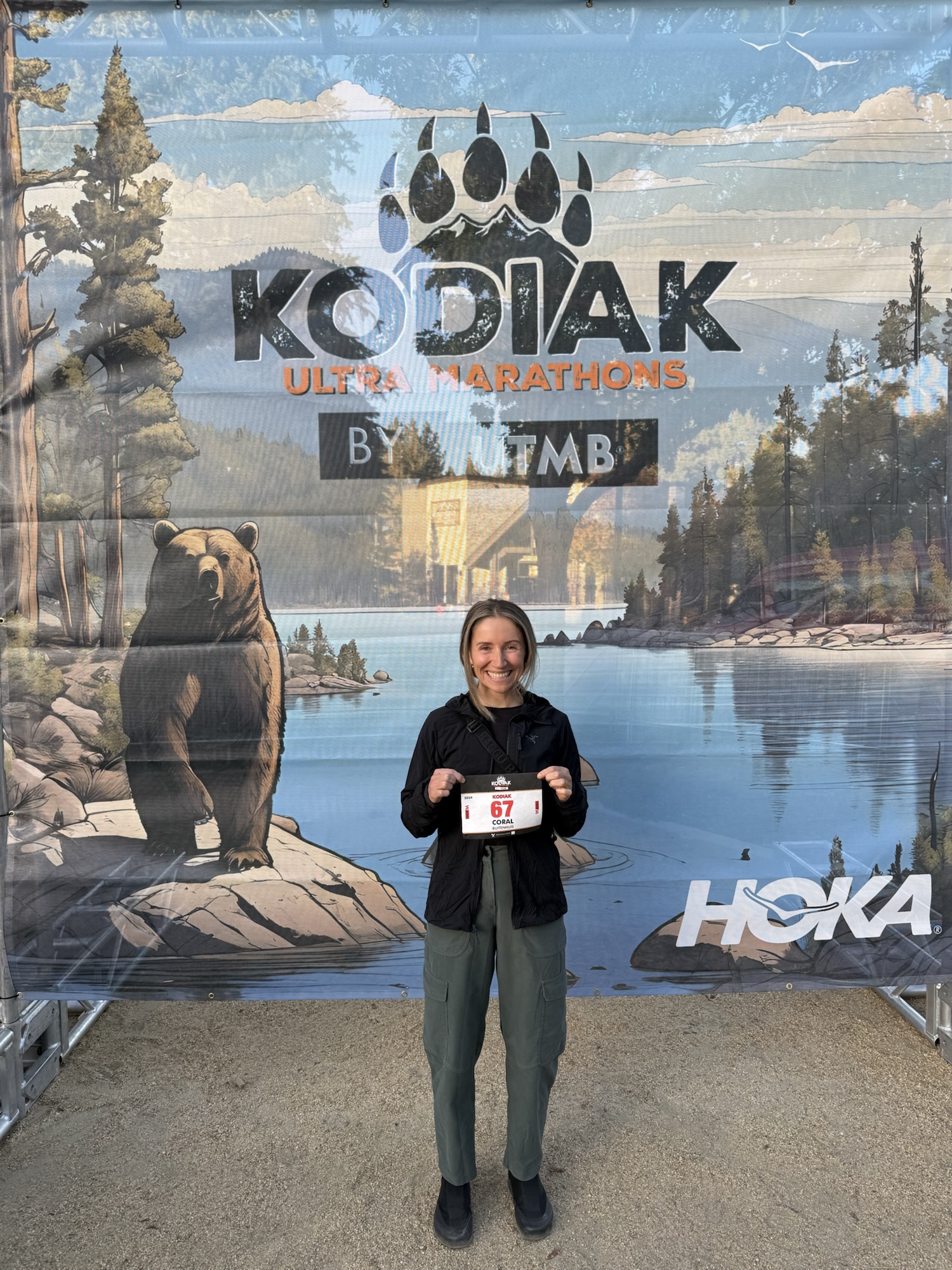
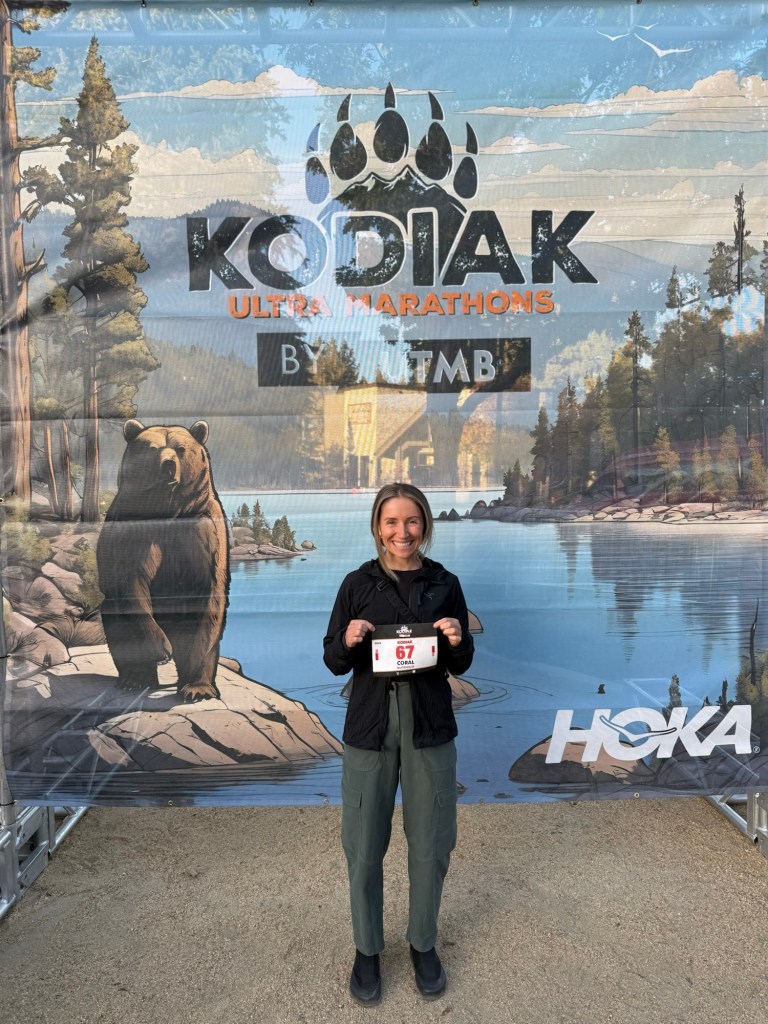
After arriving home from Mount Logan in June 2024, I decided I was ready for another major athletic event and signed up for Kodiak 100 mile. I chose Kodiak for three main reasons:

  1. I wanted a fall race so that I wouldn’t have to be focused on training all summer.
  2. I needed a race with no entry requirements. All of my qualifying races had long since expired and I wasn’t open to doing a 50 mile or 100k before a 100 mile.
  3. The regular course (which I did not run because of the Line fire) is one big loop. I wanted to avoid out and backs and multiple loops.

Kodiak is an incredibly runnable race with only 5000m of elevation gain on the regular course, and just 4000 on the course I did. My strength is in mountain running, lots of vert and technical trails, not in super speedy running. But I knew it would be an interesting challenge to train for something I’m not naturally good at, and most of the more mountainous 100 milers have entry requirements (which is justifiable). As we’ve already established, I had no interest in spending my entire summer training for and running multiple long distances. So Kodiak it was.

Race Goals: No fucking around

My race goal was to run fast and hard and see what it’s like to run 100 miles. I wanted to experience physical and mental discomfort in a safe environment (trail running is my safest sport, there are no crevasses or avalanches, I don’t need to wear a helmet). Finishing was not one of my race goals. I wanted to see if I could perform in a 100 mile race and I was ready to drop if any injuries popped up or if I was going to spend hours walking.

Training

Because my baseline is relatively high volume (10-20h per week of training), and because I’ve been base building for about 20 years, I was able to skip this part of training. After speaking with a few friends, I decided that I could do 8 weeks of specific training for Kodiak. Kodiak is based in the Village of Big Bear, California, which is about 2000m above sea level. The race stayed mostly around 2000-2400m, and went as low as 1800m. I knew I didn’t want to spend the time it would take to acclimate in Big Bear, so I decided to arrive the day before. I was up around 4000m in May (for Mt Logan) and July (to pace Audree at High Lonesome) and had no issues, so I was hoping 2000m would feel fine.

The training plan: Not perfect but good enough

I built a training plan for myself, based off of the SWAP podcast and training plans, Dr. Stacy Sims’s research on the menstrual cycle, and my own experience training for ultras with my menstrual cycle, and launched my training August 12. I signed up for one 50k 4 weeks out from Kodiak to practice racing.

A typical training week included:

  • 3 gym sessions (full body, lifting heavy)
  • mobility and yoga
  • 5 days of running with 1-2 speed workouts (e.g. 5k easy, 8x2m fast, 1m easy, 4x1m hills hard, 5k easy), 1-2 long runs, often with strides sprinkled in
  • 1 day cross training

I knew Kodiak was runnable so I focused on building speed and running economy. My running volume was relatively low with my highest volume week being 92km.

I trained on a 4-week cycle aligned with my menstrual cycle, meaning I based my training volume and intensity on the natural fluctuation of my hormones. Weeks 1 and 2 were higher intensity and higher volume. This is when I did key workouts and longer runs. During week 3, I still went hard but pulled back a little, especially if I felt tired. During week 4, the week before my period, I rested and listened to my body. Instead of a speed workout during week 4, I’d do strides, and my long runs were shorter.

The week after my 50k, around mid-to late September, I had a calf injury pop up. It felt like either a calf strain or shin splints, similar to what I felt when I had a tibial stress fracture in 2012. I took a week off running and instead rode my bike and hiked uphill (which strangely wasn’t painful). I also got IMS, massage, and chiropractic work during that week, and did rehabbing exercises to relieve muscle tightness and build strength.

I also got Covid one week before Kodiak, took 3 days off of everything, and recovered quickly. Through both of these minor setbacks, I frequently reminded myself that a training plan isn’t meant to be followed with 100% accuracy. I missed a few key workouts and long runs, but overall I think my body was happy for the rest, and I tried not to stress about it.

Fueling & nutrition: Gels don’t make you poop your pants anymore! (Or do they? Spoiler!)

I have a history of disordered eating and have had RED-S from intentionally under fueling in the past, resulting in a tibial stress fracture and months-long recovery. I try to get 2 grams of protein per kg of body weight and I eat mostly whole foods. I was an on-again-off-again vegetarian for about 15 years because I always wanted to be smaller and slimmer, and eating vegetarian makes me a few pounds lighter. However, it also makes me feel weaker in every way. Eating meat gives me more energy, improves my iron levels, and ensures that I’m always strong enough to punch the patriarchy in the face on short notice. Note that as a climate change professional, I don’t put too much weight in personal accountability for climate change. Our biggest impact is through our work and through voting, so I don’t use climate action as an excuse to change my diet so that I can look smaller. I’m an athlete who needs quality fuel. (Full disclosure, I do sometimes get grossed out that I’m eating an animal and take a small break from meat, but then I have to remember that the circle of life moves us all).

One of the biggest differences in trail running performance since I used to race is the nutrition science. There are many more options and they’re so much better. My previous experiences trying to eat gels ended in me nearly pooping my pants, and I swore off gels for years. During Fat Dog 70 mile, I ate half a package of bacon instead of running food, which I strongly do not recommend. Brands like Maurten, Precision, and Science in Sport feel much safer to consume, so I started experimenting with those in the summer. Spoiler alert, my gut training didn’t really work this time, but I’m optimistic that it will in the future.

The Race

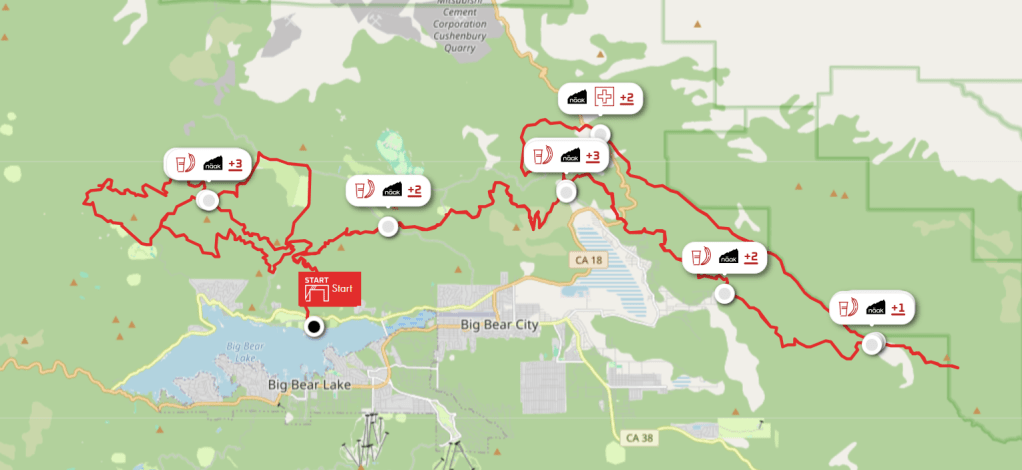
California’s Line Fire had been burning since September and was close to Big Bear. Sections of the San Bernardino forest were closed and it was looking like the race would be cancelled in the weeks leading up. I had started looking for contingency plans but the Race Director was able to pull together a last minute course. It was no longer a loop and it now had much more forest service road, but it would have to do.

The 2024 course is quite different from the regular course, which circumnavigates the lake.
The elevation profile for the 2024 course, note the scale is from 1800m to 2400m, so not much elevation change here. You can also see the multiple loops towards the end of the race.

Eric took control of my life the day before the race and made all of the decisions, from what to eat to when to leave to get to the race, I didn’t have to think about anything except myself.

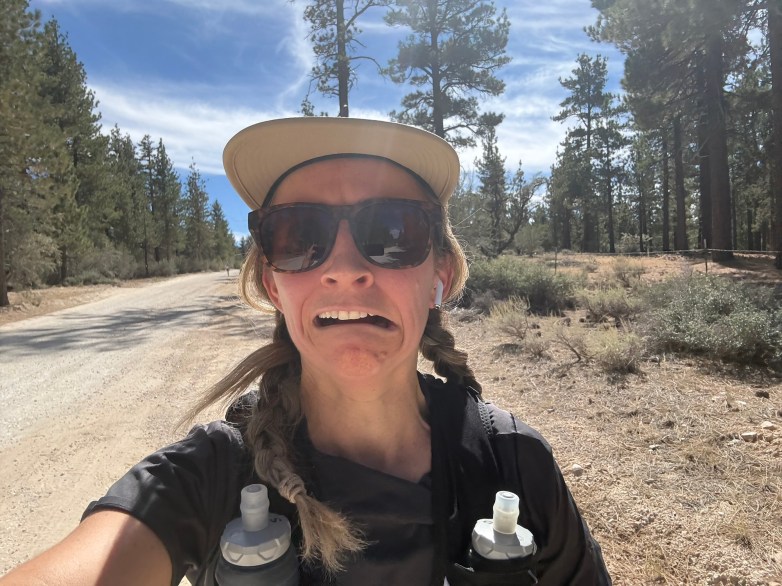
The race started at 1pm. It was 25 celsius, we were at 2000m, and it felt like a furnace. I missed the recent cold temps of Squamish. I seeded myself right at the front of the race, forgot to put my hand over my heart as they sang the anthem (whoops), and started hot. I probably put too much pressure on myself to stay with the lead pack at the beginning, I would have been wiser to run my own race for the first few hours, because I felt awful. My stomach started to hurt less than an hour in, I was super warm, and my right hip, which has been problematic for about 6 years, started to act up.

45 minutes in and feeling terrible

By 20km in, I had kicked enough rocks that I knew I had broken most of my toenails off. It felt awful but it’s happened before and there’s nothing to be done about it, so I didn’t take my shoes off to investigate.

I took my first non-running steps 25km in, but kept pushing hard. I was avoiding talking with my extremely friendly fellow competitors because I felt like crap. At this point, someone leaned out of their car and yelled at me “Hey, you’re 4th place woman and the other 3 are only a few minutes ahead, go get them!” I appreciated their enthusiasm but all I could think was that I had almost 90 miles left to run and that I was probably too close to the lead pack as it was.

About 35km in, on a neverending false flat forest service road with no shade, I decided that I wasn’t going to try hard anymore. I would rather finish last than be miserable for the entire race. I allowed myself to walk sections of that false flat and I took the pressure off of myself. I reached the 42km aid station in good spirits. My stomach continued to feel terrible, but I kept trying to take gels, chews, and bars. This aid station was my first bathroom break, and I would end up needing frequent bathroom breaks for the entire race. Lucky for me there were frequent aid stations, and I unfortunately became familiar with almost every single Porta Potty on the course, as well as a few bushes :(.

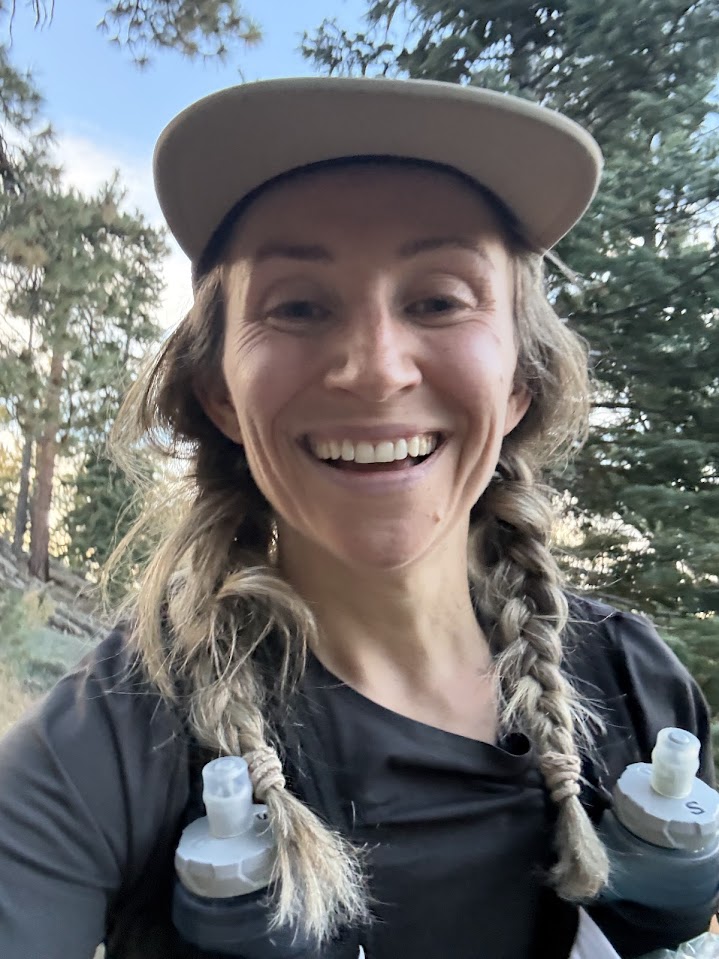
Around 45km and 5 hours in, I finally started to feel good. My stomach never improved but my mood did, and some of the pain in my body started to ease up. Sometimes it takes me many hours to warm up, but also the sun started going down around 6pm and things cooled down. I started to run fast and pass people, and I think I took the lead around 50km in, just after sunset. I met some great running buddies (Daniel who quietly cheered me as I made the passes, and Jake who I ran probably 20km with) around this time and started to thrive in the dark and cooler temperatures. I started drinking coca cola at every opportunity and it went down well. I also started eating a lot of tums and ginger chews. Nothing fixed the problem, but it all made it a little more manageable.

Finally starting to feel better as the sun sets

Seeing my crew 63km in was a huge boost. Eric and Audree took care of me and only asked once if I needed a chair (I said no, of course!) before they hustled me out of there. The early part of the night, from sunset until after midnight, were my most enjoyable. I got to see many people on the small out and back (including the huge pack of women VERY close behind me) and had fun chatting with them as we passed each other. Between km 63 and 100 was a nice section of single track and then a horrible off camber rocky road, including the out and back, which eventually eased into a very flat and low road, leading into the Cactus Flats aid station.

The kind folks from SAR were posted up at the turnaround point on the out and back and agreed on a photo

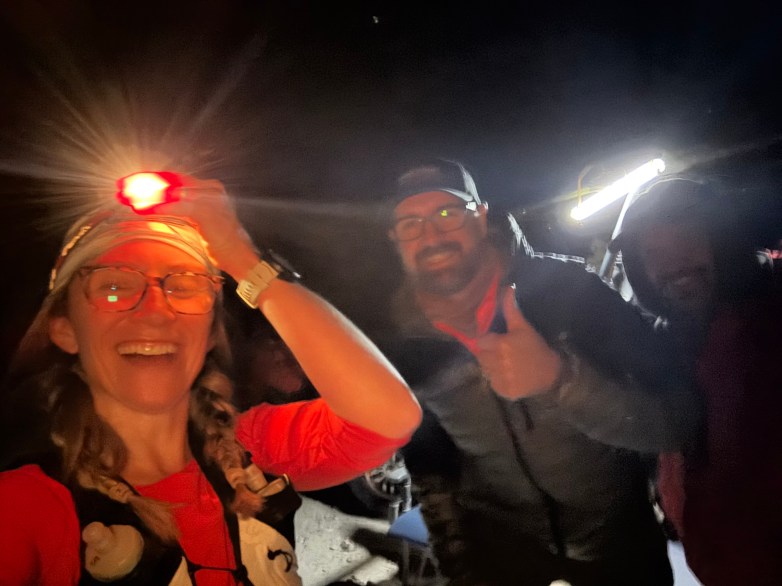
At Cactus Flats, Andrea joined me as my first pacer. She ran with me for 35km and during this time I started to fall apart a bit. A combination of not being able to eat properly, constant bathroom breaks, pain from continuously stubbing my very fucked up toenails, and general pain that comes from running (arguably too) far had me in a pretty fragile state. Andrea gently coaxed me to eat, provided excellent company, and helped me to get ground myself by getting back in touch with my breathing and footsteps. Just before sunrise, Kristina, the eventual winner, passed me absolutely HAULING ASS. I was attempting to choke down another Maurten 160 while it happened and ended up taking a sad little fall on some rocks just after she passed. I think I said to Andrea “I think I’m not in first place anymore” and she agreed. Watching the sun rise over the desert landscape was cool. The place looked different than I had imagined at night.

I came back to Cactus Flats aid station sometime after sunrise, about 5 minutes behind Kristina at that point, and Audree hopped in to take me to the finish line. I started off fairly strong and motivated to catch Kristina, and I think I may have even gained a minute or two on the climb, but about 10km from the finish line I completely fell apart. My gait had devolved into an awful looking right foot pronation, right arm swing, peg-leg hop situation, and I was crying every time I stubbed my toes, which was frequent given that I could hardly lift my legs off the ground, and I had very little energy from having struggled to eat for the entire race. Against all odds, my stomach stopped hurting around 20 hours. I ate a lot of gels once that happened, but I was in too deep a hole already.

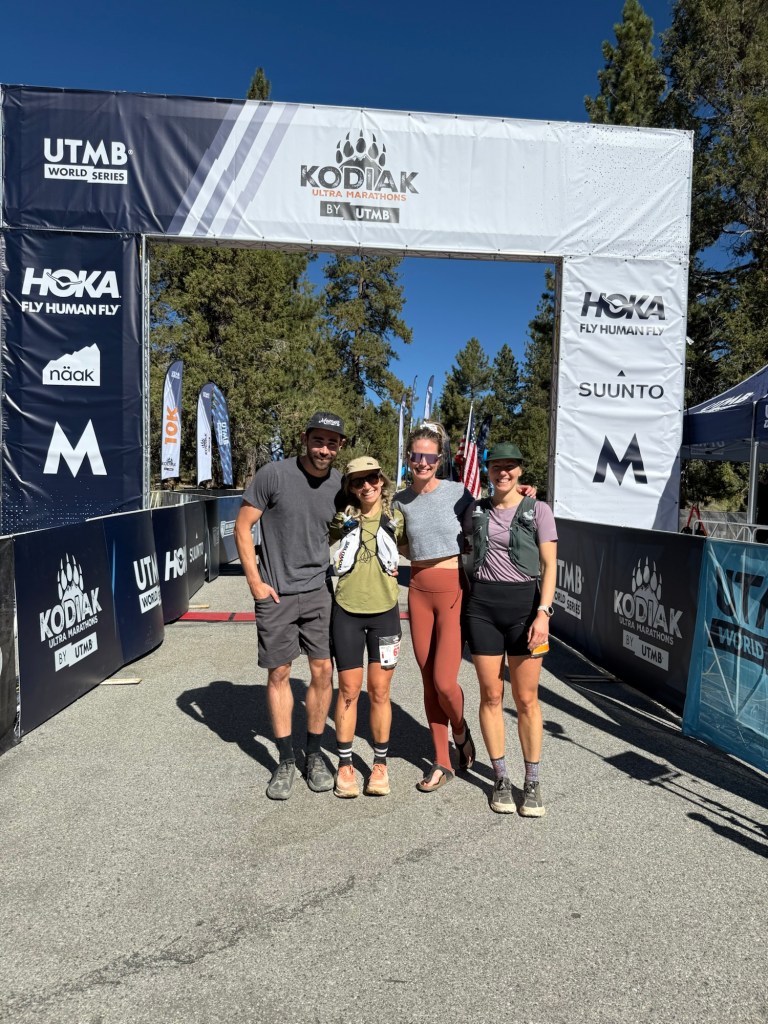
Audree motivated me by calling me a tough bitch (Audree: “Coco, you’re a tough bitch!” Me, while loudly sobbing “I’m… a… tough… bitch, tell me again!”) and promised me that we’d be done soon. She also greeted bystanders, hikers, and fellow runners as I zombie shuffled my way to the finish line. Running downhill for the last few kms was torturous and I was extremely dramatic about it, but we finally made it to the finish line at 10:29am, having completed the race just under 21 and a half hours for second place.

I managed to sleep fairly well Saturday night but woke up Sunday feeling bad. Luckily things started to loosen up quickly and I only needed minor assistance to ascend the podium during the awards ceremony (in my defense, I was definitely the oldest person on the podium). The most damaged part of my body is still my toenails. I broke 8 of them off below the cuticle (so no, getting a gel pedicure wouldn’t have helped), and I’m not sure if they’ll ever be the same. Maybe if I’m lucky they won’t grow back.

Final thoughts

  • Need more mountains
    • Fortunately/unfortunately, I auto-qualified for UTMB in August 2025 by finishing top 3 at Kodiak. This means I’ll get to run a mountainous 100 mile, which is way more my style.
    • Runnable 100 milers are HARD. This race was not well suited to my natural talents and abilities, and I found the monotony of running the entire time challenging both mentally and physically. I’m super curious to experience running 100 miles in the mountains!
  • Standard fare ‘ultras are hard’ stuff
    • My taper tantrum was catching Covid the week before my race. I think it contributed to my feeling of utter emptiness around mile 90, and my lungs were in rough shape for about a week post-race, likely from a combination of Covid, altitude, dryness, and trying too hard.
    • The two cruxes of my race were eating and dealing with toe pain after shattering most of my toenails. Eating is hard, and I’ll probably get better at it after more months/years of consistent gut training. I don’t know what to do about my toes, since I already buy shoes with a little toe room. It might be my ‘efficient’ (lazy) running gait, or maybe my toes just hate California.
  • Unexpected sources of joy
    • Before the race I asked a few friends to add songs to a playlist, just in case I needed a boost while running. My first five hours were hellacious so I pulled out my headphones pretty early on. The playlist was bangin’ and I could feel love from my friends coming through each song.
    • Receiving messages from friends, family, and acquaintances who were tracking me live was an unexpected source of joy both during and after my race. I had cell reception for most of the race and would sneak quick peeks at phone to read awesome and encouraging messages. This motivated me so much, thanks everyone!
  • The crew from heaven
    • I knew my crew would be dialed, but holy moly, I fell in love with them all over again during this race. They were equal parts loving and efficient: they’d give me a hug and deny me the chair; they’d (try to) feed me and shuffle me out of the aid station with haste. They took care of all of my needs throughout every step of the process.
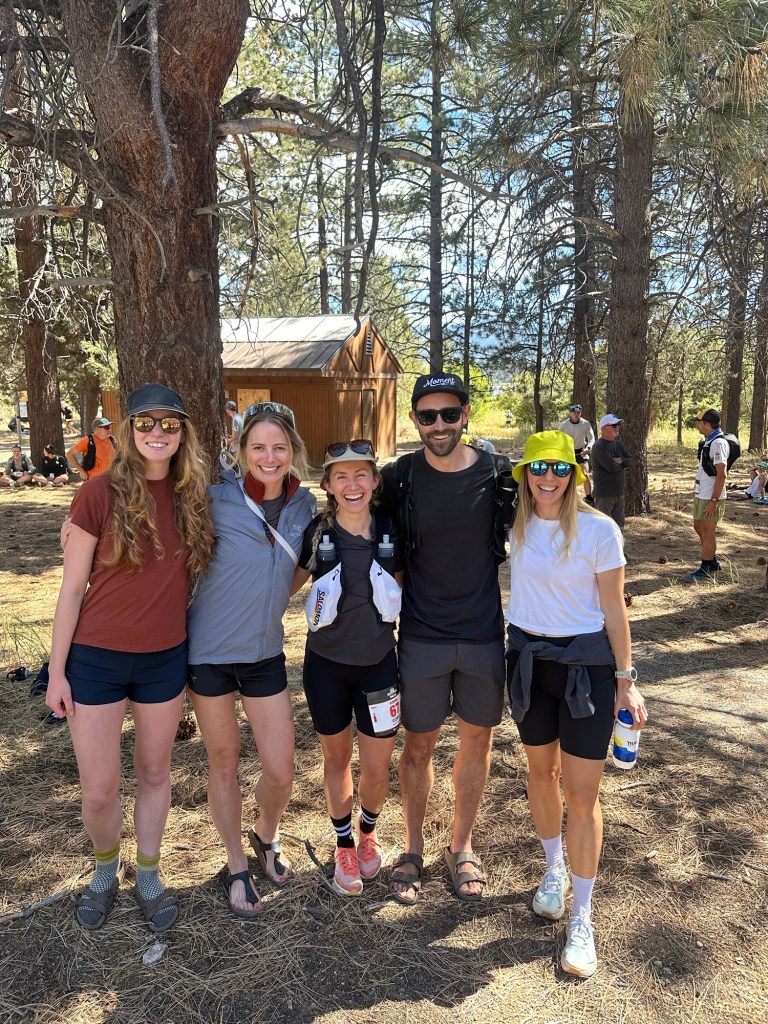
    • Eric, Audree, Andrea, you three made my race. THANK YOU! Also, shoutout to Sam who made the wise decision to drop from her 100k after an achilles injury flared up. Dropping is so often the more difficult choice, but the right choice.

Some more details for the nerds

Gear

  • Shoes Adidas Terrex Agravic Speed Ultra
  • Vest 12L Salmon vest
  • Clothing Arc’teryx Norvan t shirt & long sleeve shirt (for night), Arc’teryx Essent short, Stance socks, Lululemon Energy bra, Arc’teryx Rho gloves.
  • Headlamp Fenix HM62-T, and wore my glasses at night (I have astigmatisms and a small prescription and being able to see made me much more confident at night)
  • No poles The race didn’t allow pole pick ups or drop offs at aid stations so I chose to run without, which was the right call in the end.
  • Other gear I had an Arc’teryx Squamish Hoody in my bag which I never wore, as well as two pairs of backup runners in drop bags just in case (Arc’teryx Sylan, Norda 001)

Nutrition Plan (eat every two hours)

  • Maurten 160
  • Maurten 100
  • Package Bonk Breakers/Honey Stingers/Gu Chews/Precision chews
  • 2 Scoops Precision Hydration & Carbs
  • Electrolyte top ups: LMNT, Precision, etc
  • Anything else I could stomach from the aid station
  • Caffeine as needed

What I actually ate

  • 8 Maurten 160
  • 5 Maurten 100
  • 3 Bonk Breakers/Gu chews/Precision chews
  • 7-8 cups of coke
  • 2 scoops Precision drink mix (with carbs)
  • 1.5 Naak carb drink mix
  • 1 Maurten drink mix
  • A variety of electrolytes from pills, tabs, etc
  • A few bites of quesadilla, 2 baby boiled potatoes, maybe 10 chips, a few bites of bagel sandwich, and one bite of PB&J sandwich
  • Probably 400-500mg of caffeine via Maurten caffeine gels, caffeine pills, and Gu chews.

This was clearly not enough, and I felt it, but it was the best I could do with my stomach in a bad state. I estimate that I consumed an average of 170 calories per hour, which is a somewhat generous estimate. This would be okay for a 50k (maybe), but definitely is low for a 100 miler.

Finally, my Strava file: https://www.strava.com/activities/12639521394