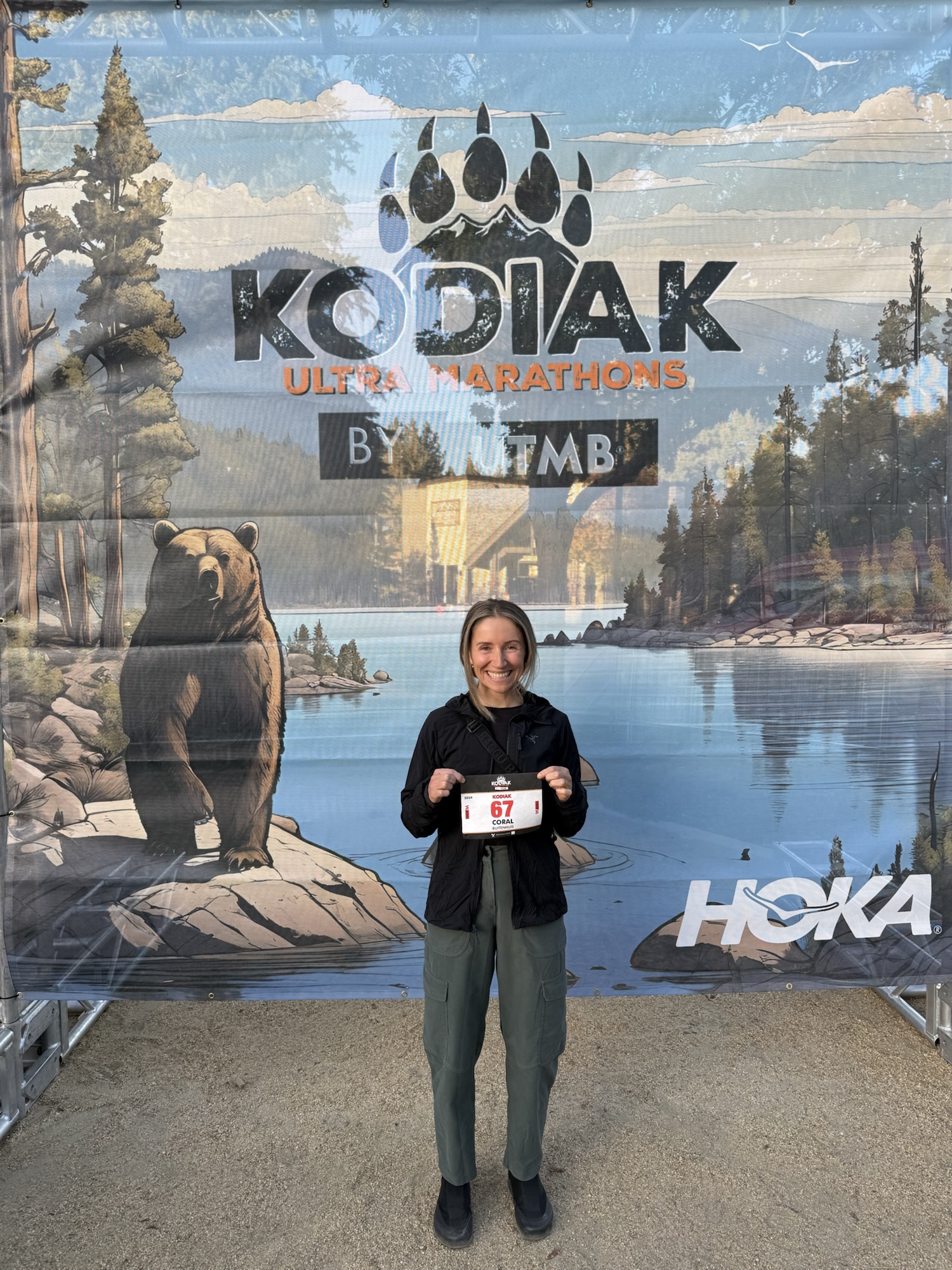
TL:DR
Efficient & solid training, got Covid a week before, runnable races are hard, goodbye toenails, eating is overrated (it isn’t), my crew was perfect, happy with my first 100 miler.
How did we get here?
I started racing ultras in 2016 and quickly increased in distance from 50k to 100k plus, racing Fat Dog 70 mile in 2017 and Miwok 100k in 2018. After Miwok, I took a 5-year break from racing, focusing instead on mountain biking in Squamish where I had just moved. I had thought a 100 miler would be my next step after Miwok, but was having so much fun mountain biking, and was progressing so quickly, that I never took that next step. Throughout that five year period I paced and crewed many friends on their ultras, helping at least five friends run their first 50k, and I picked up fastpacking, but mostly I rode my bike.
Fast forward to 2023, I competed in a nearby sky race called Meet the Minotaur, approximately 35km with 3000m of elevation gain. Despite my legs feeling weak and unresponsive, I had a blast and realized I could still be somewhat competitive despite major growth in trail running since I last raced.
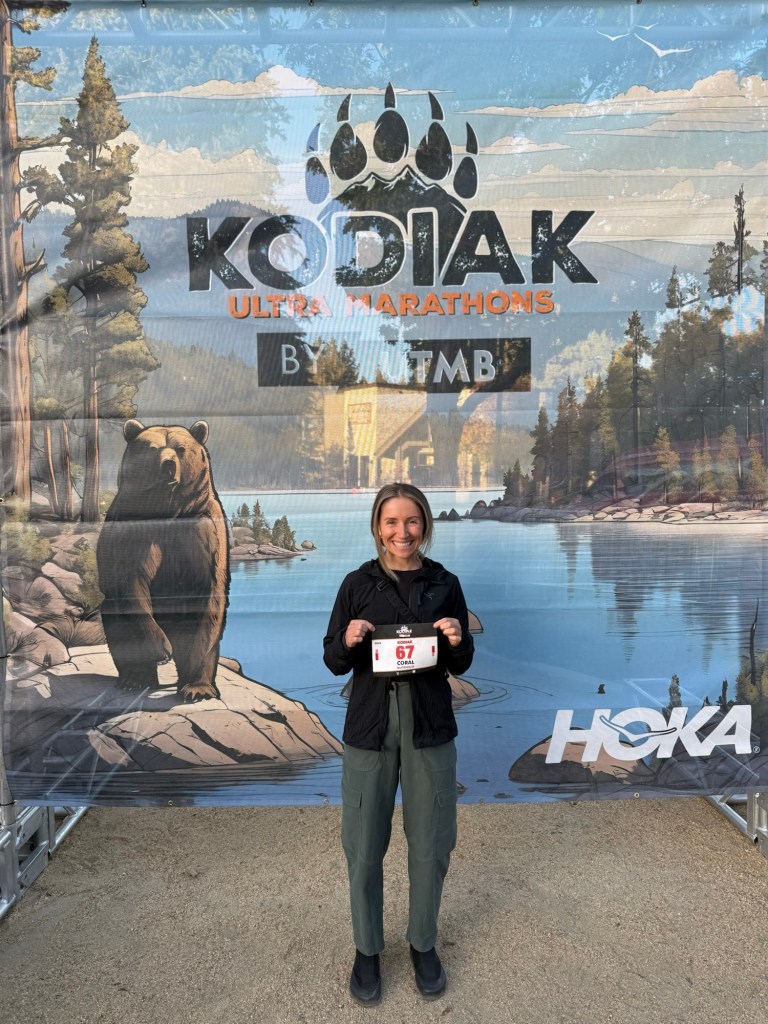
After arriving home from Mount Logan in June 2024, I decided I was ready for another major athletic event and signed up for Kodiak 100 mile. I chose Kodiak for three main reasons:
- I wanted a fall race so that I wouldn’t have to be focused on training all summer.
- I needed a race with no entry requirements. All of my qualifying races had long since expired and I wasn’t open to doing a 50 mile or 100k before a 100 mile.
- The regular course (which I did not run because of the Line fire) is one big loop. I wanted to avoid out and backs and multiple loops.
Kodiak is an incredibly runnable race with only 5000m of elevation gain on the regular course, and just 4000 on the course I did. My strength is in mountain running, lots of vert and technical trails, not in super speedy running. But I knew it would be an interesting challenge to train for something I’m not naturally good at, and most of the more mountainous 100 milers have entry requirements (which is justifiable). As we’ve already established, I had no interest in spending my entire summer training for and running multiple long distances. So Kodiak it was.
Race Goals: No fucking around
My race goal was to run fast and hard and see what it’s like to run 100 miles. I wanted to experience physical and mental discomfort in a safe environment (trail running is my safest sport, there are no crevasses or avalanches, I don’t need to wear a helmet). Finishing was not one of my race goals. I wanted to see if I could perform in a 100 mile race and I was ready to drop if any injuries popped up or if I was going to spend hours walking.
Training
Because my baseline is relatively high volume (10-20h per week of training), and because I’ve been base building for about 20 years, I was able to skip this part of training. After speaking with a few friends, I decided that I could do 8 weeks of specific training for Kodiak. Kodiak is based in the Village of Big Bear, California, which is about 2000m above sea level. The race stayed mostly around 2000-2400m, and went as low as 1800m. I knew I didn’t want to spend the time it would take to acclimate in Big Bear, so I decided to arrive the day before. I was up around 4000m in May (for Mt Logan) and July (to pace Audree at High Lonesome) and had no issues, so I was hoping 2000m would feel fine.
The training plan: Not perfect but good enough
I built a training plan for myself, based off of the SWAP podcast and training plans, Dr. Stacy Sims’s research on the menstrual cycle, and my own experience training for ultras with my menstrual cycle, and launched my training August 12. I signed up for one 50k 4 weeks out from Kodiak to practice racing.
A typical training week included:
- 3 gym sessions (full body, lifting heavy)
- mobility and yoga
- 5 days of running with 1-2 speed workouts (e.g. 5k easy, 8x2m fast, 1m easy, 4x1m hills hard, 5k easy), 1-2 long runs, often with strides sprinkled in
- 1 day cross training
I knew Kodiak was runnable so I focused on building speed and running economy. My running volume was relatively low with my highest volume week being 92km.
I trained on a 4-week cycle aligned with my menstrual cycle, meaning I based my training volume and intensity on the natural fluctuation of my hormones. Weeks 1 and 2 were higher intensity and higher volume. This is when I did key workouts and longer runs. During week 3, I still went hard but pulled back a little, especially if I felt tired. During week 4, the week before my period, I rested and listened to my body. Instead of a speed workout during week 4, I’d do strides, and my long runs were shorter.
The week after my 50k, around mid-to late September, I had a calf injury pop up. It felt like either a calf strain or shin splints, similar to what I felt when I had a tibial stress fracture in 2012. I took a week off running and instead rode my bike and hiked uphill (which strangely wasn’t painful). I also got IMS, massage, and chiropractic work during that week, and did rehabbing exercises to relieve muscle tightness and build strength.
I also got Covid one week before Kodiak, took 3 days off of everything, and recovered quickly. Through both of these minor setbacks, I frequently reminded myself that a training plan isn’t meant to be followed with 100% accuracy. I missed a few key workouts and long runs, but overall I think my body was happy for the rest, and I tried not to stress about it.
Fueling & nutrition: Gels don’t make you poop your pants anymore! (Or do they? Spoiler!)
I have a history of disordered eating and have had RED-S from intentionally under fueling in the past, resulting in a tibial stress fracture and months-long recovery. I try to get 2 grams of protein per kg of body weight and I eat mostly whole foods. I was an on-again-off-again vegetarian for about 15 years because I always wanted to be smaller and slimmer, and eating vegetarian makes me a few pounds lighter. However, it also makes me feel weaker in every way. Eating meat gives me more energy, improves my iron levels, and ensures that I’m always strong enough to punch the patriarchy in the face on short notice. Note that as a climate change professional, I don’t put too much weight in personal accountability for climate change. Our biggest impact is through our work and through voting, so I don’t use climate action as an excuse to change my diet so that I can look smaller. I’m an athlete who needs quality fuel. (Full disclosure, I do sometimes get grossed out that I’m eating an animal and take a small break from meat, but then I have to remember that the circle of life moves us all).
One of the biggest differences in trail running performance since I used to race is the nutrition science. There are many more options and they’re so much better. My previous experiences trying to eat gels ended in me nearly pooping my pants, and I swore off gels for years. During Fat Dog 70 mile, I ate half a package of bacon instead of running food, which I strongly do not recommend. Brands like Maurten, Precision, and Science in Sport feel much safer to consume, so I started experimenting with those in the summer. Spoiler alert, my gut training didn’t really work this time, but I’m optimistic that it will in the future.
The Race
California’s Line Fire had been burning since September and was close to Big Bear. Sections of the San Bernardino forest were closed and it was looking like the race would be cancelled in the weeks leading up. I had started looking for contingency plans but the Race Director was able to pull together a last minute course. It was no longer a loop and it now had much more forest service road, but it would have to do.
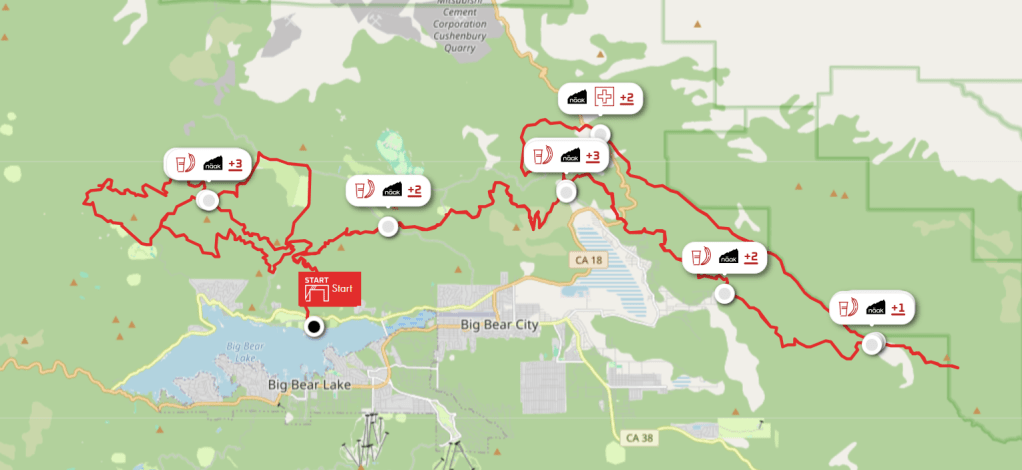

Eric took control of my life the day before the race and made all of the decisions, from what to eat to when to leave to get to the race, I didn’t have to think about anything except myself.
The race started at 1pm. It was 25 celsius, we were at 2000m, and it felt like a furnace. I missed the recent cold temps of Squamish. I seeded myself right at the front of the race, forgot to put my hand over my heart as they sang the anthem (whoops), and started hot. I probably put too much pressure on myself to stay with the lead pack at the beginning, I would have been wiser to run my own race for the first few hours, because I felt awful. My stomach started to hurt less than an hour in, I was super warm, and my right hip, which has been problematic for about 6 years, started to act up.
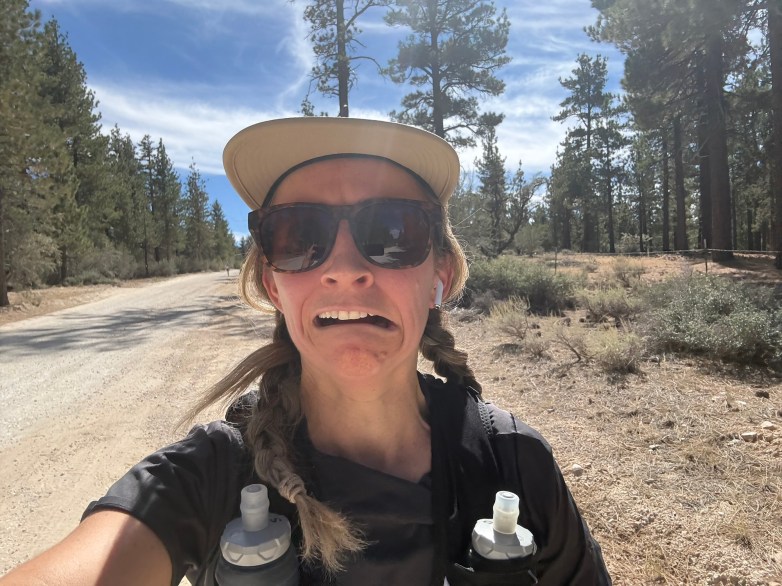
By 20km in, I had kicked enough rocks that I knew I had broken most of my toenails off. It felt awful but it’s happened before and there’s nothing to be done about it, so I didn’t take my shoes off to investigate.
I took my first non-running steps 25km in, but kept pushing hard. I was avoiding talking with my extremely friendly fellow competitors because I felt like crap. At this point, someone leaned out of their car and yelled at me “Hey, you’re 4th place woman and the other 3 are only a few minutes ahead, go get them!” I appreciated their enthusiasm but all I could think was that I had almost 90 miles left to run and that I was probably too close to the lead pack as it was.
About 35km in, on a neverending false flat forest service road with no shade, I decided that I wasn’t going to try hard anymore. I would rather finish last than be miserable for the entire race. I allowed myself to walk sections of that false flat and I took the pressure off of myself. I reached the 42km aid station in good spirits. My stomach continued to feel terrible, but I kept trying to take gels, chews, and bars. This aid station was my first bathroom break, and I would end up needing frequent bathroom breaks for the entire race. Lucky for me there were frequent aid stations, and I unfortunately became familiar with almost every single Porta Potty on the course, as well as a few bushes :(.
Around 45km and 5 hours in, I finally started to feel good. My stomach never improved but my mood did, and some of the pain in my body started to ease up. Sometimes it takes me many hours to warm up, but also the sun started going down around 6pm and things cooled down. I started to run fast and pass people, and I think I took the lead around 50km in, just after sunset. I met some great running buddies (Daniel who quietly cheered me as I made the passes, and Jake who I ran probably 20km with) around this time and started to thrive in the dark and cooler temperatures. I started drinking coca cola at every opportunity and it went down well. I also started eating a lot of tums and ginger chews. Nothing fixed the problem, but it all made it a little more manageable.
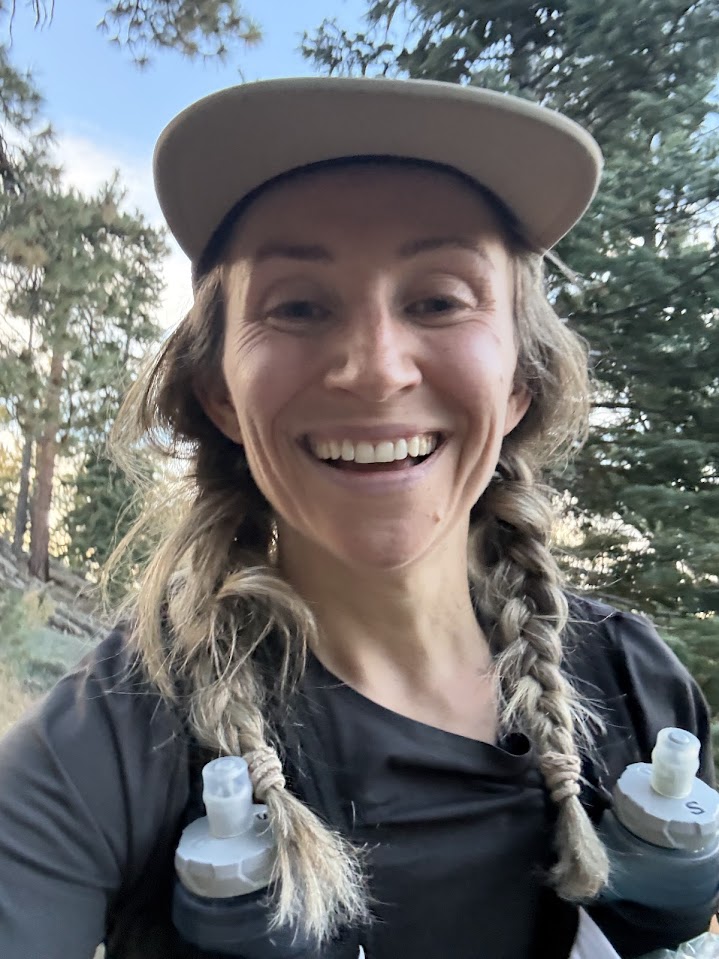
Seeing my crew 63km in was a huge boost. Eric and Audree took care of me and only asked once if I needed a chair (I said no, of course!) before they hustled me out of there. The early part of the night, from sunset until after midnight, were my most enjoyable. I got to see many people on the small out and back (including the huge pack of women VERY close behind me) and had fun chatting with them as we passed each other. Between km 63 and 100 was a nice section of single track and then a horrible off camber rocky road, including the out and back, which eventually eased into a very flat and low road, leading into the Cactus Flats aid station.
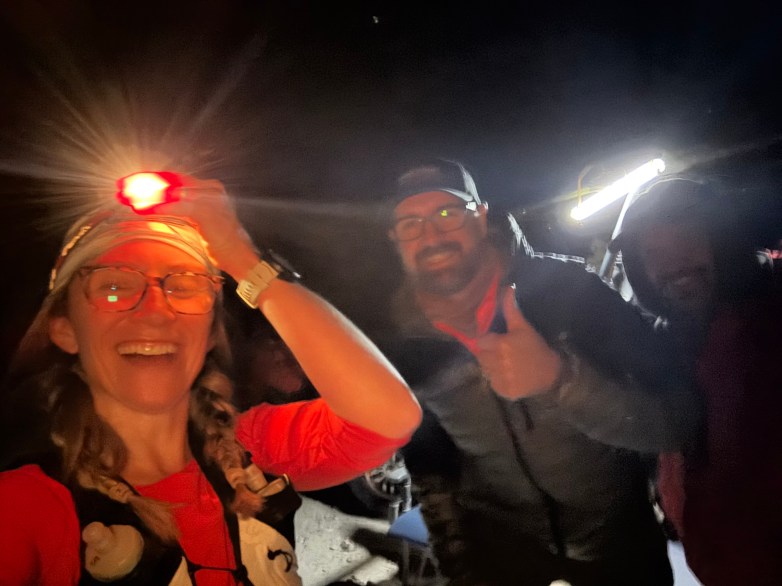
At Cactus Flats, Andrea joined me as my first pacer. She ran with me for 35km and during this time I started to fall apart a bit. A combination of not being able to eat properly, constant bathroom breaks, pain from continuously stubbing my very fucked up toenails, and general pain that comes from running (arguably too) far had me in a pretty fragile state. Andrea gently coaxed me to eat, provided excellent company, and helped me to get ground myself by getting back in touch with my breathing and footsteps. Just before sunrise, Kristina, the eventual winner, passed me absolutely HAULING ASS. I was attempting to choke down another Maurten 160 while it happened and ended up taking a sad little fall on some rocks just after she passed. I think I said to Andrea “I think I’m not in first place anymore” and she agreed. Watching the sun rise over the desert landscape was cool. The place looked different than I had imagined at night.
I came back to Cactus Flats aid station sometime after sunrise, about 5 minutes behind Kristina at that point, and Audree hopped in to take me to the finish line. I started off fairly strong and motivated to catch Kristina, and I think I may have even gained a minute or two on the climb, but about 10km from the finish line I completely fell apart. My gait had devolved into an awful looking right foot pronation, right arm swing, peg-leg hop situation, and I was crying every time I stubbed my toes, which was frequent given that I could hardly lift my legs off the ground, and I had very little energy from having struggled to eat for the entire race. Against all odds, my stomach stopped hurting around 20 hours. I ate a lot of gels once that happened, but I was in too deep a hole already.
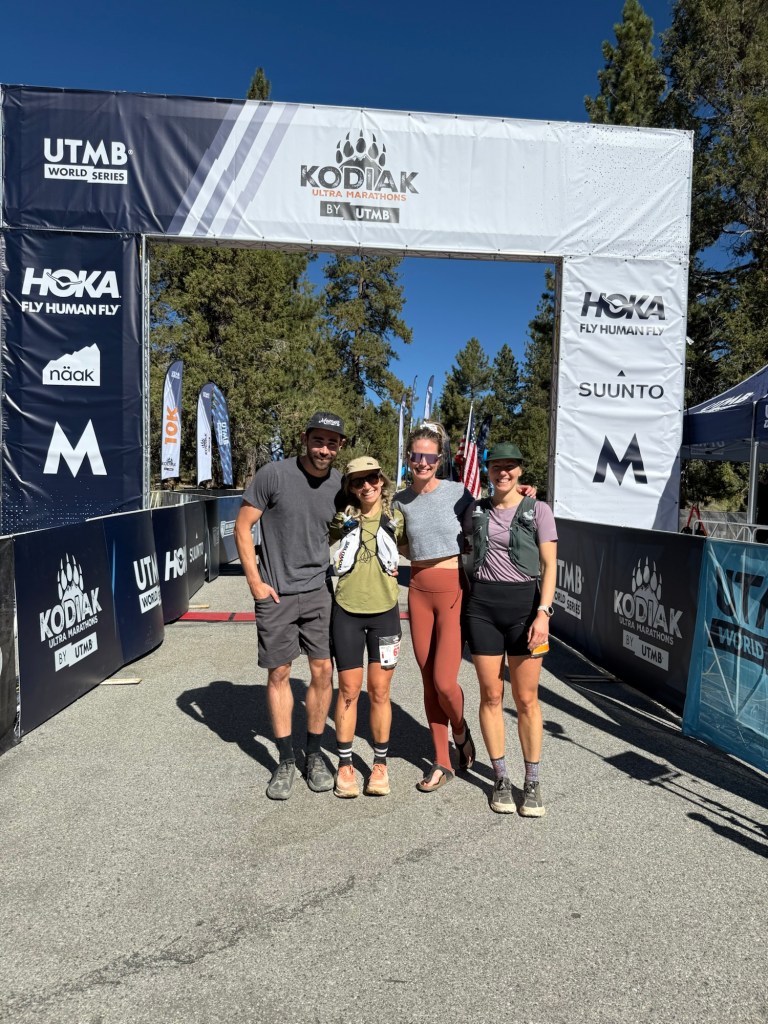
Audree motivated me by calling me a tough bitch (Audree: “Coco, you’re a tough bitch!” Me, while loudly sobbing “I’m… a… tough… bitch, tell me again!”) and promised me that we’d be done soon. She also greeted bystanders, hikers, and fellow runners as I zombie shuffled my way to the finish line. Running downhill for the last few kms was torturous and I was extremely dramatic about it, but we finally made it to the finish line at 10:29am, having completed the race just under 21 and a half hours for second place.
I managed to sleep fairly well Saturday night but woke up Sunday feeling bad. Luckily things started to loosen up quickly and I only needed minor assistance to ascend the podium during the awards ceremony (in my defense, I was definitely the oldest person on the podium). The most damaged part of my body is still my toenails. I broke 8 of them off below the cuticle (so no, getting a gel pedicure wouldn’t have helped), and I’m not sure if they’ll ever be the same. Maybe if I’m lucky they won’t grow back.
Final thoughts
- Need more mountains
- Fortunately/unfortunately, I auto-qualified for UTMB in August 2025 by finishing top 3 at Kodiak. This means I’ll get to run a mountainous 100 mile, which is way more my style.
- Runnable 100 milers are HARD. This race was not well suited to my natural talents and abilities, and I found the monotony of running the entire time challenging both mentally and physically. I’m super curious to experience running 100 miles in the mountains!
- Standard fare ‘ultras are hard’ stuff
- My taper tantrum was catching Covid the week before my race. I think it contributed to my feeling of utter emptiness around mile 90, and my lungs were in rough shape for about a week post-race, likely from a combination of Covid, altitude, dryness, and trying too hard.
- The two cruxes of my race were eating and dealing with toe pain after shattering most of my toenails. Eating is hard, and I’ll probably get better at it after more months/years of consistent gut training. I don’t know what to do about my toes, since I already buy shoes with a little toe room. It might be my ‘efficient’ (lazy) running gait, or maybe my toes just hate California.
- Unexpected sources of joy
- Before the race I asked a few friends to add songs to a playlist, just in case I needed a boost while running. My first five hours were hellacious so I pulled out my headphones pretty early on. The playlist was bangin’ and I could feel love from my friends coming through each song.
- Receiving messages from friends, family, and acquaintances who were tracking me live was an unexpected source of joy both during and after my race. I had cell reception for most of the race and would sneak quick peeks at phone to read awesome and encouraging messages. This motivated me so much, thanks everyone!
- The crew from heaven
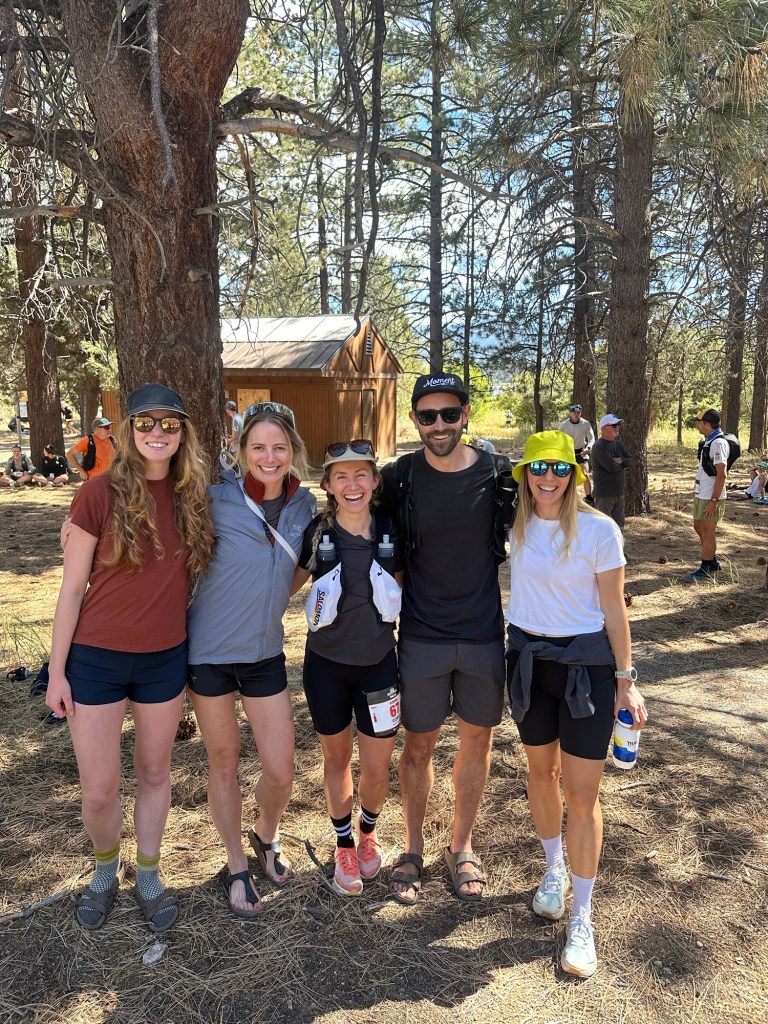
- I knew my crew would be dialed, but holy moly, I fell in love with them all over again during this race. They were equal parts loving and efficient: they’d give me a hug and deny me the chair; they’d (try to) feed me and shuffle me out of the aid station with haste. They took care of all of my needs throughout every step of the process.
- Eric, Audree, Andrea, you three made my race. THANK YOU! Also, shoutout to Sam who made the wise decision to drop from her 100k after an achilles injury flared up. Dropping is so often the more difficult choice, but the right choice.

Some more details for the nerds
Gear
- Shoes Adidas Terrex Agravic Speed Ultra
- Vest 12L Salmon vest
- Clothing Arc’teryx Norvan t shirt & long sleeve shirt (for night), Arc’teryx Essent short, Stance socks, Lululemon Energy bra, Arc’teryx Rho gloves.
- Headlamp Fenix HM62-T, and wore my glasses at night (I have astigmatisms and a small prescription and being able to see made me much more confident at night)
- No poles The race didn’t allow pole pick ups or drop offs at aid stations so I chose to run without, which was the right call in the end.
- Other gear I had an Arc’teryx Squamish Hoody in my bag which I never wore, as well as two pairs of backup runners in drop bags just in case (Arc’teryx Sylan, Norda 001)
Nutrition Plan (eat every two hours)
- Maurten 160
- Maurten 100
- Package Bonk Breakers/Honey Stingers/Gu Chews/Precision chews
- 2 Scoops Precision Hydration & Carbs
- Electrolyte top ups: LMNT, Precision, etc
- Anything else I could stomach from the aid station
- Caffeine as needed
What I actually ate
- 8 Maurten 160
- 5 Maurten 100
- 3 Bonk Breakers/Gu chews/Precision chews
- 7-8 cups of coke
- 2 scoops Precision drink mix (with carbs)
- 1.5 Naak carb drink mix
- 1 Maurten drink mix
- A variety of electrolytes from pills, tabs, etc
- A few bites of quesadilla, 2 baby boiled potatoes, maybe 10 chips, a few bites of bagel sandwich, and one bite of PB&J sandwich
- Probably 400-500mg of caffeine via Maurten caffeine gels, caffeine pills, and Gu chews.
This was clearly not enough, and I felt it, but it was the best I could do with my stomach in a bad state. I estimate that I consumed an average of 170 calories per hour, which is a somewhat generous estimate. This would be okay for a 50k (maybe), but definitely is low for a 100 miler.
Finally, my Strava file: https://www.strava.com/activities/12639521394

 Coral Buitenhuis